BioEmu-1 made protein-conformation emulation a sampling question
Microsoft Research introduced BioEmu-1 on February 20, 2025, reporting a generative model intended to emulate protein equilibrium ensembles for research.
Historical reporting: Microsoft Research introduced BioEmu-1 on February 20, 2025. The model’s generated structures are research outputs; they do not establish a protein mechanism, drug effect, clinical benefit or molecular safety.
Key takeaways
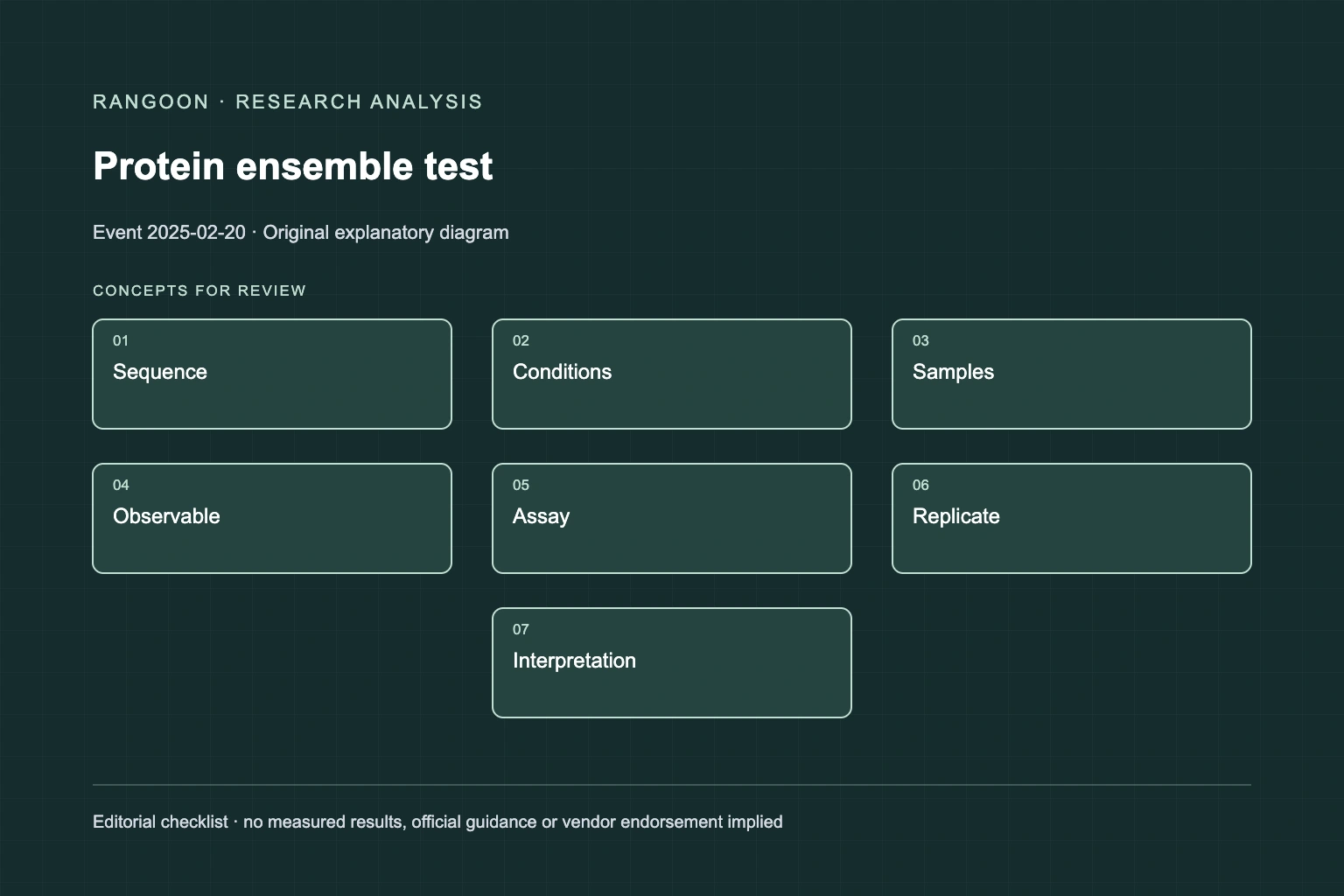
- BioEmu-1 was framed around sampling protein conformational ensembles rather than one structure.
- A generated ensemble should be evaluated against the relevant protein, conditions and experimental observable.
- Structural hypotheses require experimental confirmation before therapeutic interpretation.
Microsoft framed the model around many plausible conformations[source 1][source 2]
Microsoft Research introduced BioEmu-1 on February 20, 2025, describing a deep-learning system for generating protein equilibrium ensembles. The release positioned the work as an aid to protein-science and drug-discovery research. That framing differs from a single-structure prediction: an ensemble asks how a protein might occupy multiple conformations under stated assumptions. The event does not show that every sampled conformation occurs in a cell, that a conformational population is correctly quantified for every target, or that a structure suggests a useful intervention.
Sampling quality depends on the protein and physical context[source 1][source 2]
A protein’s observable behavior can depend on sequence, solvent, temperature, binding partners, modifications and time scale. A learned emulator can propose a distribution far faster than a conventional simulation in its intended domain, but its samples are still conditional on training and modeling choices. The paper and associated materials are the place to inspect reported benchmarks and baselines. A visually varied set of structures alone is weak evidence: it does not show whether the right states, transition relationships or population weights were captured for a new protein system.
A conformational sample is not a functional or medical result[source 1][source 2]
Researchers should not infer binding affinity, pathogenicity, potency, toxicity or treatment effect directly from an ensemble visualization. Those claims need separately matched assays and, where relevant, clinical evidence. Protein models can help select candidates for experiments, but model confidence should be reported with the input sequence, model version, sampling count and physical assumptions. This article contains no drug-design advice. Its purpose is to preserve the boundary between a computational conformation hypothesis and the experimental evidence required to make a biological interpretation.
Ensemble studies should specify observables before sampling[source 1][source 2]
A robust plan starts with a defined question: for example, whether a model can rank a conformational change measured by a particular technique. Set a held-out protein group and compare distributional outputs to independent structural, spectroscopic or kinetic evidence where available. Include negative controls where no claimed state is supported, and test sensitivity to input preparation and sampling seed. If the output informs a downstream screen, evaluate the full selection pipeline rather than judging the model on an attractive structure. Keep discrepancies as first-class results.
Analysis: distributions need experimental anchors[source 1][source 2]
BioEmu-1 is historically useful because it draws attention to a more difficult target than one predicted fold: a distribution of possible protein states. The editorial standard should rise with that ambition. Every distribution needs an experimental anchor, a condition statement and a clear decision it can or cannot support. The February release documents a research tool and reported results. It does not establish a general molecular-design outcome or a clinical application. Treat its samples as an organized hypothesis set whose value is measured by the next carefully controlled experiment, not by a rendered structure alone.
Ensemble quality should be assessed against observations that identify both which protein states occur and under which conditions their population changes.
Sources
- Microsoft Research: Exploring protein structural changes with BioEmu-1 (February 20, 2025)
- bioRxiv: Scalable emulation of protein equilibrium ensembles (December 6, 2024)
Continue reading