

Nevada’s AB 325 put human final-decision boundaries around emergency AI use
Nevada approved AB 325 on May 30, 2025, barring AI from making final emergency-response resource decisions and utility shutoff decisions during a disaster or emergency.
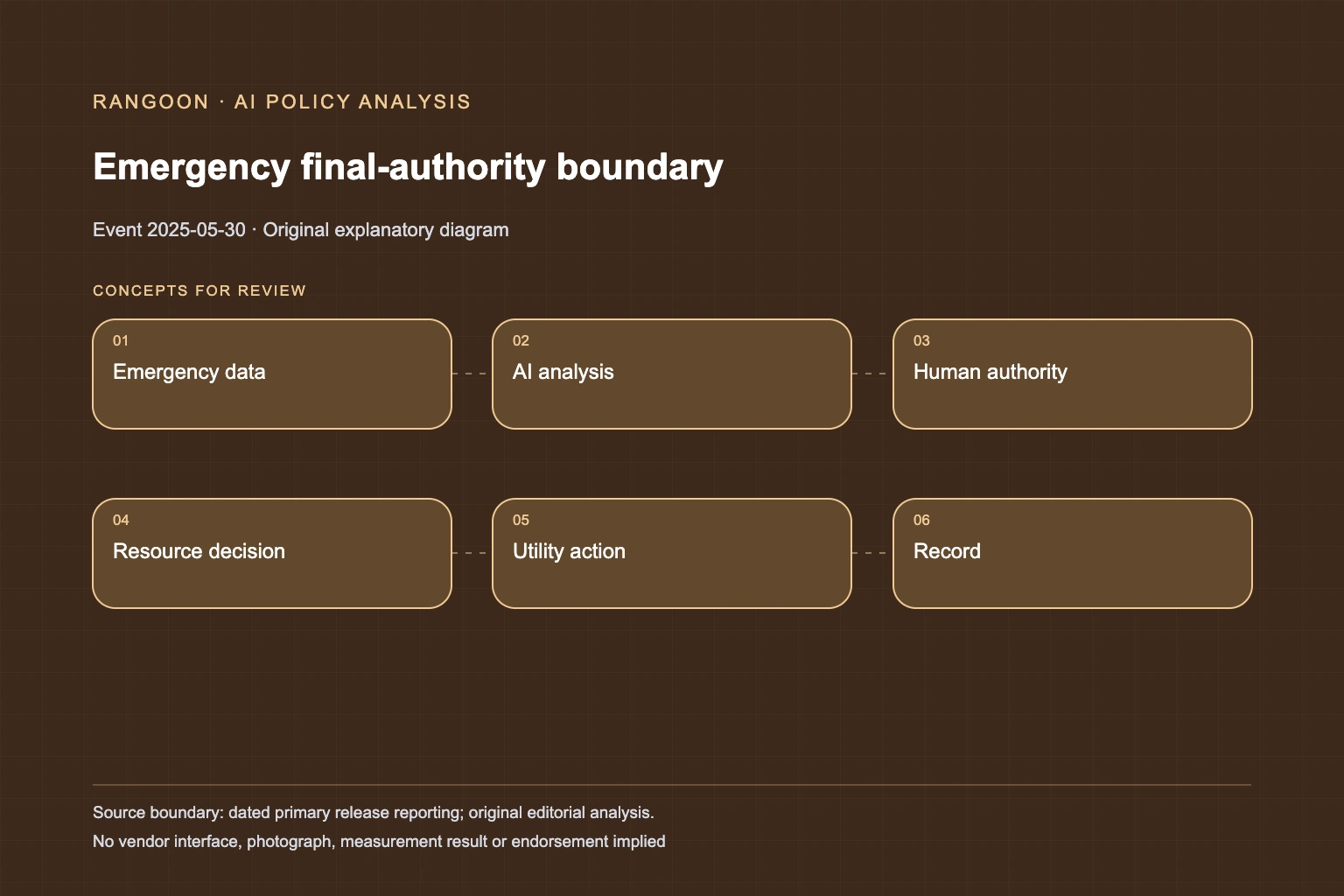
Historical reporting, not legal advice: Nevada’s official 2025 session law records Assembly Bill 325 as approved May 30, 2025, chapter 123. The act defines AI in the emergency-management context, requires state and local emergency plans to ensure that AI does not make final emergency-response planning or resource-allocation decisions, and bars a public utility from making a final decision to reduce or shut down service during a disaster or emergency based solely on AI. The article does not claim the act bans all emergency-management software, all AI assistance or all utility decisions.
Key takeaways
- AB 325 is a signed Nevada session law with defined final-decision limits for emergency-response planning and resource allocation.
- The utility rule targets final service-reduction or shutdown decisions during a disaster or emergency when based solely on AI.
- Human final authority does not itself establish that planning inputs, models, data or operational communications are correct.
The official session law records May 30 approval and chapter 123[source 1][source 2]
Nevada’s 2025 session-law record identifies Assembly Bill 325 as chapter 123 and says it was approved May 30, 2025. The act is titled as legislation relating to artificial intelligence and emergency management. It adds a definition of artificial intelligence in that setting and changes rules governing emergency-management plans and certain utility decisions. That is the event preserved here: a signed state law on a precise operational boundary. It is not a claim that Nevada created a complete emergency-AI code, adopted a particular model or evaluated every emergency technology. Approval date, subsequent agency preparation, statutory effective dates and real incident operations are separate matters. A historical account should not turn the law’s stated guardrails into evidence that every plan or utility workflow immediately changed.
The law requires plans to keep final emergency resource decisions out of AI hands[source 1]
AB 325 requires emergency-management plans prepared by the Governor and plans adopted by state or local governmental agencies to include provisions ensuring that final decisions regarding emergency-response planning and resource allocation are not made by artificial intelligence. The word final is material. It leaves room for a system to assist with information processing, forecasting or options analysis while drawing a boundary at the authoritative decision described in the act. The statute does not say that all quantitative tools are forbidden or that an operator may ignore AI-derived information. It requires that the final decision not be made by AI. A responsible implementation therefore needs to identify which person or authorized body made the final call, what inputs it reviewed and how that record can be examined after an event.
The utility provision is limited to disaster or emergency service decisions based solely on AI[source 1]
The same act prohibits a public utility from making a final decision whether to reduce or shut down utility service in response to a disaster or emergency based solely on the use of artificial intelligence. That statement has a narrower boundary than a general prohibition on using algorithms in utility operations. It describes a final decision, a response to a disaster or emergency, a specific service outcome and a “based solely” condition. The law should not be summarized as a guarantee that service will never be interrupted or as proof that a human reviewer will always prevent harm. Disaster response can involve physical safety, grid conditions, field observations, law and other constraints. The policy significance is that Nevada placed a human-decision safeguard at a high-consequence point in a defined scenario.
Final-authority boundaries need records that survive a real emergency[source 1][source 2]
A human-final-decision requirement works only when an organization can show where authority rested and what happened under pressure. An emergency-management or utility record can identify the responsible official, decision time, applicable plan, facts and forecasts reviewed, role of any automated system, communications sent and any later revision. Such records can help distinguish an analytical recommendation from an action authorized by a person. They do not eliminate urgency, model error, conflicting data or accountability failures. This is governance guidance, not a conclusion about compliance with Nevada law. AB 325 provides a concrete historical example of state policy placing a final-authority boundary around AI in emergency conditions. It does not prove the quality of a system’s forecast, the outcome of a utility decision or the adequacy of a specific emergency plan.
Sources
Continue reading
Related reading
 News analysisOregon’s AI Advisory Council delivered a five-action state-government plan3 min read
 News analysisUK’s third-party AI assurance roadmap mapped professionalization, information access and a planned innovation fund3 min read
 News analysisUK published an AI cyber-security code with 13 voluntary principles and an implementation guide3 min read