

NVIDIA released Parakeet-TDT-0.6B-v3 for 25-language speech-to-text
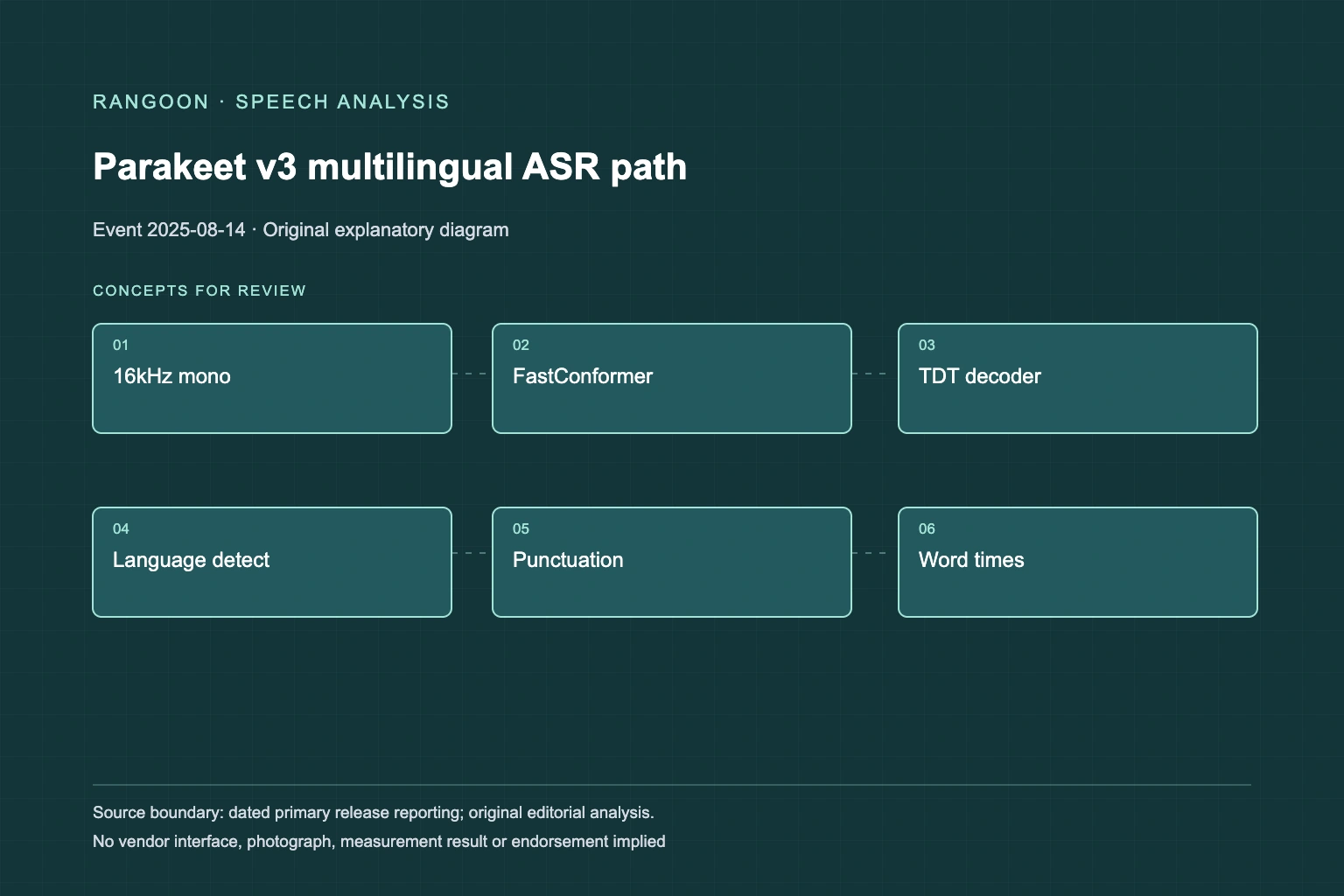
NVIDIA’s August 14, 2025 Parakeet-TDT-0.6B-v3 model record expanded a 600M-parameter recognizer from English to 25 European languages with automatic detection and timestamps.
Historical reporting: Source 0 is NVIDIA’s dated Parakeet-TDT-0.6B-v3 model record. Source 1 is the later technical report by the model authors, used for training and model-family context rather than as the August release-date authority.
Key takeaways
- NVIDIA’s model card gives August 14, 2025 as the Hugging Face release date for Parakeet-TDT-0.6B-v3.
- The 600M-parameter FastConformer-TDT model expanded its predecessor from English to 25 European languages and listed automatic language detection, punctuation, capitalization, word timestamps and segment timestamps.
- NVIDIA’s cited report links the model to the Granary and NeMo ASR Set 3.0 data effort, but benchmark results and maximum audio durations remain tied to stated settings, hardware and evaluation choices.
A smaller multilingual recognizer entered the model catalog[source 1]
NVIDIA’s Parakeet-TDT-0.6B-v3 model card gives August 14, 2025 as its Hugging Face release date. The card describes a 600-million-parameter multilingual automatic speech-recognition model for high-throughput speech-to-text. Its specific change from v2 was language scope: the earlier English model became a recognizer for 25 European languages, with automatic language detection instead of a required prompt. The listed languages include English, French, German, Spanish, Ukrainian and 20 others. This event is distinct from NVIDIA’s June 2025 Parakeet v2 coverage because it identifies a v3 checkpoint and a multilingual expansion. It does not establish equal performance across every language, accent, recording condition or downstream transcription use.
The card combined transcription text with timing metadata[source 1]
The v3 card names automatic punctuation and capitalization, accurate word-level timestamps and segment-level timestamps. It also says full-attention long-audio transcription could reach 24 minutes on an A100 80GB, while local attention could reach three hours. Those statements describe a model and documented inference modes, not a promise that every deployment can process that length. Hardware memory, runtime implementation, chunking, language and audio quality all remain relevant. The card’s input section specifies 16 kHz mono WAV or FLAC audio and its output is text with punctuation and capitalization. A system that accepts arbitrary media therefore still needs preprocessing and interface tests before it can represent the model’s published limits as its own product capacity.
The later report describes the family’s training choices[source 2]
A technical report submitted in September 2025 by NVIDIA-affiliated authors places Parakeet-TDT-0.6B-v3 beside Canary-1B-v2. It calls v3 a successor to v2 that provides multilingual ASR across the same 25 languages with 600 million parameters. The report’s broader Canary analysis names 1.7 million hours of samples, including Granary and NeMo ASR Set 3.0, dynamic data balancing and non-speech audio added to reduce hallucinations. Those details describe family research context; they should not be treated as a complete public training-data inventory for v3 or as a proof that non-speech behavior is eliminated. The report is also later than the stated August model release, which is why it supports technical explanation rather than the event date.
A model card is not a universal transcript guarantee[source 1][source 2]
NVIDIA released the weights under CC-BY-4.0 and stated that the model was ready for commercial and non-commercial use. The same card qualifies its evaluation: its comparison covers 24 supported languages because listed comparison models lacked Latvian support, and it notes that European-versus-Brazilian Portuguese differences can affect results. Those caveats make a useful operational lesson. Language names, benchmarks and license terms do not answer whether a real call, lecture, song, clinical note or subtitle file is transcribed accurately enough for its use. Teams should record audio provenance and consent, test representative languages and noise conditions, inspect time alignment, preserve the exact checkpoint and runtime, and retain human review for consequential text.
Sources
Continue reading
Related reading
 News analysisNVIDIA Riva 2.18 added Canary NIM options for offline multilingual speech work3 min read
 News analysisNVIDIA announced Canary-Qwen-2.5B as an open ASR and language-model combination3 min read
 News analysisTencent published the Hunyuan-MT technical report for multilingual translation models3 min read