

NVIDIA Riva 2.18 added Canary NIM options for offline multilingual speech work
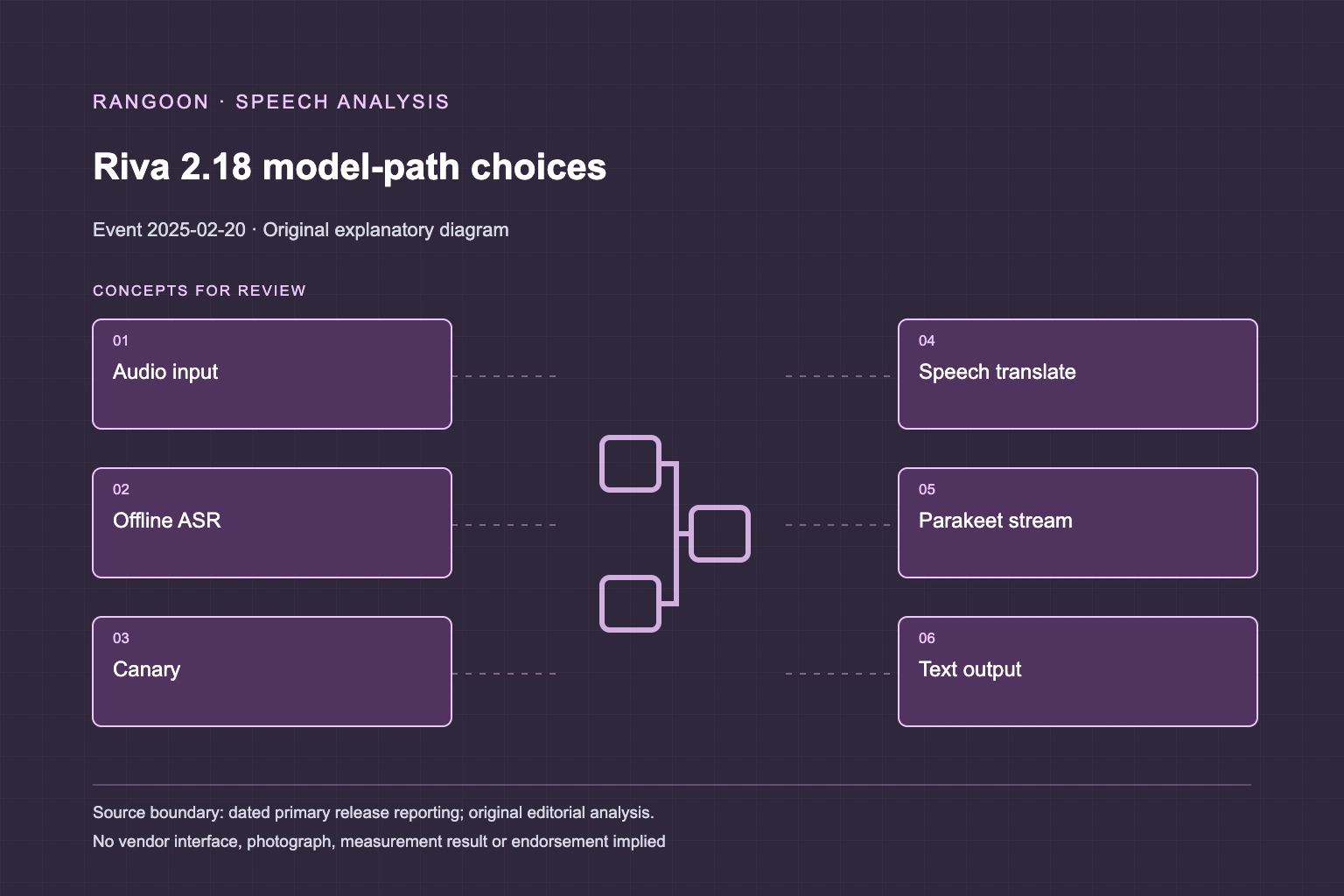
NVIDIA’s February 20, 2025 Riva 2.18 record added Canary NIM implementations for offline ASR and speech translation, while model choice and deployment conditions remained separate.
Historical reporting: Source 0 is NVIDIA’s dated Riva 2.18 technical post. Source 1 is NVIDIA’s current Canary 1B Flash model card, used for checkpoint and integration context only; it does not prove an individual deployment or the February configuration of every Riva environment.
Key takeaways
- NVIDIA dated the Riva 2.18.0 container and SDK update February 20, 2025, including Canary support for offline ASR and several speech-translation directions.
- The event separated offline Canary work from streaming Parakeet support and from Whisper or Distil-Whisper choices, so a model label alone did not define a complete voice pipeline.
- The current Canary 1B Flash card documents a downloadable four-language checkpoint and NeMo loading path; it does not certify latency, accuracy, language coverage or access in a particular Riva deployment.
A dated Riva release widened its speech-model menu[source 1]
NVIDIA dated its Riva 2.18 technical post February 20, 2025 and identified a recently released 2.18.0 container and SDK. The post named Canary models for offline automatic speech recognition and for any-to-English, English-to-any and any-to-any automatic speech translation. It also named Parakeet for streaming multilingual ASR and Whisper-Large or Distil-Whisper-Large for offline ASR and any-to-English translation. That list matters because it describes a product integration event, not one undifferentiated speech model. The historical record supports saying that Riva exposed several model paths at that point. It does not say that each path had identical language support, response time, hardware needs or endpoint behavior.
Offline translation and live recognition remained different jobs[source 1]
The Riva post calls automatic speech translation a task that turns speech in one language into text in another without first producing an intermediate transcription in the original language. That definition helps explain why its Canary claim included translation directions as well as ASR. By contrast, the same release described Parakeet as streaming multilingual ASR. A service designer therefore had at least two separate operational questions: whether an audio workload needed partial results as audio arrived, and whether it needed translated text rather than a transcription. Riva’s supplied choice did not erase those questions. Recording format, language pair, endpoint configuration, fallback behavior and evaluation corpus still determine whether an assembled workflow is useful.
A Canary checkpoint carried its own scope and interface[source 2]
NVIDIA’s current Canary 1B Flash model card supplies specific checkpoint context. It identifies the model as automatic speech recognition and automatic speech translation, lists four languages, and shows loading through NeMo with an audio file. The card also identifies a CC-BY-4.0 license and links model architecture, input, output, training and evaluation sections. Those details are more useful than treating “Canary” as a generic capability word: a checkpoint has a named family, supported languages, a loader and terms. They are current documentation, however. The page itself points readers toward the later Canary 1B V2 release, so it should not be used to silently rewrite what Riva 2.18 shipped or to infer a customer’s exact model revision.
A NIM option was not deployment proof[source 1][source 2]
The February event established an NVIDIA-provided route for deploying selected speech models through the Riva release. It did not establish that an organization ran the container, had sufficient GPU capacity, processed any specific language pair correctly or met a service-level objective. NVIDIA’s architectural descriptions and performance framing remain supplier information tied to the stated release and models. For a retrospective implementation record, retain the Riva version, selected model identifier, language settings, input audio conditions, NIM or container version, hardware, test corpus and error measurements. That evidence separates the dated announcement from a later deployment claim. It also prevents an offline ASR or AST model from being described as a proven real-time or universal multilingual system merely because it appeared in one Riva product update.
Sources
Continue reading
Related reading
 News analysisNVIDIA announced Canary-Qwen-2.5B as an open ASR and language-model combination3 min read
 News analysisNVIDIA released Parakeet-TDT-0.6B-v3 for 25-language speech-to-text3 min read
 News analysisNVIDIA’s Llama-Embed-Nemotron-8B paper documented an instruction-aware multilingual retriever3 min read