ChatGPT Pulse previewed a daily, proactive research briefing for Pro mobile users
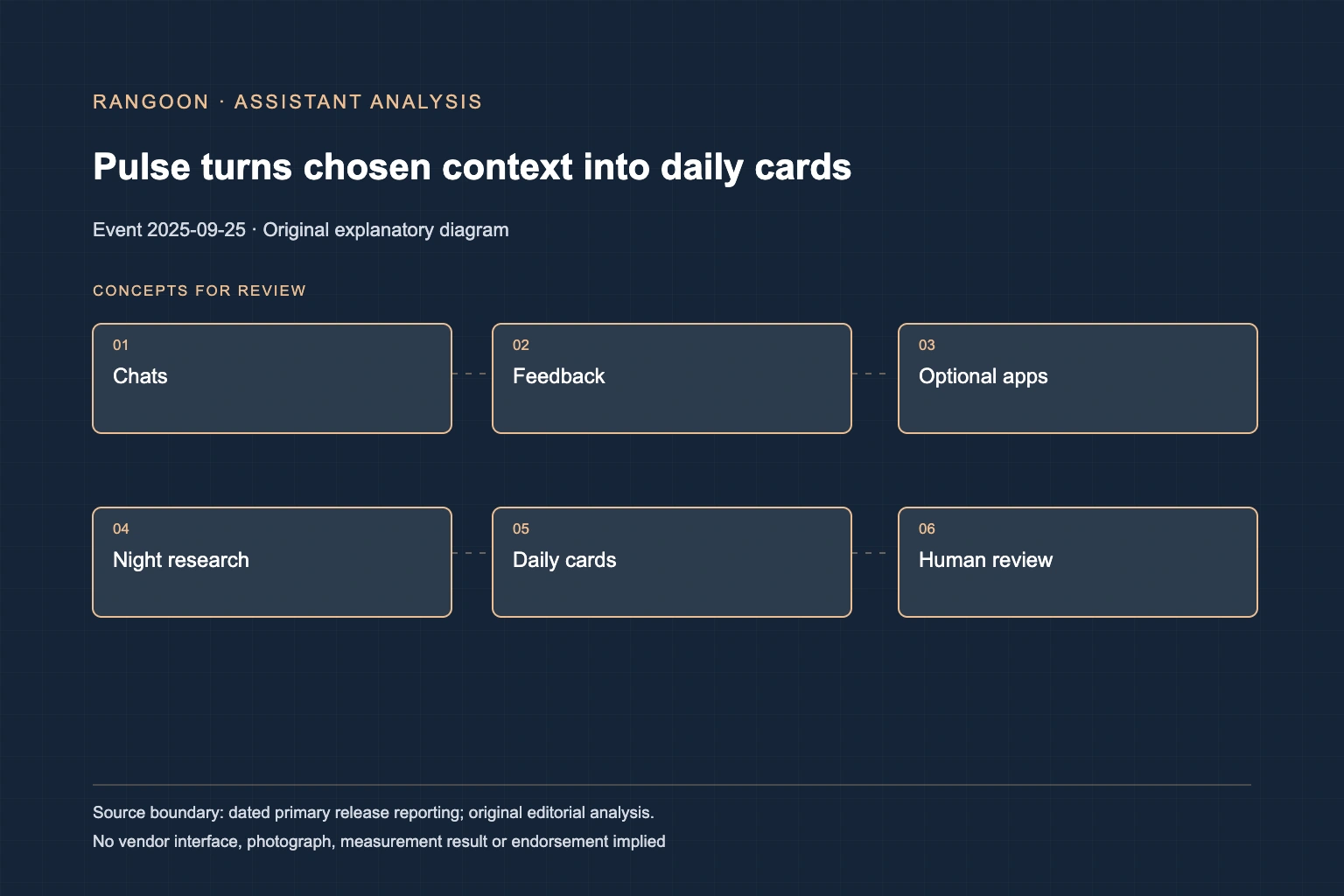
OpenAI's September 25, 2025 Pulse preview gave ChatGPT Pro users on mobile a daily set of personalized research updates built from chats, feedback and optionally connected apps.
Historical reporting: Source 0 is OpenAI's dated September 25, 2025 Pulse announcement and establishes the preview, Pro-mobile audience, overnight research framing, optional integrations and described retention of daily cards. Source 1 is a current Memory guide, used only to explain present personalization controls; it does not establish Pulse's 2025 settings, availability or data handling.
Key takeaways
- The September preview put a once-daily, proactive research surface in ChatGPT for Pro users on mobile rather than making it a general all-plan launch.
- Pulse combined chats, feedback and optional Gmail or Calendar context, while the announcement said those integrations were off by default and controllable in settings.
- A daily card could be saved into chat or expanded, but the launch itself warned that preview suggestions could miss the mark.
Pulse was a limited mobile preview, not a universal assistant behavior[source 1]
OpenAI announced ChatGPT Pulse on September 25, 2025 as a preview for Pro users on mobile. The dated post described an assistant that would perform research asynchronously and present a fresh, focused group of updates the following day. That launch boundary matters. The company said it would learn from early use before a later Plus rollout, with an eventual goal of wider availability. It did not say every ChatGPT account had the feature, that it worked on every surface, or that a user would receive a particular number of useful results. The announcement framed the product shift as moving some research work from a user-initiated prompt to a scheduled, once-daily briefing. A historical description should preserve that specific plan and mobile scope instead of treating later availability changes or a generic ChatGPT answer as evidence that Pulse was enabled for everyone on the event date.
The briefing used selected personal context and optional connected-app context[source 1]
The launch post said Pulse synthesized information from memory, chat history and direct feedback overnight to decide what might be relevant. It also named Gmail and Google Calendar as optional sources of additional context. OpenAI said those integrations were off by default and could be switched on or off in settings. This supplies a useful technical distinction: a personalization feature may draw from several kinds of user context, but each source has its own availability and control state. The post gave examples such as a meeting agenda, a birthday-gift reminder and travel recommendations; examples are not proof that an account had linked a calendar or authorized a particular use. Nor does the announcement establish what a connected service exposed, whether a setting remained enabled, or whether generated suggestions accurately represented calendar information. The news event is the described data path and opt-in integration design, not a guarantee about any individual briefing.
Daily cards were designed for scanning, follow-up and selective preservation[source 1]
Pulse surfaced its research as topical visual cards that a person could scan or open for more detail. The release said a person could ask the assistant to curate future editions, give thumbs-up or thumbs-down feedback, inspect or delete feedback history, and request recurring subjects. It also said a daily update was available only for that day unless the person saved it as a chat or asked a follow-up, which added it to conversation history. Those claims make the launch more specific than a feed: the product paired a scheduled result with a user feedback loop and a stated path for retaining selected material. They do not establish that deletion removed every underlying source, that a saved item was complete, or that an ephemeral card met a business recordkeeping obligation. A user needed to decide which generated items deserved preservation and review rather than treating the morning view as a durable source of truth.
Current Memory guidance explains controls but cannot rewrite the preview[source 1][source 2]
OpenAI's current Memory guide says personalization can use relevant past chats, saved memories, custom instructions, Library files and connected-app content, depending on plan, region and settings. It also describes reviewing sources, correcting or deleting memories, disconnecting an app, and separate model-improvement controls. These are useful current operating concepts for evaluating a feature like Pulse: source access, personalization, retention and training choices are different controls. The guide is not event-date evidence. It does not prove that the same controls, source display or propagation behavior existed in the September 2025 preview, and it does not show what information Pulse used for a particular account. The dated announcement itself also warned that preview recommendations could be wrong or irrelevant. A responsible use of a proactive briefing therefore keeps source settings, the visible card, any saved conversation and a human decision separate rather than assuming personalization makes a suggestion correct.
Sources
- OpenAI: Introducing ChatGPT Pulse (September 25, 2025)
- OpenAI Help: Memory in ChatGPT
Continue reading