ChatGPT Record entered a macOS-only meeting-capture rollout
OpenAI's June 18, 2025 release-note entry introduced ChatGPT Record for Pro, Enterprise and Edu users on the macOS desktop app, after an earlier Team rollout.
Historical reporting: Source 0 is OpenAI's dated June 18, 2025 release-note entry for ChatGPT Record. Source 1 is a current, product-specific help record, used only to explain the present recording, transcript and retention controls; it does not establish the June 2025 plan, capability or availability state.
Key takeaways
- OpenAI's June 18 entry put Record on the macOS desktop app for Pro, Enterprise and Edu, while saying Team had received it on June 4.
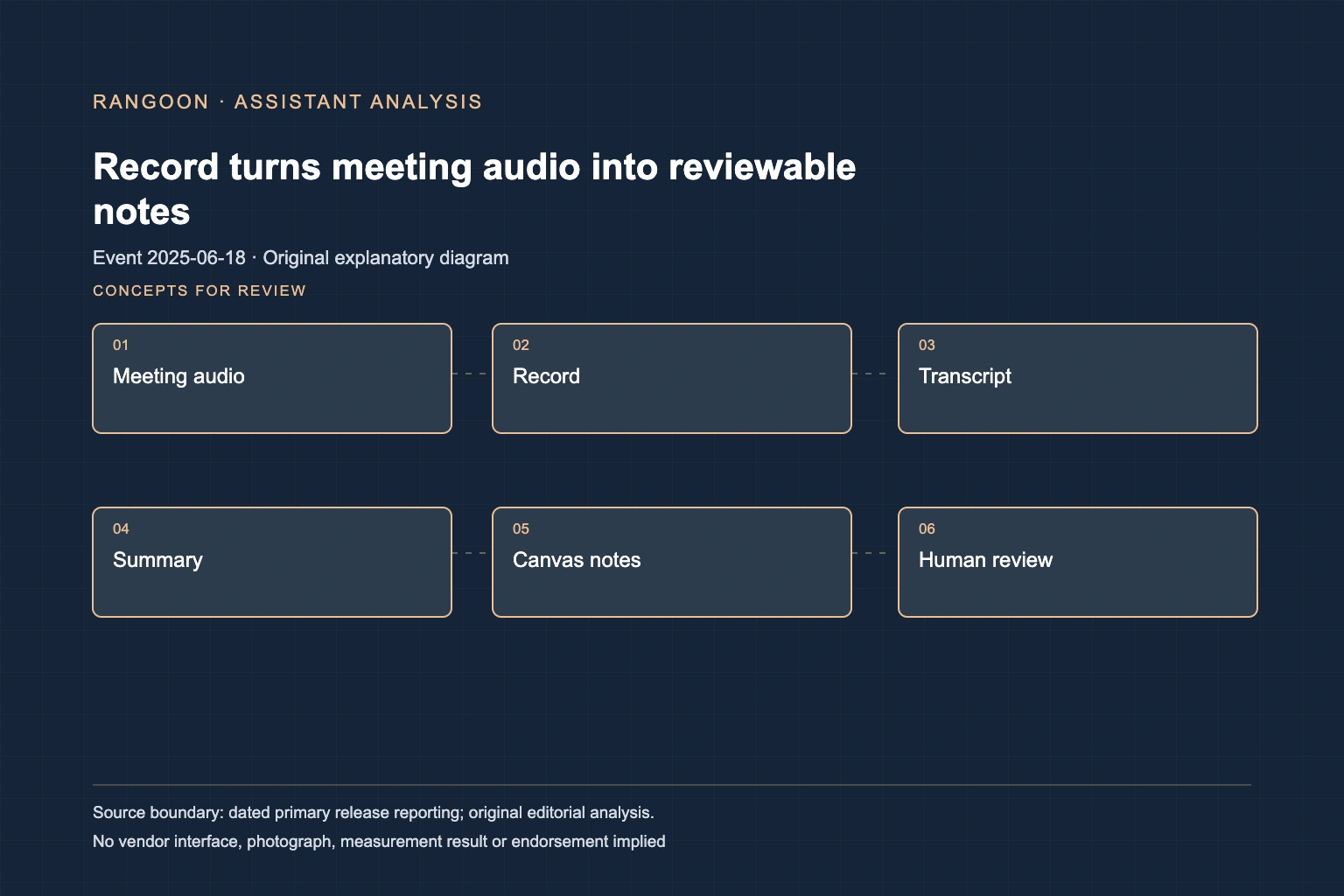
- The announced workflow turned meetings, brainstorms and voice notes into transcripts, summaries and follow-up-style outputs.
- A current help record adds operating limits and data-handling detail, but cannot rewrite the original rollout boundary.
Record was a bounded desktop rollout[source 1]
OpenAI's June 18, 2025 ChatGPT release notes introduced Record as a way to capture meetings, brainstorms and voice notes. The entry said it was launching that day for Pro, Enterprise and Edu users, while Team users had received it on June 4. It also limited the feature to the ChatGPT macOS desktop app. Those details make the event more precise than a generic claim that ChatGPT could record meetings: the announcement described a staged plan and platform boundary. The source does not say that every account, country, operating-system version or later subscription tier had the feature. This historical record therefore preserves the named plans and macOS scope without projecting today's access state backward into June 2025.
Audio capture fed a text work product[source 1]
The release-note entry described a short chain: Record would transcribe audio, summarize it, then turn it into outputs such as follow-ups, plans or code. That makes the product event about more than microphone input. It joined a live conversation or note to a text artifact that could be used for subsequent work. The announcement did not claim that a summary was a faithful meeting record, that action items reflected an organization's decisions, or that generated code was ready to run. A participant still needed to review names, commitments, dates and technical content before relying on them. The difference matters because transcription, summarization and transformation are separate model-mediated steps, each able to introduce an error or omit context.
Current help guidance separates audio from later text records[source 2]
OpenAI's current Record help article describes recordings as transcribed and summarized into notes, then stored as a canvas or attached record. It also says a session is capped at four hours, warns that transcription can be wrong, and asks users to obtain the needed consent before recording other people. The same current guide says audio is used for transcription and then deleted, while transcripts and canvases can be used for model improvement for eligible personal accounts when the relevant setting is enabled; Business, Enterprise and Edu content is excluded from training by default. These are current operating statements read on October 24, 2026. They explain why a recording workflow needs a data and consent review, but they are not proof of the June 2025 configuration.
Meeting capture did not authorize reliance or recording[source 1][source 2]
The news value of the June event is a constrained assistant feature: a macOS ChatGPT surface could turn captured speech into editable work outputs for particular account categories. It was not a declaration that every participant had consented, that a transcript was complete, or that a generated plan could execute without human approval. The dated release does not establish an organization's retention policy, regional recording law, microphone permissions, meeting-platform integration or present plan eligibility. Those are separate facts that need local evidence. A useful operational record would retain the participant notice, the exact account and settings, the original audio where policy permits, the reviewed transcript, and the human-approved follow-ups. The launch supplies the first product-history fact; it cannot provide those later controls.
Sources
Continue reading