

OpenAI’s Codex CLI put a lightweight coding agent in the local terminal
OpenAI introduced Codex CLI on April 16, 2025 as an open-source terminal coding agent, linking local repository access with multimodal reasoning.
Historical reporting: OpenAI’s April 16, 2025 o3 and o4-mini announcement explicitly introduced Codex CLI. The May 16 cloud announcement supplies later CLI context; current repository behavior is not inferred.
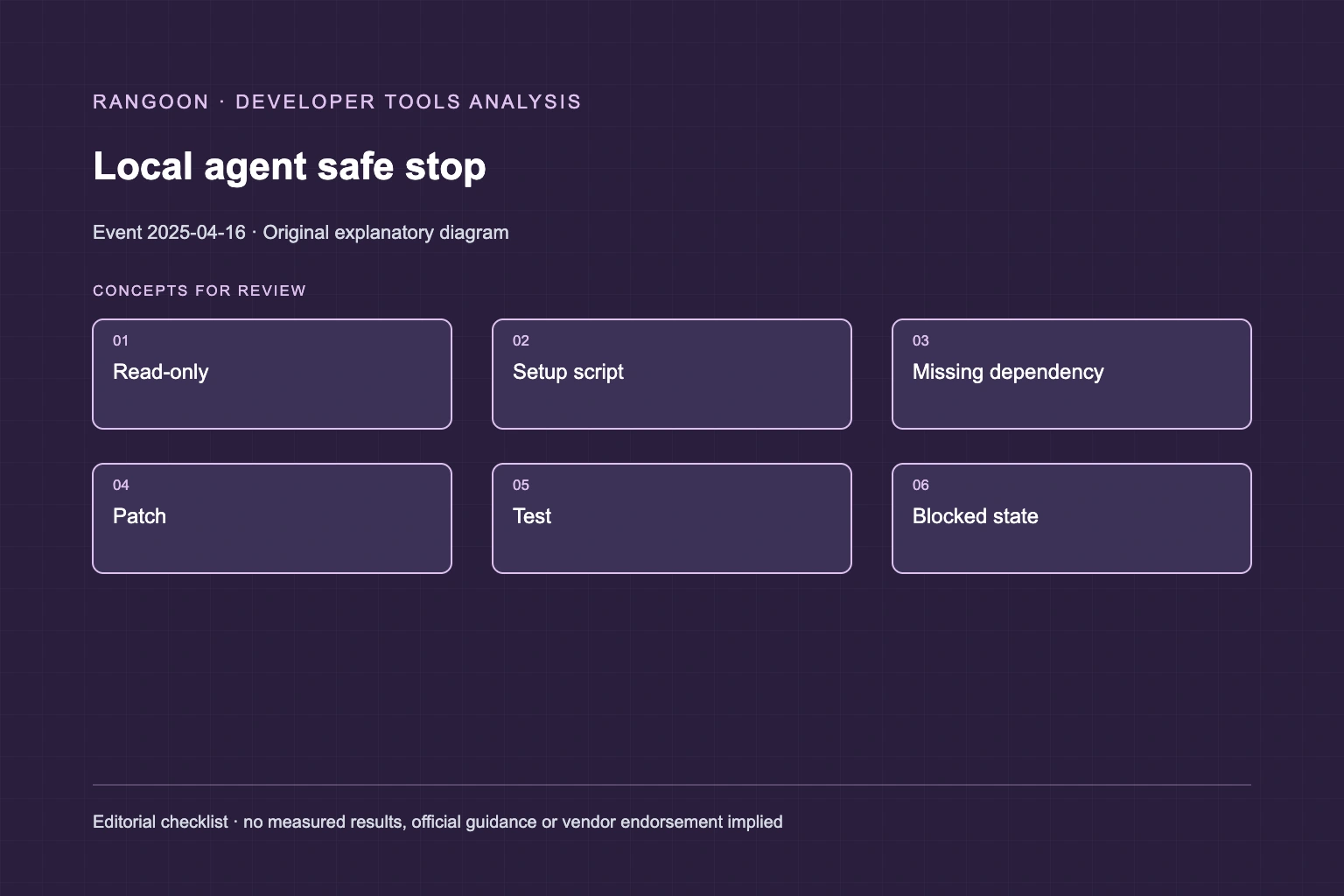
Key takeaways
- Terminal convenience does not eliminate local secret exposure.
- Model selection and host permission need separate controls.
- A command log is necessary but not sufficient release evidence.
April 16 introduced a terminal experiment[source 1][source 2]
OpenAI introduced Codex CLI in its April 16, 2025 o3 and o4-mini announcement, describing an open-source coding agent that runs from a terminal on the user’s computer. The post connected local code access with multimodal inputs such as screenshots and sketches. Its May 16 Codex announcement later revisited the CLI while introducing a separate cloud agent. These records establish different execution surfaces rather than one permanent Codex architecture.
Local coding assistance runs beside real developer state[source 1][source 2]
A terminal tool works near checked-out code, caches, SSH configuration and environment variables. The security question is not only which model answers a prompt, but which files and commands the host permits. Configure the working directory, network rules and tool allowlist deliberately. If a task requires a secret, use a narrow human-owned injection path and a fixture that confirms the agent cannot print or persist it in logs, patches or generated files.
Separate exploration commands from modification commands[source 1][source 2]
Start a session in read-only mode for repository discovery, then require explicit consent before editing files or running package scripts. Record base revision and commands so the reviewer can reproduce a claimed test result. A task should stop when it reaches an unavailable dependency, permission issue or architecture choice. That stop behavior is valuable evidence: it shows the tool does not silently substitute a guess for a missing owner decision.
Analysis: local tools reward precise boundaries[source 1][source 2]
Editorial analysis: a local CLI can shrink the gap between idea, inspection and patch, especially for a developer who already understands the repository. It should be adopted through small, deterministic tasks first. Successful use means the developer can explain every changed file and rerun the validation, not simply that the terminal conversation ended with a confident summary.
The screenshot path creates a concrete engineering distinction. A visual mockup can express layout intent, while the repository supplies component names, dependencies and tests. A plausible match to the picture does not settle keyboard behavior, accessible names or responsive layout. Those properties need checks against the resulting application. This is a technical implication of combining visual input with code access, rather than a claim that the April release implemented any particular browser-testing workflow.
Local execution also changes failure recovery. A command may leave an edited file, generated lockfile or interrupted process even when the model’s answer reports failure. Review therefore needs to inspect the actual worktree and process outcome. The historical CLI launch is useful precisely because it placed a reasoning model near those concrete developer artifacts; it did not turn a conversational completion into evidence that a software task had succeeded.
Sources
- OpenAI: o3 and o4-mini announcement, Codex CLI section (April 16, 2025)
- OpenAI: Introducing Codex (May 16, 2025)
Continue reading
Related reading
 News analysisOpenAI introduced SWE-Lancer to test coding agents against freelance software work3 min read
 News analysisTerminal-Bench released version 2.0 with Harbor and renewed task verification3 min read
 News analysisSWE-smith published a pipeline for turning Python repositories into software-agent training tasks3 min read