OpenAI introduced SWE-Lancer to test coding agents against freelance software work
OpenAI introduced SWE-Lancer on February 18, 2025, using freelance software tasks, end-to-end tests and manager-choice evaluations.
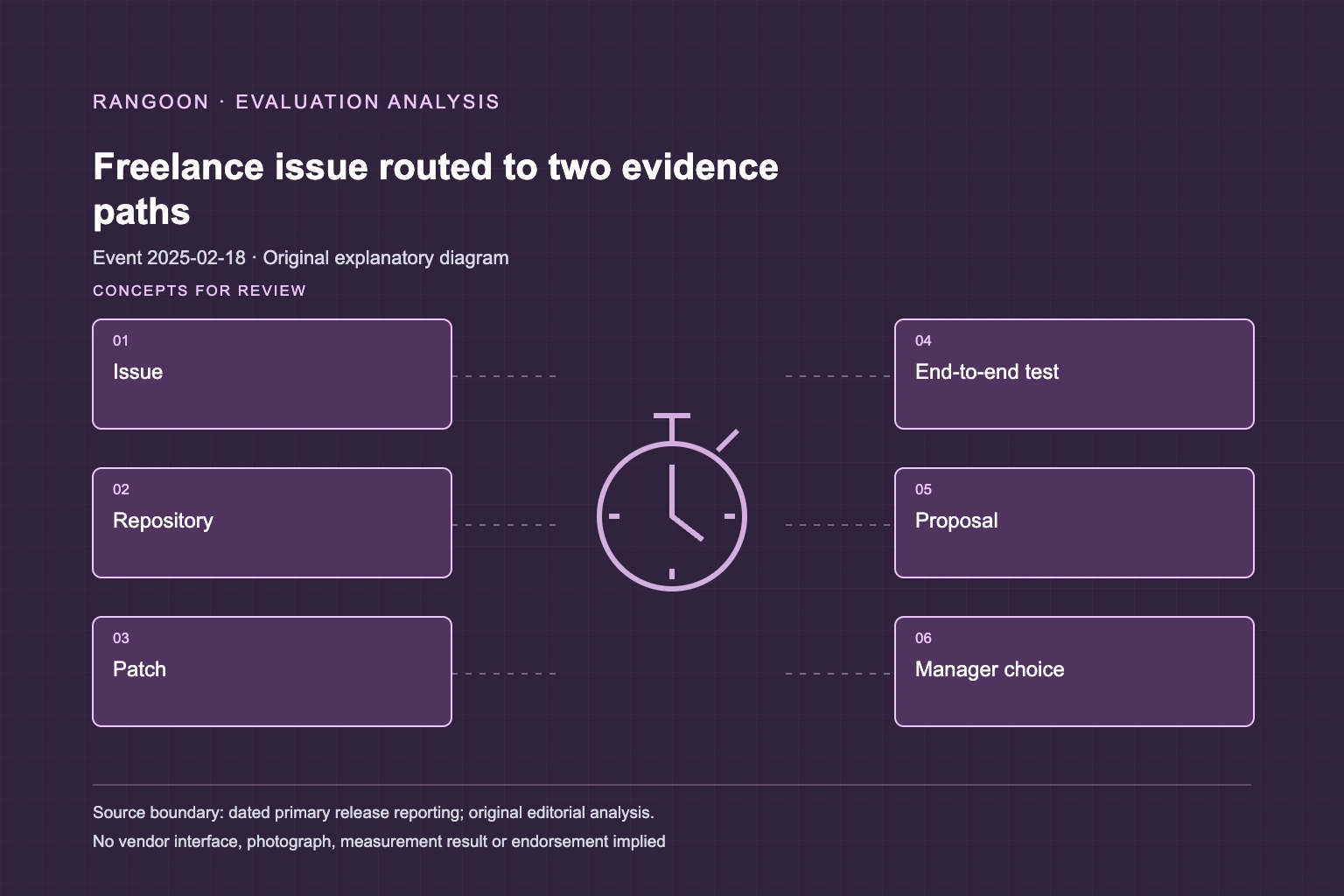
Historical reporting: OpenAI introduced SWE-Lancer on February 18, 2025 as a benchmark of more than 1,400 freelance software-engineering tasks drawn from Upwork. OpenAI described two task types: individual-contributor work assessed with end-to-end tests and managerial choices assessed against original engineering-manager selections. Its public Frontier Evals repository documents SWE-Lancer as a reproducible evaluation project. OpenAI’s reported payouts, task results, and July 2025 dataset revision are publisher records, not independent proof of a model’s economic output, a contractor replacement, or performance in another repository, runtime, or revision.
Key takeaways
- SWE-Lancer made task provenance, end-to-end testing and manager-choice grading part of one coding-agent evaluation.
- A task’s listed freelance payout gives the benchmark an economic frame; it does not establish a model earned money or can deliver work without review.
- OpenAI later removed an Internet-connectivity requirement, so scores need their dataset and runtime revision attached.
OpenAI dated SWE-Lancer to February 18 and described two kinds of software work[source 1]
OpenAI introduced SWE-Lancer on February 18, 2025 as a benchmark built from more than 1,400 freelance software-engineering tasks sourced from Upwork. The launch separates individual-contributor tasks from managerial tasks. The first group ranges from bug fixes to feature work; the second asks a model to choose between technical implementation proposals. That split matters because producing a patch and selecting a proposal are different actions with different grading targets. The reportable event is the benchmark introduction and its stated task design. It is not evidence that an agent had accepted a client contract, understood unstated requirements, communicated with a stakeholder, or delivered production-ready work in a live organization.
The benchmark used end-to-end tests for patches and prior human selections for managerial decisions[source 1]
For individual-contributor tasks, OpenAI says experienced software engineers wrote end-to-end test suites and that each suite was independently reviewed three times. A candidate patch is therefore measured against a withheld behavioral target rather than only a text answer. For managerial tasks, OpenAI says the reference is the choice made by the engineering manager originally hired for the work. Those methods make the evaluation more concrete than a short code-completion prompt, while they do not erase the assumptions in task construction, test coverage, or one historic manager decision. Passing a test suite shows behavior under that suite. It does not prove maintainability, security, deployment approval, or fit with requirements absent from the task package.
Payout values provide task context without turning a benchmark score into realized revenue[source 1]
OpenAI presented the task collection as worth one million dollars in total real-world payouts, with examples ranging from a fifty-dollar bug fix to a thirty-two-thousand-dollar feature implementation. Those figures describe the value framing of the original freelance work. They do not mean an evaluated model earned that amount, could complete every related communication and acceptance step, or would incur the same time and infrastructure cost. The launch says frontier models were unable to solve the majority of the tasks it evaluated. That is a result within OpenAI’s stated setup, not an independent labor-market measurement. A reader comparing systems needs the model, harness, tool permissions, token budget, benchmark revision, and whether a result came from the individual-contributor or managerial subset.
OpenAI’s public evaluation repository and July revision make the environment part of the result[source 1][source 2]
OpenAI’s Frontier Evals repository identifies SWE-Lancer as a real freelance software-engineering evaluation with end-to-end tests and gives the project its own isolated instructions. The February launch also linked a public evaluation split called SWE-Lancer Diamond. In a July 2025 update, OpenAI said the dataset and results had been revised as of July 17 and that the revised setup removed a requirement for Internet connectivity during execution. That revision is material because network access can alter both what an agent can retrieve and how repeatable a run is. The historical conclusion is limited: OpenAI introduced and later revised a benchmark. A score should travel with its dataset version and environment, rather than being treated as a timeless property of a model.
Sources
Continue reading