OpenAI’s Codex general availability release paired SDK access with admin controls
OpenAI announced Codex general availability on October 6, 2025, adding Slack, SDK and workspace-administration surfaces.
Historical reporting: OpenAI’s October 6, 2025 GA announcement and ChatGPT release notes are source records. Current access and controls are out of scope.
Key takeaways
- SDK embedding makes agent policy a product integration concern.
- Admin analytics need a defined privacy and retention boundary.
- Workspace controls should be tested against local configuration.
General availability broadened Codex’s integration surfaces[source 1][source 2]
OpenAI announced Codex general availability on October 6, 2025 and listed a Slack integration, Codex SDK and new workspace administration tools. ChatGPT release notes for the same date independently record the Slack and SDK updates. The two documents establish the event date and high-level scope. They do not prove that a given organization enabled those features, nor that an integration’s permissions or logging posture matched the product description.
Embedding an agent makes host application policy part of the design[source 1][source 2]
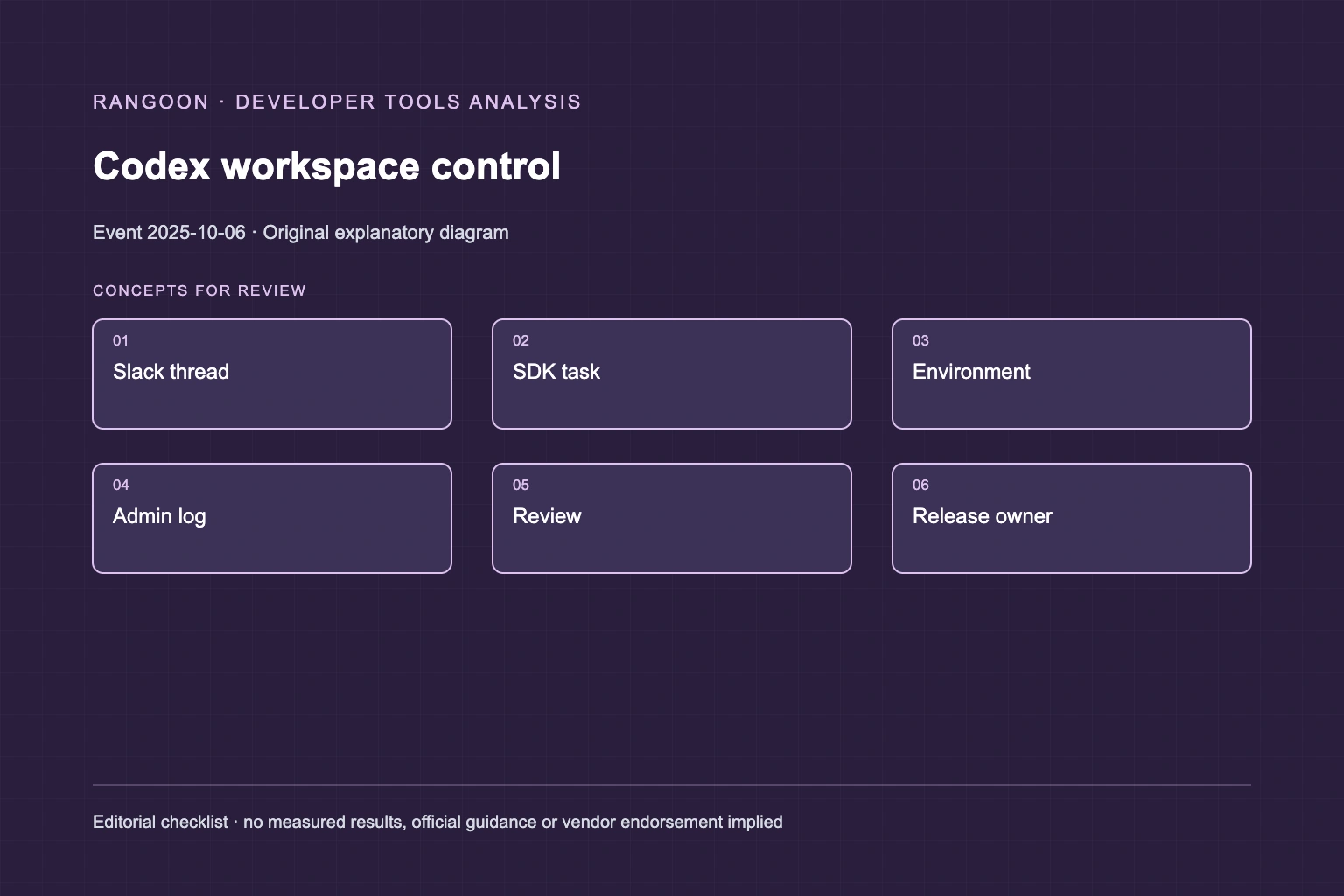
An SDK can place coding-agent behavior inside an existing workflow, but the host still owns identity, input selection, tool grants, trace handling and side-effect confirmation. A Slack command is especially sensitive to context boundaries: a thread may include incomplete requirements, pasted credentials or requests from users without repository authority. Treat each integration point as a distinct ingress with explicit authorization and a narrow mapping to the task environment.
Admin features need independent verification fixtures[source 1][source 2]
Test managed configuration by applying a restrictive setting, attempting a prohibited local action and confirming the agent cannot bypass it through a different entry point. Test monitoring with a benign run and inspect whether the record contains enough detail for audit without unnecessary source content. For SDK use, pin a task schema and verify that malformed requests, unavailable tools and attempted external writes return clear stopped states. Keep the release owner separate from the person who runs the agent.
Analysis: availability adds governance work before it removes it[source 1][source 2]
Editorial analysis: GA and an SDK can make an agent easier to distribute, which increases the importance of consistent policy rather than reducing it. The practical milestone is a controlled pilot with clear task classes, audit receipts and escalation owners. Once those controls work across the terminal, cloud and chat surfaces, broader usage has a stronger operational foundation.
The October release announced three named surfaces: a Slack integration for tasks or questions from a channel or thread, an SDK for embedding the agent that powered Codex CLI, and workspace-admin controls for environments, monitoring and analytics. It also said Codex could be used through editor, terminal and cloud experiences connected by a ChatGPT account. Those are separate routes into an engineering workflow.
A Slack message must be mapped to a specific authorized task and repository before it becomes an execution request. An SDK caller should validate its task envelope and preserve the environment policy supplied with that call. Admin telemetry can show activity, but a review still needs the resulting diff, base SHA and test evidence.
The launch’s adoption figures are supplier context; they do not prove that any one workspace has correctly configured its environment controls.
Sources
- OpenAI: Codex is now generally available (October 6, 2025)
- OpenAI Help: ChatGPT release notes (October 6, 2025)
Continue reading