GPT-5 made routing part of a flagship-model release
OpenAI introduced GPT-5 on August 7, 2025, describing a unified model system that combined fast responses, deeper reasoning, and a routing layer.
Historical reporting: OpenAI introduced GPT-5 on August 7, 2025. This article preserves the launch framing and does not make a current availability, price, safety, or benchmark claim.
Key takeaways
- A routed model system needs route-level evaluation, not one aggregate score.
- Latency, tool access, and output policy belong in the test record.
- A flagship launch date does not identify a later model revision.
Release record[source 1][source 2]
OpenAI introduced GPT-5 on August 7, 2025, and described it as a unified system rather than a single fixed response path. Its launch material said the system combined a fast model, a deeper reasoning model, and a router that selected between them. The accompanying system card is a different kind of primary record: it describes evaluations and safeguards around the release.
Technical design[source 1][source 2]
Together, those documents establish an event and a vendor-described design. They do not establish how a later product configuration, account tier, prompt, tool setting, or deployment will behave. That distinction matters because routing can make two requests with similar words take different paths.
Operating boundary[source 1][source 2]
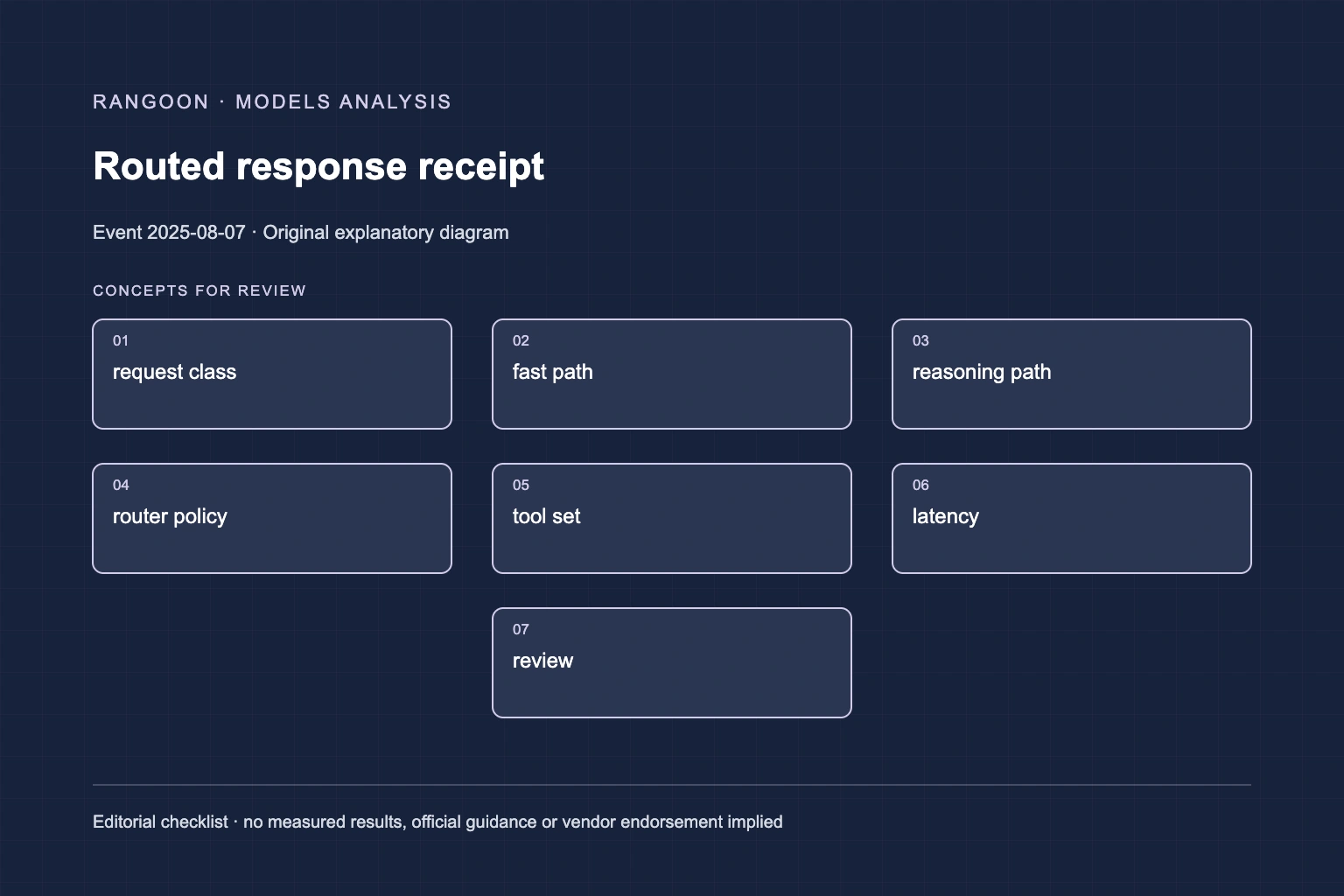
An evaluator should preserve the route-relevant context instead of treating the label GPT-5 as a complete experiment description. A useful test ledger records request class, system instructions, attached material, tools, model setting, response path when exposed, latency, output, and any refusal or escalation. If route visibility is unavailable, the result should say so rather than inventing a hidden explanation.
Evaluation evidence[source 1][source 2]
The launch also made a product-design point: a system can offer a simple front door while retaining internal specialization. That can reduce user-facing choice, but it shifts responsibility toward observability. Teams comparing a routed model with a manually selected model should use matched tasks and report distributions, not only the best observed answer.
Historical implication[source 1][source 2]
Include short questions, long documents, structured extraction, tool use, safety-sensitive prompts, and failures caused by unavailable dependencies. Measure time to a usable result separately from raw generation time, because routing, retrieval, and human review can dominate the total path. For production work, keep authority outside the route.
A router may select a capable model, but it does not validate a payment, grant access, approve a deployment, or prove a generated statement. Require schema checks and explicit action gates at those boundaries. The historical takeaway is therefore narrower than a claim of universal improvement: the August release made model selection itself an operational variable.
The correct response is versioned fixtures, route-aware telemetry where allowed, and a record of what the system actually did on the day a decision was made. A release review should retain one deliberately difficult fixture that changes only routing-relevant context. If its path or result differs, log that difference as a system observation.
This prevents an impressive aggregate answer from concealing a route-specific regression that users will encounter in ordinary work. Publish the test date, request sample, and acceptance rule with the conclusion. Readers can then see whether a claimed change came from model selection, a revised router, or a changed task definition.
Route policy should be reviewed as code and changed through a documented release path. It determines the practical system users receive, even when a product surface presents one model name. Keep that record independent from promotional language. It is a maintenance artifact for the people who must diagnose a surprising answer months after release.
Sources
- OpenAI: Introducing GPT-5 (August 7, 2025)
- OpenAI: GPT-5 system card (August 7, 2025)
Continue reading