gpt-oss put deployment evidence beside an open-weight release
OpenAI released gpt-oss-120b and gpt-oss-20b in August 2025 with Apache 2.0 weights, architecture details and a model card with reported evaluation conditions.
Historical reporting: OpenAI announced gpt-oss-120b and gpt-oss-20b on August 5, 2025. The same-date model card records OpenAI’s methods and results. Reported evaluations and safety findings are not an independent assessment of any deployment.
Key takeaways
- Open weights change who can host and modify a model; they do not remove the need for local evaluation and operational controls.
- The model card provides test conditions and caveats that should travel with a deployment decision.
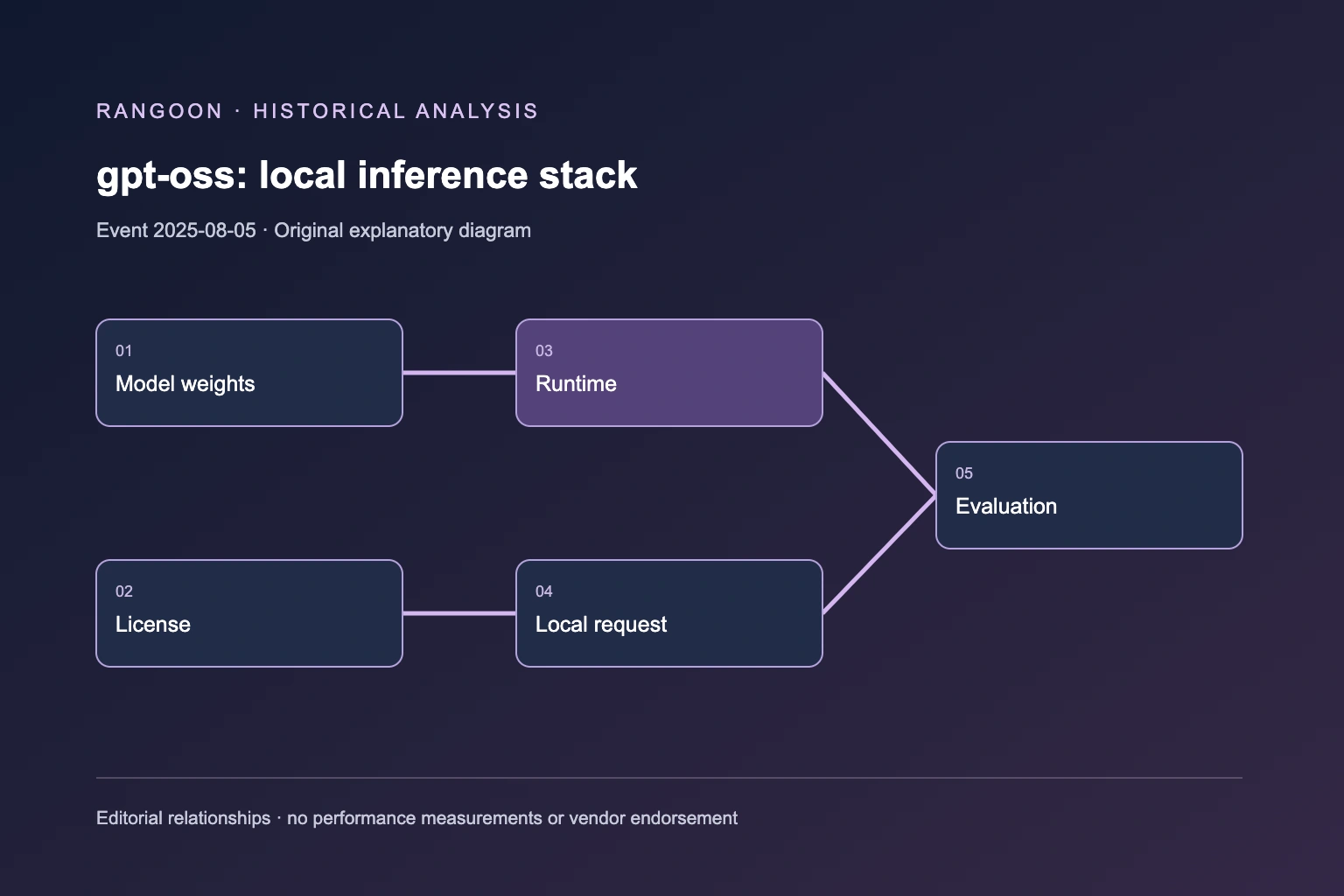
- An installer, model revision, runtime settings, tool policy and monitoring plan form one release unit.
Two models arrived with weights and deployment claims[source 1][source 2]
On August 5, 2025, OpenAI announced gpt-oss-120b and gpt-oss-20b as open-weight reasoning models under the Apache 2.0 license. The release described them as text-only models designed for local or hosted use, and said they supported common developer patterns including function calling and structured outputs. OpenAI presented the release as an option for teams that want to run and customize models on their own infrastructure.
The announcement also described mixture-of-experts architectures. It listed 117 billion total parameters with 5.1 billion active per token for gpt-oss-120b, and 21 billion total with 3.6 billion active for gpt-oss-20b. Those are model-design facts, not an estimate of the hardware, latency, reliability or total cost required for every production workload.
The model card supplied the conditions behind the claims[source 1][source 2]
OpenAI’s same-date model card records architecture, training, evaluations and safety testing. It says the models use a 128k context length and reports benchmark results at specified reasoning levels. The card also documents an adversarial fine-tuning evaluation of gpt-oss-120b under the company’s Preparedness Framework. These are OpenAI-reported results with particular prompts, tools, settings and evaluation designs.
The card includes limitations that are operationally useful. It reports that both gpt-oss models underperformed o4-mini on the SimpleQA and PersonQA hallucination evaluations, and says browsing or external information gathering can reduce errors where internal knowledge is insufficient. That statement does not make any retrieval pipeline accurate or authorize a model to rely on unreviewed external sources.
Analysis: treat a local model deployment as a versioned release[source 1][source 2]
Open weights are not a finished application. The deployable unit includes the weight checksum, tokenizer, inference engine, quantization, system instructions, tool definitions, retrieval corpus, access controls and monitoring configuration. Record those pieces together with the evaluation results that justified the launch. A model name alone cannot reproduce an observed answer after any of those adjacent components change.
Before handling consequential work, create a small task-specific evaluation set with known answers, abstention cases, stale-source traps and policy denials. Evaluate the exact serving configuration. Then repeat after changing a runtime, prompt template, tool schema or retrieval index. This practice is independent editorial guidance; it is not a requirement attributed to OpenAI or an assurance that the tests capture all failure modes.
Analysis: a model card is evidence, not a transfer of responsibility[source 1][source 2]
A model card helps a reviewer ask better questions: What did the authors test? What capability and safety bounds did they report? Which conditions differ from the proposed system? It cannot decide whether a local deployment has appropriate identity controls, data handling, human review or incident response. Those decisions belong to the team operating the system and the systems it can reach.
Keep a reversible rollout path. Limit the initial user group, log only the metadata needed to investigate failures, give users a route to flag harmful or incorrect results, and retain the prior configuration until the new one is understood. The release was a dated open-weight model event. It was not a certification of a downstream product, a claim that hosted and local implementations behave identically, or an endorsement of Rangoon.
Sources
- OpenAI: Introducing gpt-oss (August 5, 2025)
- OpenAI: gpt-oss-120b & gpt-oss-20b Model Card (August 5, 2025)
Continue reading