SimpleQA narrowed factuality evaluation to short answers with inspectable grading
OpenAI introduced the SimpleQA factuality benchmark on October 30, 2024, using short fact-seeking questions and source-supported reference answers for tractable grading.
Historical reporting: OpenAI introduced SimpleQA on October 30, 2024 and published the associated paper. This article treats it as a bounded factuality benchmark, not a general certification of truthfulness or safety.
Key takeaways
- SimpleQA targeted short fact-seeking responses, which makes one evaluation question more tractable.
- Reference-supported answers and predictable grading do not cover every open-ended product claim.
- A product evaluation needs task-specific sources, abstention rules and update handling.
SimpleQA focused on short fact-seeking questions[source 1][source 2]
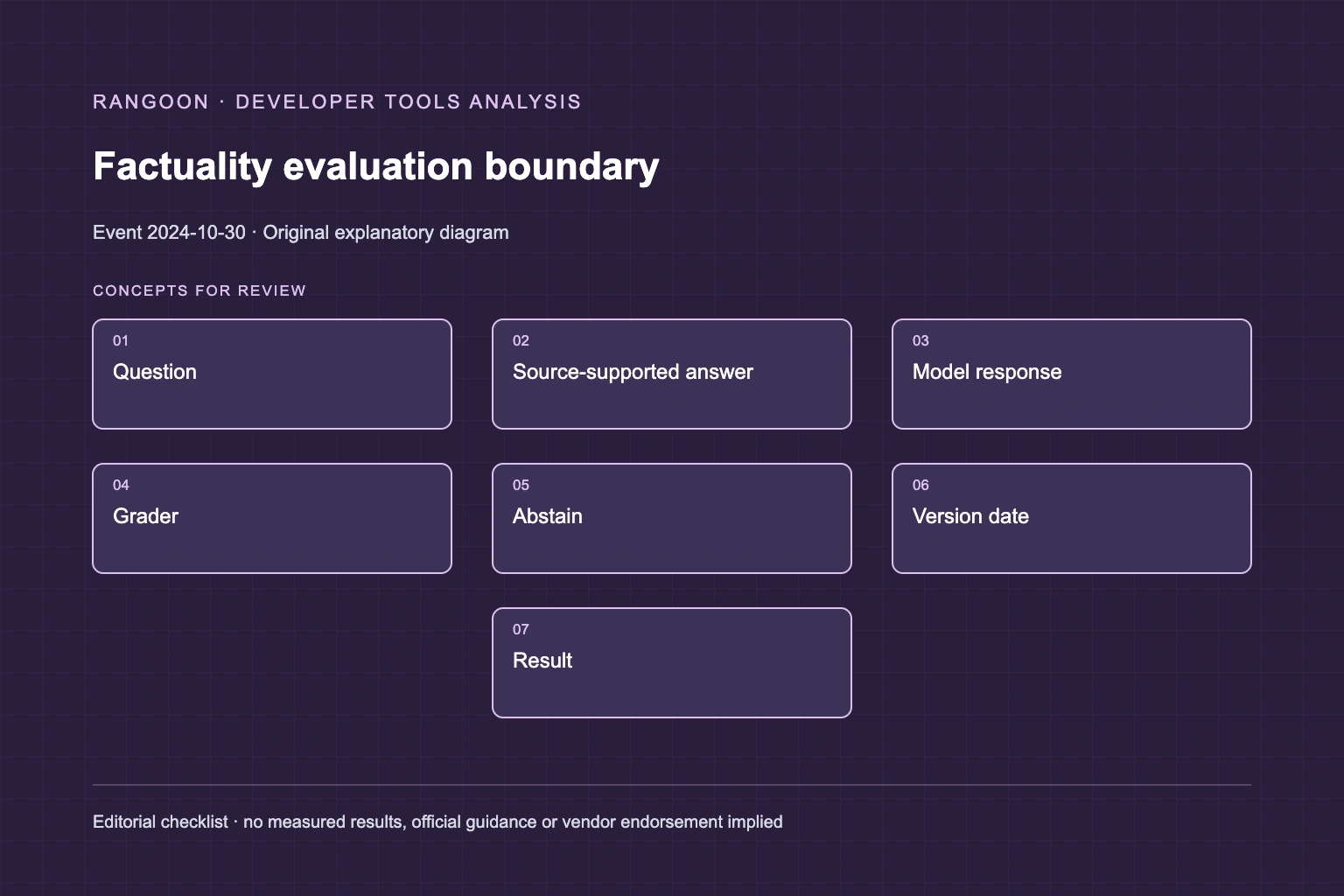
OpenAI introduced SimpleQA on October 30, 2024 as a factuality benchmark for short fact-seeking questions. Its release post said reference answers were supported by sources from two independent AI trainers and that questions were written to make predicted answers easy to grade. The associated paper described the benchmark and its correctness, diversity, challenge and researcher-UX goals.
That design choice narrows the evaluation problem. It does not measure every factual claim in a long answer, every multimodal interpretation, a retrieved citation, a tool result or a decision made from generated text. A short-answer score can be useful evidence while remaining insufficient for a broad assertion that a model is factual in production.
Reference answers are part of the benchmark contract[source 1][source 2]
Evaluation results depend on the question set, source support, answer normalisation and grading procedure. Preserve all four. If a team changes the source date, accepts a wider wording or substitutes an automated judge, it has created a different evaluation. That is not a defect; it is a reason to name the variant and avoid comparing numbers as if they came from one fixed test.
Include abstention and citation behaviour when they matter to the product. A model may avoid a wrong answer by saying it lacks evidence, and a system with retrieval may have a separate failure path when a cited document is stale or irrelevant. The benchmark release does not settle which policy is best for another application.
Analysis: connect factuality to a product’s decision boundary[source 1][source 2]
Build a local factuality suite from the facts a product actually needs: supported policy versions, public deadlines, internal configuration, catalog data or source-grounded explanations. Attach the authoritative source, version date, answer rule and escalation path for each case. Run it after model, prompt, retrieval or source changes. Track both correct answers and cases where the system should defer to a human or a source link.
Do not turn an evaluation score into permission for an action. A correct factual answer does not establish authority to change a record, tell a user they qualify or trigger an external transaction. Keep information quality, decision rights and execution controls separate.
Analysis: a 2024 benchmark release cannot prove current model behaviour[source 1][source 2]
This article records an October 30, 2024 benchmark event. It does not claim a current score for any model, the completeness of a factuality programme or the accuracy of a particular response. Model revisions and source drift make those live questions.
The historical lesson is practical: narrow a claim, define its evidence and make grading reproducible. That makes evaluation evidence more useful than a single undated statement that a system “does not hallucinate.” Publish error categories as well as aggregate results, because two failures with the same score can require opposite controls.
Sources
- OpenAI: Introducing SimpleQA (October 30, 2024)
- OpenAI: SimpleQA paper (October 30, 2024)
Continue reading