

Qwen2.5-VL made visual input handling an explicit systems boundary
Qwen released Qwen2.5-VL on January 26, 2025, pairing image and video understanding with coordinate and structured-output claims.
Historical reporting: Qwen’s January 26, 2025 release post announced Qwen2.5-VL in 3B, 7B and 72B base and instruct variants. The vendor describes visual-agent, localization, video and structured-output capabilities; those claims require task-specific evaluation and do not prove reliable autonomous action in another interface or deployment.
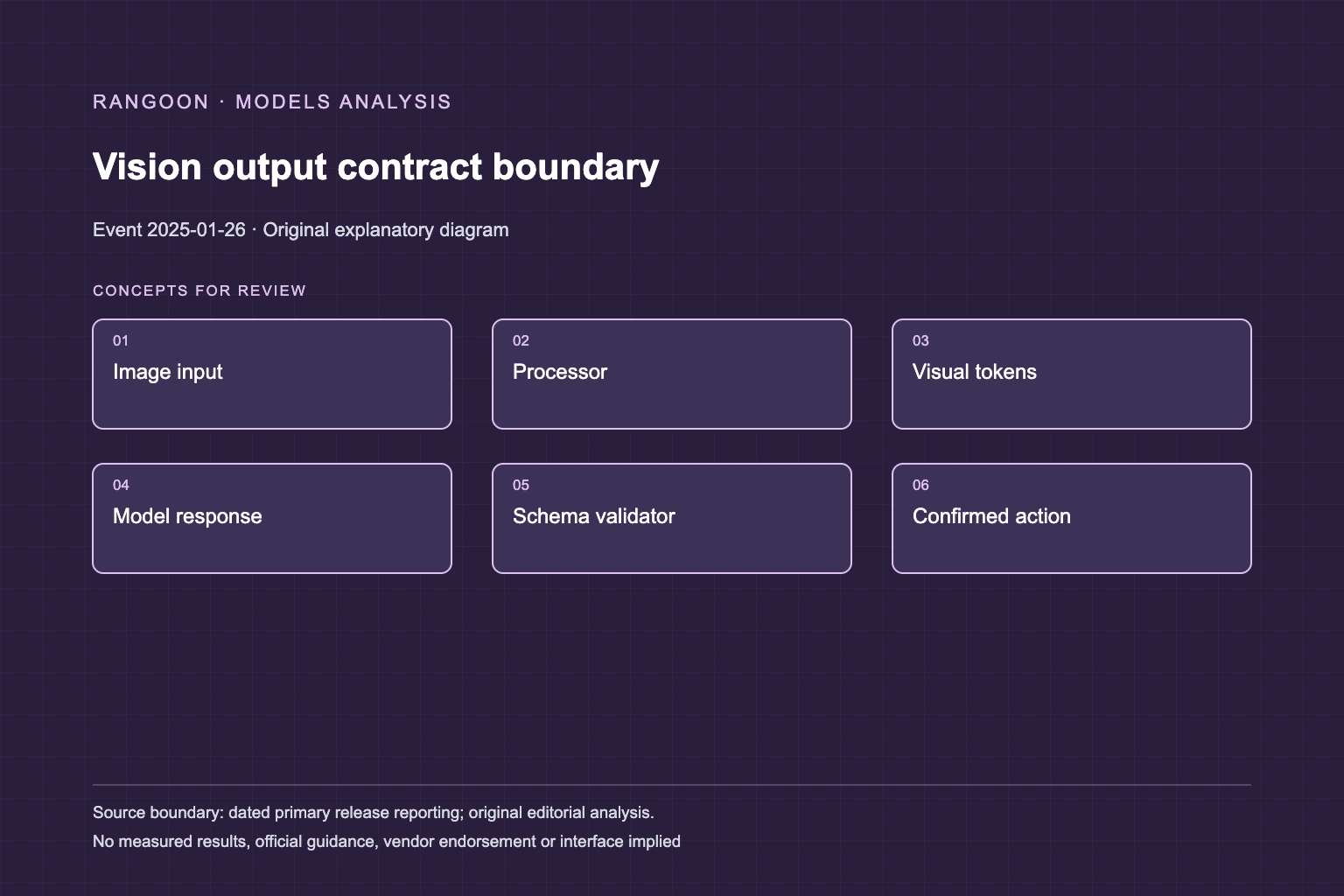
Key takeaways
- Qwen2.5-VL was a family release, so deployment decisions must name an exact checkpoint, processor and runtime.
- Coordinate and JSON-shaped output move parsing, schema validation and target confirmation into the application boundary.
- Visual-agent demonstrations are evidence of an intended capability, not authorization for a model to operate a user interface unattended.
The January release named a vision-language family and its artifacts[source 1][source 2]
On January 26, 2025, Qwen announced Qwen2.5-VL as its new flagship vision-language line. The release post said base and instruct weights were opened in 3B, 7B and 72B sizes through Hugging Face and ModelScope, while the associated model card identifies the 72B instruct checkpoint as an image-text-to-text model. That makes the event a set of separately configured artifacts, rather than a single interchangeable capability label.
The post described image, chart, icon, layout and document understanding, plus video event localization, bounding boxes or points, and structured outputs for scanned material. It also described dynamic resolution, absolute time encoding and a visual encoder with window attention. The 3B, 7B and 72B variants also create separate cost, memory and latency choices that a generic “Qwen2.5-VL” label cannot resolve. Those design details explain why input preprocessing, image scale, frame sampling and output parsing belong in a release record; they do not establish accuracy for a particular form, screen, language or video collection.
Localization turns a model response into a coordinate contract[source 1][source 2]
A box, point or JSON object is useful only when its coordinate convention is declared. An integrating system should retain image dimensions, rotation treatment, crop or resize policy, processor revision, requested schema and the raw response before mapping a coordinate to a screen or record. Otherwise a syntactically valid answer can address the wrong region after an image transform or a changed client viewport.
Structured output also needs ordinary contract controls: validate types and required fields, reject unknown action values, preserve confidence or ambiguity separately from data, and bind any later action to the reviewed source item. Stable serialization should be tested with malformed responses, incomplete detections and several image orientations, not only successful demonstrations. These are application requirements inferred from the release’s stated output forms, not a claim that Qwen supplied a complete workflow. A visual model may extract candidates; business rules and a user-visible confirmation step decide whether a candidate may change state.
Visual-agent use needs traceable tests before it gains control[source 1][source 2]
Qwen presented Qwen2.5-VL as able to direct tools for computer and phone use, and supplied vendor benchmark comparisons. Those comparisons are vendor evidence under named evaluations, not an independent measurement of a different browser, accessibility tree, permission set or recovery policy. A team considering UI assistance should test its own representative screens, popups, expired sessions, layout variants, destructive controls and inaccessible states with a fixed checkpoint and harness.
For any action path, separate perception from authority. Record the screenshot or input reference, parsed target, requested tool call, policy decision, result and failure reason; require confirmation for consequential operations and provide a safe stop when the target cannot be established. Replaying these records against a pinned release exposes whether a model or a UI revision changed an observed result. That arrangement makes a visual model replaceable and auditable, while avoiding an unsupported conclusion that multimodal capability alone creates operational reliability.
Sources
Continue reading
Related reading
 News analysisQwen3-VL’s flagship release made vision deployment a versioned architecture choice3 min read
 News analysisQwen released Qwen3 Embedding and Reranking models with dual-encoder and cross-encoder retrieval paths3 min read
 News analysisNVIDIA announced Canary-Qwen-2.5B as an open ASR and language-model combination3 min read