

Qwen3-VL’s flagship release made vision deployment a versioned architecture choice
Qwen announced Qwen3-VL on September 22, 2025, describing new vision, video, spatial-modeling and multimodal-reasoning capabilities.
Historical reporting: Qwen’s September 22, 2025 official Qwen3-VL announcement described the new vision-language generation and its architecture. The current Hugging Face model card is used only as later maintained artifact and integration context; it is not proof that a later dependency, hosted endpoint or smaller variant existed on the announcement date.
Key takeaways
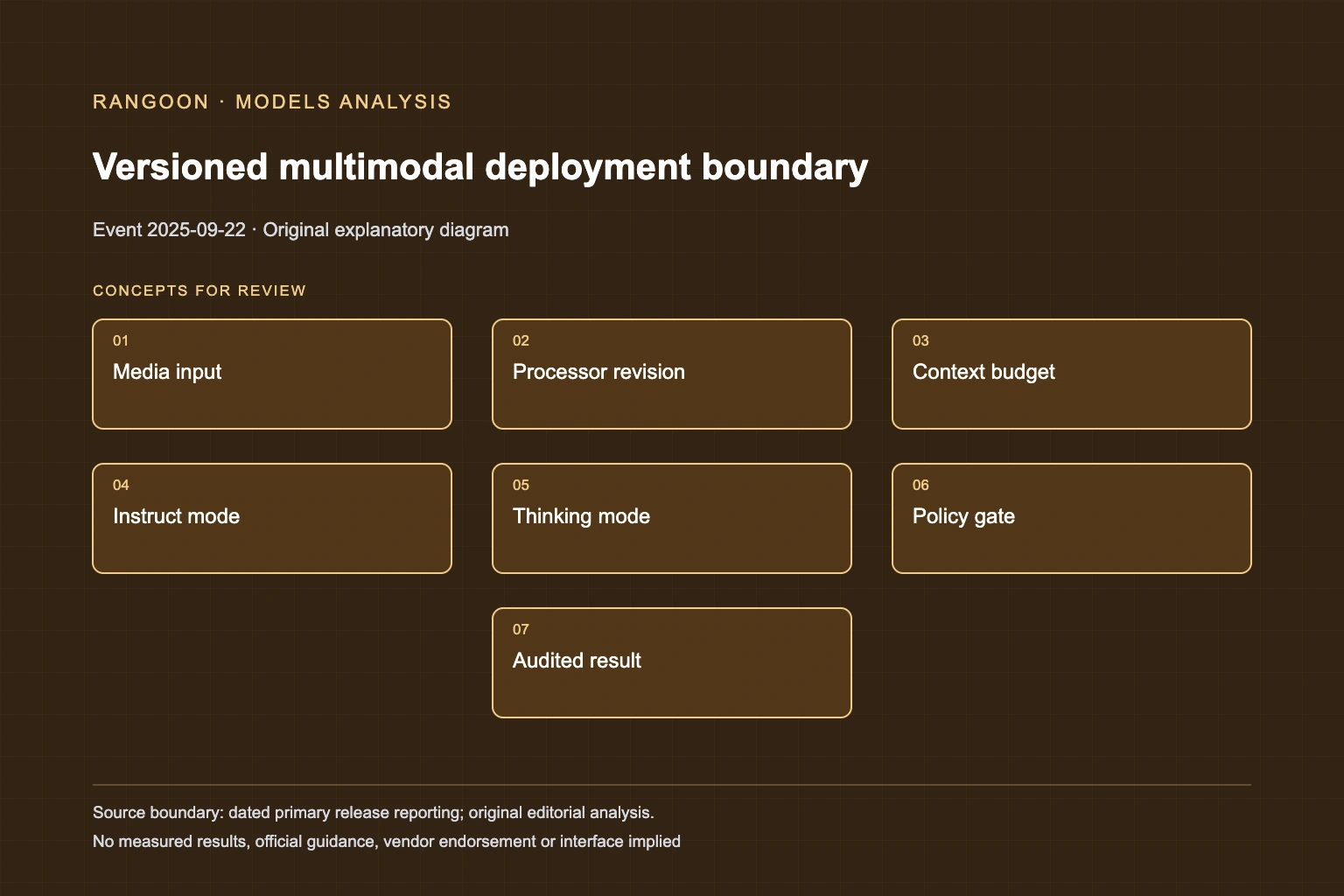
- The Qwen3-VL announcement described Instruct and Thinking editions, so mode selection belongs in deployment records and tests.
- Long context and visual grounding increase the need to control media preprocessing, positional conventions, memory budgets and retrieval evidence.
- A multimodal model upgrade needs compatibility tests for processors and runtimes as well as output-quality evaluation.
The September announcement introduced Qwen3-VL and its named modes[source 1][source 2]
On September 22, 2025, Qwen published its official Qwen3-VL announcement, presenting a new vision-language generation with Instruct and Thinking editions. The later maintained Qwen model card identifies Qwen3-VL-235B-A22B-Instruct as a mixture-of-experts vision-language artifact and describes a broader dense and MoE family. This distinction makes variant-level dates and artifacts necessary evidence fields in a historical release record. The dated event is an announcement of the family and its stated modes, not proof that every later size, runtime or API name was available that day.
The announcement described Interleaved-MRoPE, DeepStack and text-timestamp alignment, alongside long-context, spatial-grounding, video and visual-agent goals. The later card describes the named 235B-A22B configuration as 235B total parameters with 22B active parameters, but deployment feasibility still depends on the selected serving arrangement. These are vendor descriptions of architecture and intended capability; implementation teams still need to determine their processor version, media limits, GPU memory, batching policy and the specific interaction mode exposed to users.
Instruct and Thinking modes need separate operational evidence[source 1][source 2]
A named mode is a behavioral configuration, not a decorative suffix. It can alter response timing, token use, stopping behavior, tool orchestration and the format a downstream parser receives. A deployment record should include the full checkpoint identifier, weights revision, processor revision, serving engine, quantisation, context cap, sampling configuration and whether a user-facing request is routed to Instruct or Thinking.
The later maintained Qwen3-VL model card shows code examples that depend on contemporary Transformers support and recommends FlashAttention for some scenarios. That makes runtime compatibility a first-class acceptance check: an upgrade may fail before quality is measured, or preserve API calls while changing image tokenization and memory use. The test record should keep package versions and exact media fixtures because a passing text-only request does not exercise vision preprocessing. Pinning an artifact and exercising the actual image, video and multi-image path is stronger evidence than assuming a family name guarantees equivalent behavior.
Long multimodal context needs budgets and retrieval checks[source 1][source 2]
A large advertised context window does not mean every deployment can admit unlimited documents or video. Image token counts, frame sampling, prompt length, response budget, batch concurrency and key-value cache all share finite accelerator memory. A service should set and expose explicit limits, reject or segment over-budget inputs predictably, and record which frames or pages reached the model so an answer can be traced to evidence.
Qwen’s card includes benchmark comparisons and visual-agent capability statements. Those are not local measurements of a team’s documents, cameras, UI states or user population. Before relying on Qwen3-VL for grounded extraction or an assistive action, evaluate versioned fixtures with known answers, ambiguous cases, adversarial layout changes, retrieval misses and safe failure behavior; keep the decision to act outside the model output and inside a reviewed application policy. Capacity tests should report rejection and timeout behavior under load, since a well-grounded answer after an expired request is still a product failure.
Sources
Continue reading
Related reading
 News analysisQwen2.5-VL made visual input handling an explicit systems boundary3 min read
 News analysisQwen released Qwen3 Embedding and Reranking models with dual-encoder and cross-encoder retrieval paths3 min read
 News analysisNVIDIA announced Canary-Qwen-2.5B as an open ASR and language-model combination3 min read