

Snowflake introduced Cortex Agents in public preview for work across structured and unstructured data
Snowflake launched Cortex Agents in public preview on February 12, 2025, combining Cortex Analyst, Cortex Search and language models for enterprise data tasks.
Historical reporting: Snowflake’s February 12, 2025 launch post describes Cortex Agents as a public-preview, managed service using Cortex Analyst, Cortex Search and LLMs. A November 4 release note records its later general availability and says it had previously been a preview feature; it is later context, not proof that GA existed at launch.
Key takeaways
- Cortex Agents launched as a public preview, with an API-oriented service for combining structured and unstructured data work.
- The launch named planning, tool use and response generation, but did not make outputs self-validating or grant new data access by itself.
- The later general-availability release note distinguishes a later status from the February preview launch.
The February post announced a managed service in public preview[source 1]
On February 12, 2025, Snowflake published a launch post for Cortex Agents. It called the service fully managed and available in public preview, and described it as a way to integrate, retrieve and process structured and unstructured data. Public preview is a meaningful availability state, but it is not the same thing as general availability, a long-term interface guarantee, or proof that a particular account, region or workload was eligible on launch day.
The post made an enterprise-data claim rather than presenting an agent as a standalone model. Its examples included tables and views on the structured side and files such as PDFs in object storage on the unstructured side. This supports a narrow account of the product: Snowflake introduced an orchestration layer over named Cortex components. It does not establish that all document types, data locations, query shapes or permission models were supported without qualification.
Cortex Analyst, Cortex Search and language models were the named pieces of the initial workflow[source 1][source 2]
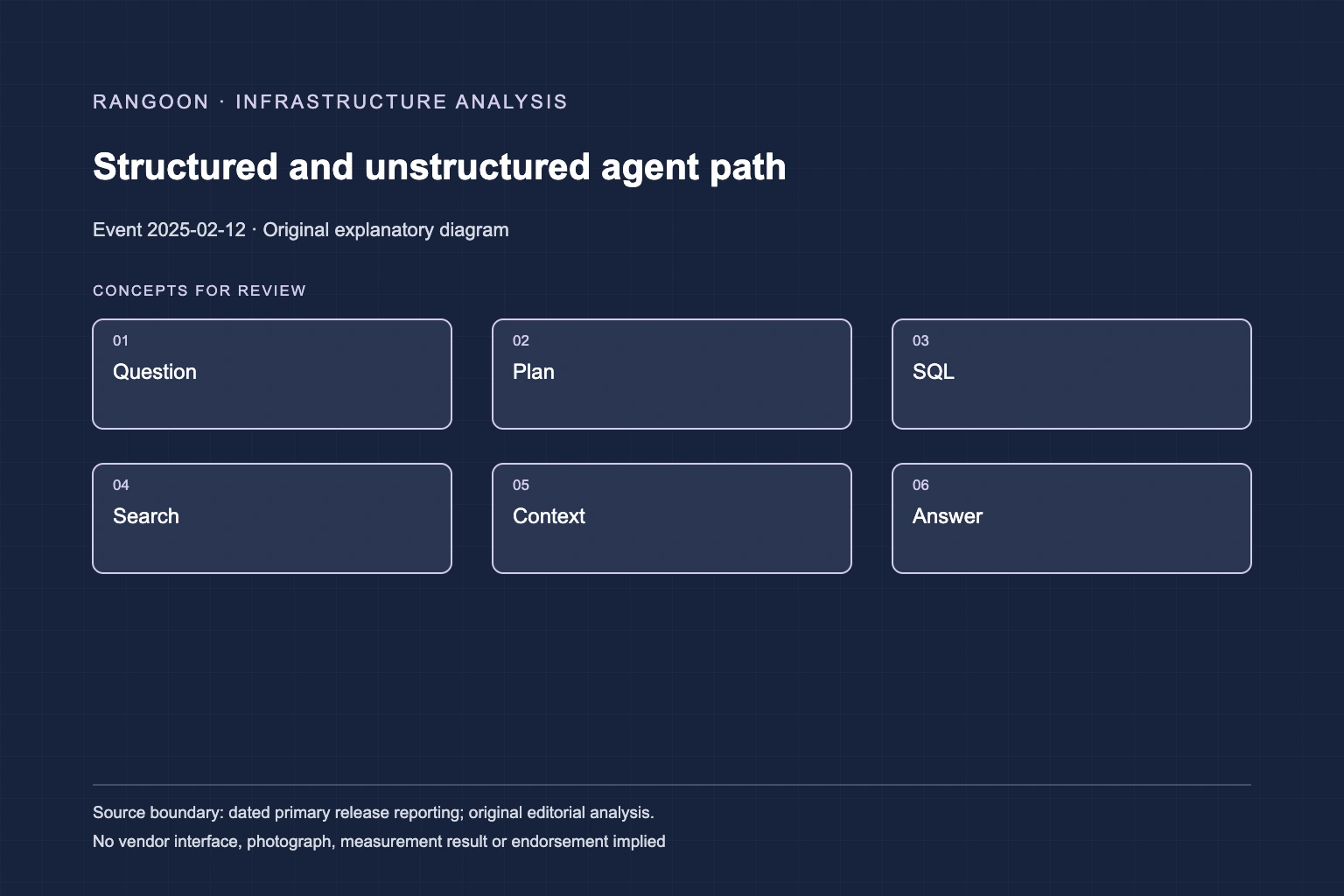
Snowflake said Cortex Agents used Cortex Analyst for structured SQL work, Cortex Search for unstructured data and LLMs to analyze and generate answers. It also described planning, tool execution and reflection as parts of an agent workflow. These names help locate the product boundary: the service was designed to coordinate existing data-oriented capabilities instead of asking a model to answer without retrieval. The launch did not say that a generated answer was automatically correct or policy-compliant.
The launch post also described a REST API, which gives an application integration surface but does not determine an application’s authorization model. A caller still needs approved credentials, scoped data access, input handling and a way to review consequential output. A later November release note says the service became generally available after having been a preview feature. That later status does not replace the dated February launch record or expand the scope announced that day.
Bringing data to an agent kept governance work inside the system design[source 1][source 2]
Snowflake’s post linked agent usefulness to access to business context while retaining security and governance policies. That link is important because retrieval quality and authorization are different questions. A service can retrieve relevant material yet still expose the wrong material if a semantic layer, search index or application role is badly scoped. The product announcement therefore cannot stand in for a review of row access, source curation, logging or a human decision point.
Structured and unstructured sources also create different failure modes. SQL may return a precise result from the wrong metric definition; document retrieval may return an incomplete or stale passage; a language model may still synthesize them poorly. The February event showed Snowflake packaging a path to combine those sources. It did not remove the need to test tool selection, validate answers against underlying records, and establish what an agent may do after it responds.
The historical record is a preview launch, not a claim about the later Cortex portfolio[source 1][source 2]
The dated post is enough to establish an early product milestone: Snowflake publicly previewed Cortex Agents and described how it would connect Analyst, Search and LLMs. It does not prove later general availability, pricing, support terms, model choices, Microsoft integrations or features added after the event. Those claims require dated records from their own releases, especially because agent products change rapidly across interfaces and cloud services.
This article also avoids treating vendor language about accuracy, scale or governance as an independent benchmark. The launch can support an account of design intent and availability status. It cannot prove that an enterprise has safely deployed a particular agent, that every response is grounded, or that an API consumer inherits permissions correctly. In February 2025, the public fact was a preview service for orchestrating named data and language components.
Sources
- Snowflake Blog: Your Enterprise Data Needs an Agent (February 12, 2025)
- Snowflake Documentation: Nov 04, 2025: Cortex Agents (General availability) (November 4, 2025)
Continue reading
Related reading
 News analysisWeaviate announced a three-agent suite while keeping availability stages distinct3 min read
 News analysisElastic introduced Agent Builder after an October technical-preview release note3 min read
 News analysisZendesk’s 2025 Resolution Platform joined service agents, knowledge, actions and QA3 min read