

TSMC’s A14 statement kept a 2025 unveiling separate from a 2028 plan
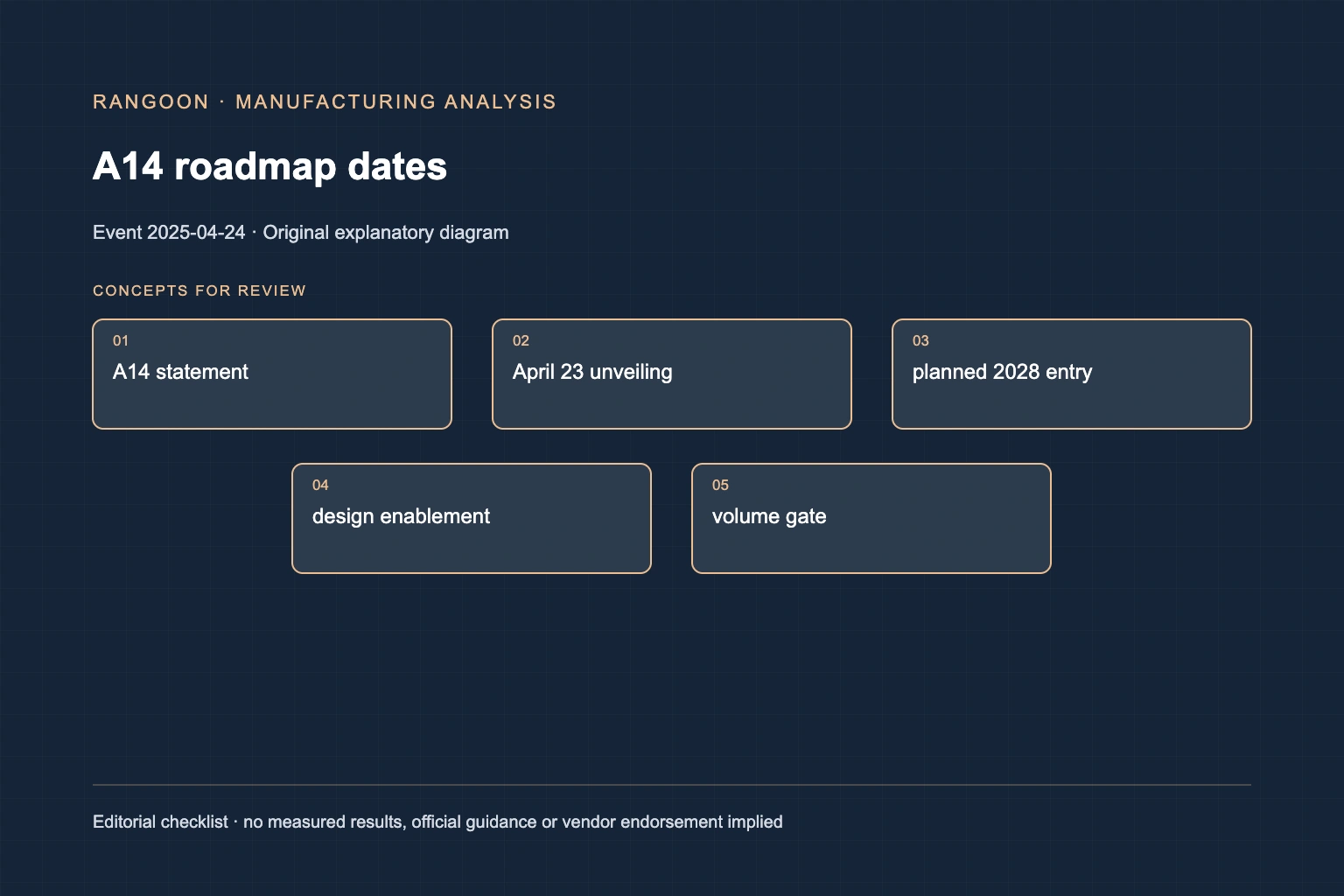
TSMC issued its A14 statement on April 24, 2025 after an April 23 unveiling. The event showed why roadmap, qualification, and production statuses must stay separate.
Historical reporting: TSMC issued its A14 statement on April 24, 2025, reporting an April 23 unveiling and a planned 2028 production entry. TSMC annual reporting supplies additional roadmap context; analysis below is editorial.
Key takeaways
- TSMC’s April 24 statement reported the April 23 A14 unveiling and a planned 2028 production entry.
- An unveiling and a planned production date are different historical claims.
- Roadmap, design enablement, qualification, and volume production should never share one status label.
What TSMC stated[source 1][source 2]
TSMC issued an A14 statement on April 24, 2025. The statement said the company had unveiled A14 at its North America Technology Symposium on April 23 and described A14 as planned to enter production in 2028. Those dates identify an unveiling and a future plan; they do not state that A14 was in volume production in April 2025.
TSMC’s annual reporting describes its continuing development of leading-edge process and advanced packaging technologies. It supplies broader corporate roadmap context, while the April 24 statement is the primary dated record for the A14 unveiling and planned production timing.
Editorial analysis: a roadmap is a conditional artifact
Process roadmaps matter because customers must begin design and ecosystem work before a manufacturing node reaches broad production. They are also conditional artifacts: design rules, libraries, process targets, packaging choices, and customer schedules can evolve. A roadmap date should be reported as a plan, with the source date that made the plan, rather than as an achieved manufacturing fact.
A node-status table can reduce confusion by separating announcement, process definition, design enablement, risk production, customer qualification, and volume production. Each state should require a distinct source and date. This is especially important when a technology combines transistor changes, backside power delivery, and new interconnect assumptions.
Editorial analysis: a roadmap begins a design-readiness question
A future process can create a new design opportunity while its rules, libraries, models, and implementation flow remain on a separate schedule. A public roadmap does not answer a customer’s block-level questions about timing closure, power integrity, physical verification, package interaction, or signoff readiness.
Teams evaluating a future node should create a design-readiness packet: target block class, performance objective, library availability, signoff flow, package interaction, and migration risks. Mark each item as demonstrated, vendor-planned, or locally verified. The packet turns a roadmap discussion into an engineering decision rather than a slogan.
Editorial analysis: preserve the date qualifiers
When a public update says a technology is on a roadmap, preserve the verb and qualifier: announced, targeted, planned, on track, or in production. Those words are operational data. Replacing them with ‘available’ makes a timeline less useful and can trigger premature design or procurement decisions.
TSMC’s April 2025 event is best understood as a roadmap checkpoint. Its lesson is simple: architecture information and manufacturing status both matter, but they prove different things and must stay separate in a chip program record.
Editorial analysis: stage design commitments
Design teams can stage commitments against specific evidence: early feasibility against architecture material, implementation against qualified rules and libraries, and product release against manufacturing status. This limits rework when a planned node schedule changes. It also makes a project’s exposure to a process, power-delivery, or ecosystem dependency visible before tapeout decisions become expensive. The design review should name the exact library and physical-verification assumptions that remain dependent on a future process release, including schedule ownership for each unresolved item.
Sources
Continue reading
Related reading
 News analysisTSMC’s Arizona expansion announcement separated a $100 billion plan from current fab output4 min read
 News analysisMicron’s Singapore HBM packaging groundbreaking set a future supply timetable4 min read
 News analysisGlobalFoundries’ New York packaging center plan made onshore test a separate capability4 min read