

UK’s AI Playbook expanded government guidance to ten principles across selection, deployment and assurance
The UK’s February 10, 2025 AI Playbook updated earlier generative-AI guidance with ten principles for public-sector AI selection, deployment and assurance.
Historical reporting: Government Digital Service published the AI Playbook for the UK Government on February 10, 2025. The publication page and the HTML playbook say it updates the January 2024 Generative AI Framework, broadens coverage beyond generative AI, and defines ten principles for government organizations. It is guidance for civil servants and public-sector organizations, not a new law, a procurement award, a system approval, or proof that a department met all ten principles. The article reports the published playbook’s scope and stated advice, not legal or operational compliance advice.
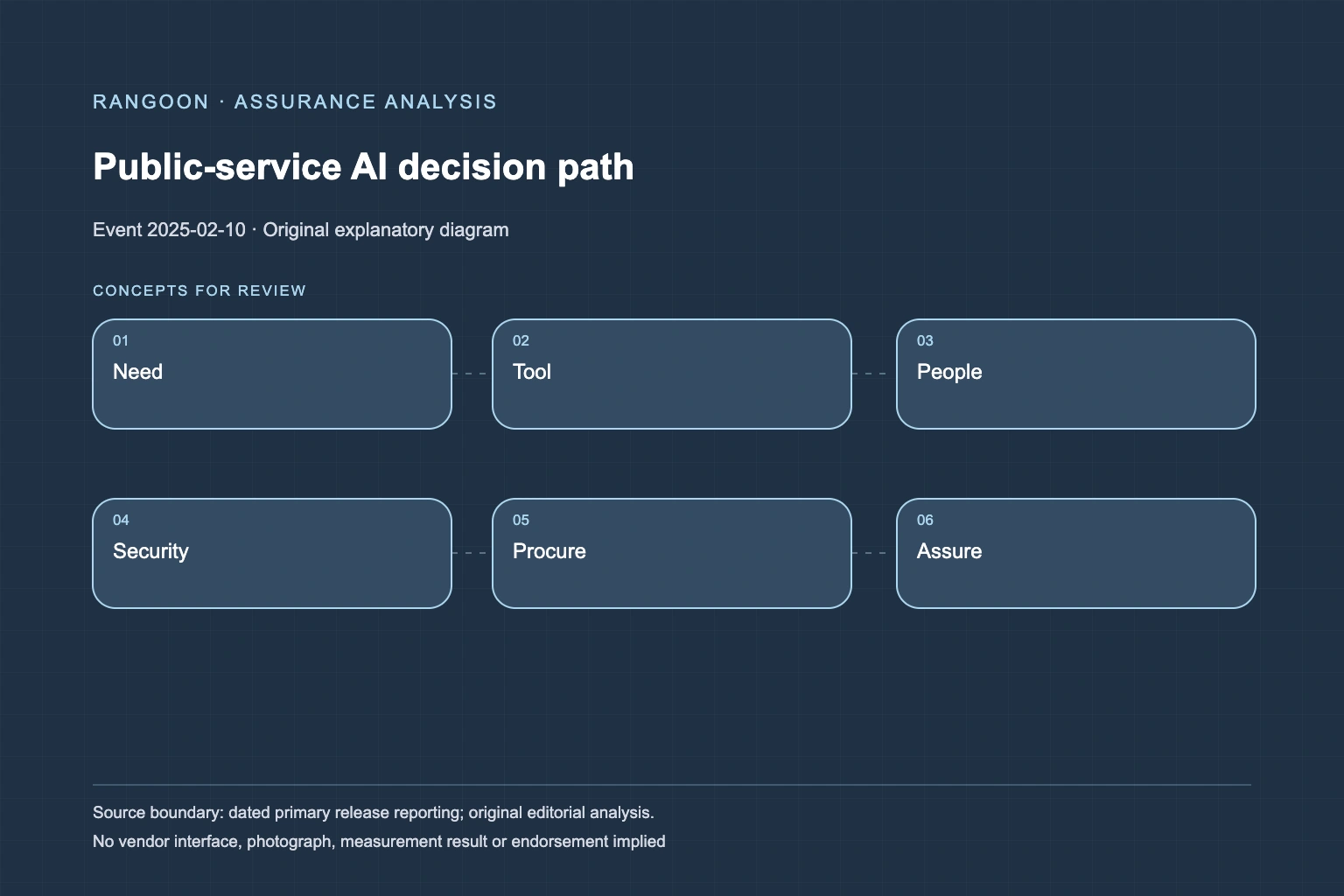
Key takeaways
- The Playbook was an updated public-sector guidance release, not a binding authorization or agency compliance finding.
- Its ten principles link AI limitations, lawful use, security, human control, lifecycle management, procurement, skills and assurance.
- The release broadened the prior Generative AI Framework to cover a wider range of AI technologies.
Government Digital Service published an expanded AI guide for public-sector use[source 1][source 2]
Government Digital Service published the AI Playbook for the UK Government on February 10, 2025. The publication says the document offers guidance for civil servants and people working in government organizations to use AI safely, effectively and securely. It also says the Playbook expands on the January 2024 Generative AI Framework and retitles the material for a wider range of AI technologies. The accompanying HTML edition records updates including new sections on user research, business cases, societal wellbeing, security opportunities, governance structures, quality assurance and managing risk. This is a specific guidance-release event, not evidence that a particular public authority had selected a tool, completed an assessment, awarded a contract or achieved a service result. The document gives an official reference point; implementation remains an agency-by-agency matter.
The ten principles tie technical limits to organizational decisions and assurance[source 2]
The Playbook states ten core principles for AI in government organizations. They cover understanding AI and its limitations; lawful, ethical and responsible use; security; meaningful human control; lifecycle management; using an appropriate tool; openness and collaboration; engaging commercial colleagues early; skills and expertise; and using organizational policies with suitable assurance. This sequence makes procurement and assurance part of a wider delivery process, rather than a post-launch checklist. The Playbook also cautions that AI outputs are not guaranteed accurate and says teams should understand limitations and have a process to test outputs. The source establishes published guidance and its structure. It does not determine whether a particular decision is lawful, whether a control is proportionate in a named service, or whether a human-control design produces a good outcome.
Human control and risk work were stated as design questions, not ceremonial sign-offs[source 2]
The Playbook’s human-control, security and lifecycle principles direct readers toward decisions that need evidence in the actual use case. Its guidance says organizations should involve legal, compliance and data-protection expertise early, consider privacy and fairness, and address ethical concerns through the project lifecycle. It also calls for user research and engagement with people who may experience harm. Those are concrete process directions, but the playbook does not replace an impact assessment, data-protection analysis, procurement record, security test or expert decision for a particular deployment. A generic claim that a service follows the Playbook would not show what model was selected, how it was evaluated, where inputs go, who can override an output or how incidents are handled. The event provided a framework for asking those questions, not a universal answer to them.
The assurance principle completes the guide without creating a certification program[source 1][source 2]
Principle 10 says organizations should use the principles alongside their own policies and have the right assurance in place. That wording makes assurance a contextual activity connected to the host organization, its service and its existing governance. It does not announce a UK-wide certificate, prescribe one test suite, or say that all AI systems must pass the same threshold. The Playbook was developed with contributions across government, public-sector bodies, academia and industry, but that collaboration is not an endorsement of every AI product or vendor. Nor do the documents publish adoption metrics, incident outcomes or independent verification for departments. The historical record is that the UK released an updated cross-government playbook that put assurance, procurement and lifecycle thinking in one guidance frame. Later procurement and service evidence is needed to establish implementation.
Sources
- GOV.UK: AI Playbook for the UK Government (February 10, 2025)
- GOV.UK: Artificial Intelligence Playbook for the UK Government (HTML) (February 10, 2025)
Continue reading
Related reading
 News analysisUK republished PPN 017 under new procurement terminology while preserving its optional AI-transparency questions3 min read
 News analysisUK’s third-party AI assurance roadmap mapped professionalization, information access and a planned innovation fund3 min read
 News analysisUK published an AI cyber-security code with 13 voluntary principles and an implementation guide3 min read