

Grok 4 Fast combined quick and reasoning responses while xAI split API access into two models
xAI announced Grok 4 Fast on September 19, 2025, combining reasoning and non-reasoning behavior in one model family and releasing two API endpoints.
Historical reporting: xAI announced Grok 4 Fast on September 19, 2025 as an efficiency-focused reasoning model. It said the consumer product would use Fast and Auto modes, while the xAI API made generally available two named endpoints, grok-4-fast-reasoning and grok-4-fast-non-reasoning, each with a stated 2-million-token context window. xAI’s cost, token-efficiency, benchmark and search claims are supplier-published results with particular methods and comparison conditions, not independent performance or safety proof. Its same-day model card describes a near-final checkpoint and stated evaluation methods; it does not make a specific deployment safe or reliable.
Key takeaways
- Grok 4 Fast was a release about an efficiency-focused model family, with consumer modes and API endpoints described separately.
- xAI’s unified-architecture claim did not remove the need to choose reasoning effort, tool permissions and output review for an application.
- Vendor cost and benchmark comparisons are evidence about the company’s reported setup, not a guarantee of customer spend or accuracy.
The September event introduced an efficiency-focused model family[source 1]
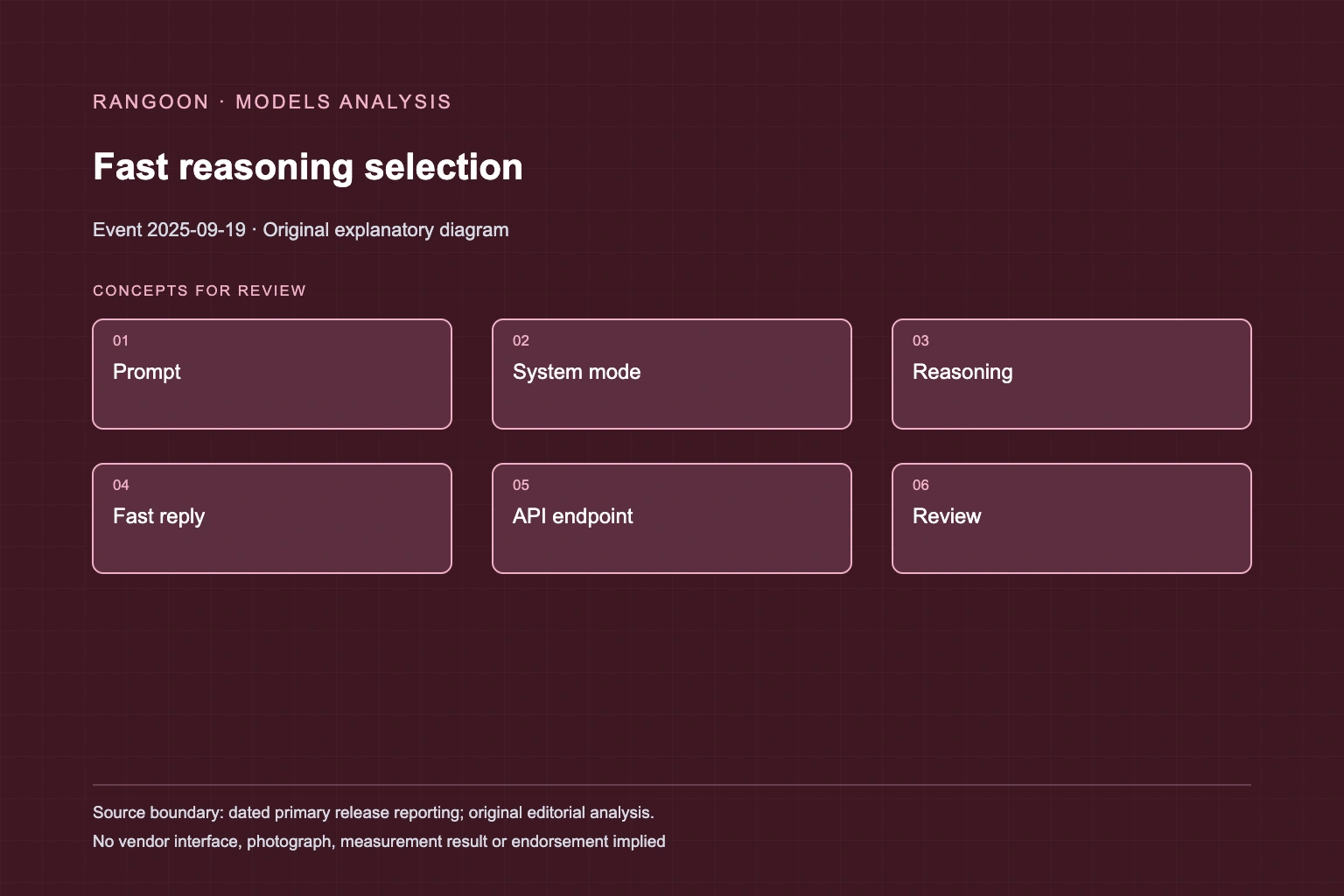
On September 19, 2025, xAI announced Grok 4 Fast as a cost-efficient reasoning model. The company described a unified architecture that could handle reasoning and non-reasoning behavior, while presenting the consumer experience through Fast and Auto modes. This describes a product strategy for trading response depth against speed; it does not eliminate the operational distinction between a quick reply and a response that spends more compute. An application still needs to decide which mode fits a task, what tools the model may use and how output is reviewed. The launch establishes xAI’s claimed model design and product modes, not a guarantee that the service will choose the right behavior for every query.
The API release retained separate reasoning and non-reasoning identifiers[source 1]
Although xAI described one underlying architecture, its release said the API would roll out grok-4-fast-reasoning and grok-4-fast-non-reasoning as two models, each with a stated two-million-token context window. This distinction is useful for developers because an API identifier can control latency, token use and integration behavior even when a provider describes shared weights. The announcement also called both endpoints generally available and listed release-era prices. That is not a permanent pricing promise, nor does a large context limit show that an application can safely supply, retrieve or process every document. Actual usable context depends on the request, system instructions, tool output, service limits and a user’s own data controls.
Search capability and benchmark claims remained bounded by their evaluations[source 1]
xAI said Grok 4 Fast had been trained with tool-use reinforcement learning and could call code execution, web browsing and X search. It also published comparisons for academic, coding and search-oriented benchmarks, plus a claim of fewer thinking tokens than Grok 4 in its evaluations. Those results can describe what xAI tested, but they do not make retrieved information true, a search result complete or a generated plan correct. The company’s price-to-intelligence and token-efficiency statements depend on its model settings, benchmarks and cost assumptions. A team should treat them as vendor evidence to verify against its workload, rather than as a prediction of total service cost, response quality or agent reliability.
The same-day model card documented a checkpoint and method, not an approval[source 1][source 2]
xAI’s Grok 4 Fast model card, last updated September 19, describes a general-purpose pre-training corpus, task and tool-use post-training, and evaluations on a near-final release checkpoint. It also describes the provider’s mitigation approach. Those are statements about xAI’s documented process and testing scope. They do not prove a particular user’s prompt is handled as intended, that an integration resists all attacks or that an agent with broader permissions is appropriate for a given system. The appropriate historical claim is limited: xAI announced an efficiency-focused model family with named consumer and API modes and published its own evaluation material. Security, reliability and cost remain deployment-specific questions after the announcement.
Sources
- xAI: Grok 4 Fast (September 19, 2025)
- xAI: Grok 4 Fast Model Card
Continue reading
Related reading
 News analysisGrok 4’s July launch put tool use, subscriber access and an API on the same release record3 min read
 News analysisxAI introduced Grok 3 as an early preview, with Think variants in beta while training continued3 min read
 News analysisxAI released Grok Code Fast 1 for coding agents, with partner trials and an API route kept separate3 min read