

The Agentic AI Foundation gave MCP, goose and AGENTS.md a shared open-governance home
The Linux Foundation formed the Agentic AI Foundation on December 9, 2025 with founding contributions including MCP, goose and AGENTS.md.
Historical reporting: Linux Foundation announced AAIF on December 9, 2025 and named its founding contributions. This is a governance event, not proof of project compatibility or security.
Key takeaways
- AAIF’s launch concerned stewardship for distinct agentic projects.
- Foundation governance does not merge project release or security processes.
- Adopters still need project-specific provenance and compatibility checks.
The December announcement placed several projects under shared stewardship[source 1][source 2]
The Linux Foundation announced formation of the Agentic AI Foundation on December 9, 2025. Its release named Anthropic’s Model Context Protocol, Block’s goose and OpenAI’s AGENTS.md as founding project contributions and listed founding members. A later Linux Foundation report likewise describes the foundation as a neutral home launched in December 2025. The event establishes organisational stewardship and project names. It does not mean the projects have one runtime, one security model, one license, or a single production support promise.
The three founding contributions occupy different layers of a developer workflow: a protocol, an agent project and a repository instruction convention. Grouping them under one foundation is a governance event, not a statement that their syntax, security model or release cadence can be managed through a single configuration file. Adoption needs component-specific evidence.
Shared governance is not shared execution architecture[source 1][source 2]
MCP standardizes a class of model-to-tool interactions; AGENTS.md is a repository instruction convention; goose is an agent project. They can appear in one developer workflow while retaining separate parsers, trust boundaries, artifact formats and release cycles. An architecture review should trace each one independently: where instructions are read, where protocol messages travel, where code executes and which identity controls an external side effect. A foundation umbrella does not erase those seams.
Instruction files deserve particular care because they can be visible to automated agents before a human sees a generated plan. Define repository trust boundaries, precedence rules and allowed actions outside the instruction text itself. A documented convention can improve clarity, but it cannot safely grant credentials, merge authority or permission to change external systems.
Project adoption needs a per-component ledger[source 1][source 2]
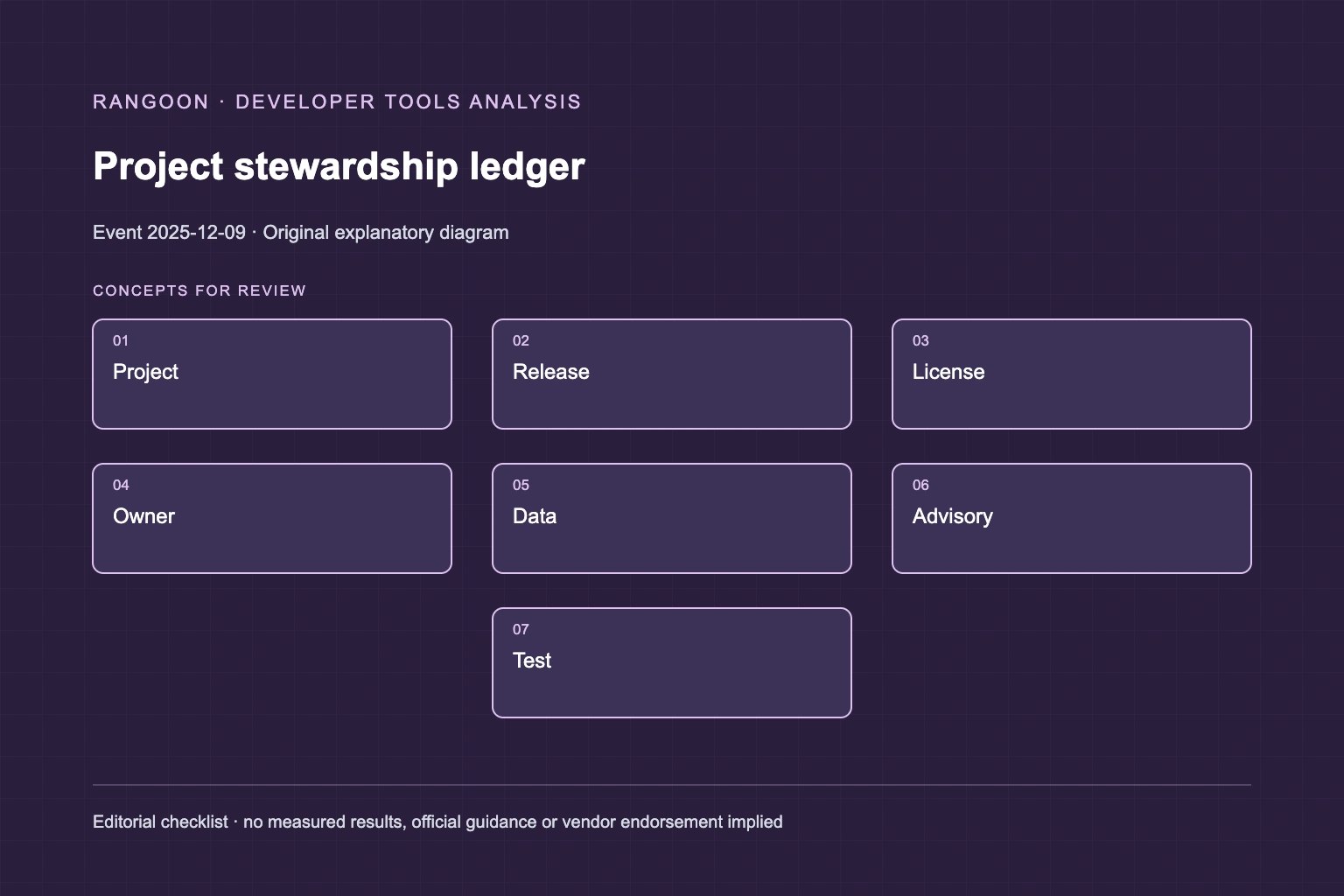
Maintain a ledger with component name, source repository, release tag or digest, license reference, owner, data access, network scope, security contact, upgrade policy and test suite. Update it when a project version changes, not when an industry headline appears. Test combinations explicitly: an instruction file may steer an agent that uses an MCP server, but each boundary needs its own validation and least-privilege rule. This is especially important when a workflow bridges local code and remote services.
When a project issues a security advisory, use the ledger to identify every workflow where it appears directly or through an integration. Then capture the mitigation decision and a post-change test. This is more reliable than searching for a product name in prose, because runtimes often embed dependencies under package, image or extension identifiers.
Analysis: neutral stewardship can improve traceability, not replace it[source 1][source 2]
A foundation can provide a durable place for governance, community contribution and public issue tracking. The practical benefit for adopters is better traceability if they use it: follow versioned releases, advisories, changelogs and project policies. Do not translate the announcement into an assurance claim. Local deployment evidence remains the only way to show what a particular stack actually downloaded, connected to and allowed to do.
A good stewardship review distinguishes neutral hosting from release authority. The host may coordinate a project, while maintainers and downstream distributors still control code, artifacts and support. Name those roles in the adoption record. That makes a December 2025 foundation announcement operationally useful without assigning it guarantees it never made.
Sources
- Linux Foundation: Agentic AI Foundation formation (December 9, 2025)
- Linux Foundation: Open Source and the Future of AI report (April 9, 2026)
Continue reading
Related reading
 News analysisAnthropic donated Agent Skills to AAIF: treat open governance as a new supply-chain input3 min read
 News analysisMCP’s November 2025 revision treated a protocol anniversary as a compatibility release3 min read
 News analysisMCP’s June 2025 revision made transport and authorization compatibility testable contracts3 min read