

Agility outlined Digit battery, safety and AMR-integration changes for commercial use
Agility Robotics announced Digit changes on March 31, 2025 spanning battery, stop functions, charging and AMR integration for its commercial humanoid program.
Historical reporting: Agility’s dated press index lists its Digit innovations announcement on March 31, 2025; the release describes battery, safety and AMR-integration changes. Its March 18 NVIDIA release supplies official training and simulation context. These sources establish announced features and stated deployment work; they do not establish universal safety, a regulated certification outcome, or success at every customer site.
Key takeaways
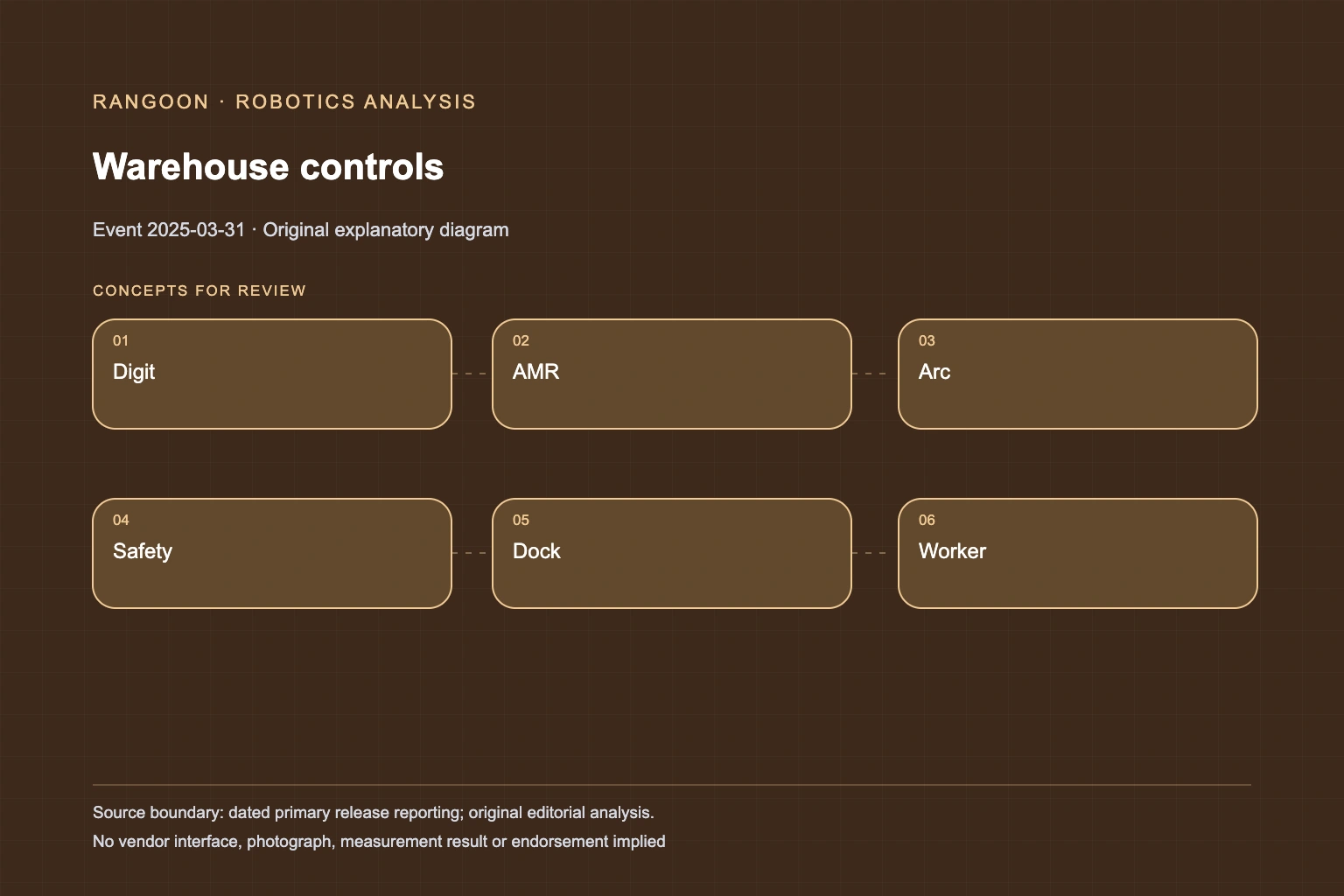
- Agility described Digit changes for power, charging, safety and AMR integration.
- The company separated robot functions from its Arc fleet-management platform.
- Announced features and simulations do not prove every warehouse deployment is safe or productive.
The March release grouped product changes around commercial operation[source 1]
Agility Robotics announced new Digit capabilities on March 31, 2025, including expanded battery operation, autonomous docking, hardware changes, stop functions and integration with autonomous mobile robots. The release frames these items as ways to support customers and fleet deployment. That makes the event a product-and-operation update, rather than a new general-purpose model release. A battery-runtime statement, a docking feature and a safety control each address a different subsystem. The public page does not provide a common test protocol, a customer-by-customer result or an independent comparison with another platform. It therefore supports a bounded account of Agility’s announced capabilities and intended use, not a claim that every facility gained the same outcome.
Stop functions and safety hardware are controls, not proof of a complete safety case[source 1]
The announcement lists a Category 1 stop, safety PLC, on-robot emergency stop, teach pendant and FailSafe over EtherCAT communication. These are concrete engineering controls relevant to industrial automation, and the company describes them as part of a path toward collaborative safety. A list of controls does not disclose a full site-specific risk assessment, validation record, maintenance plan or worker-training programme. Safety depends on the physical layout, payload, speed limits, access controls, fault response and how a machine interacts with other equipment. The article therefore records what Agility announced without inferring regulatory approval, an OSHA finding or a universal safety result. Those conclusions would require specific, dated documentation from the relevant assessment or operating site.
NVIDIA tools provide training context but do not substitute for field validation[source 1][source 2]
Agility’s March 18 NVIDIA release says it was expanding use of Isaac Sim and Isaac Lab to train and test Digit behaviors, and describes work with digital twins for customer deployments. Simulation can help generate and test candidate policies before physical trials, especially for disturbances, facilities and repeated scenarios. It is not itself proof that a behavior will work reliably under a warehouse’s sensing, timing and contact conditions. The later Digit product update should therefore be read with the simulation announcement as context: the company described a development and deployment workflow involving both software and hardware. Neither primary source publishes a full customer acceptance dataset or establishes a result for every workflow listed in marketing materials.
Features, customer deployment and operating results remain distinct evidence states[source 1][source 2]
The March records establish that Agility publicly described new Digit features and a simulation relationship with NVIDIA. They do not establish a fleet-wide commercial outcome, a productivity gain, a safety certification or a customer’s cost result. Claims about AMR coordination are also narrower than a claim that Digit can replace every transport or manipulation system in a facility. Deployments require operational integration with workflows, staff, inventory and existing machines. The archive preserves the product announcement and the stated development context, while leaving field performance to later records that report an environment, task, run period and measured result. This distinction prevents feature lists from being mistaken for customer evidence.
Sources
- Agility Robotics: Announces new innovations for Digit (March 31, 2025)
- Agility Robotics: Expands relationship with NVIDIA (March 18, 2025)
Continue reading
Related reading
 News analysisMercado Libre and Agility announced a Digit agreement beginning with a Texas fulfillment facility3 min read
 News analysisHyundai Mobis publicly detailed an Atlas actuator-supply framework after CES3 min read
 News analysisBoston Dynamics unveiled Atlas as a product at CES, with manufacturing underway and future deployments scheduled3 min read