Tülu 3 treated post-training as a reproducible artifact chain
Ai2 released Tülu 3 on November 21, 2024 with models, data, code, decontamination tooling, and evaluation materials, making recipe changes inspectable research inputs.
Historical reporting: Ai2’s November 21, 2024 technical release post records Tülu 3 and links its artifacts. The linked Tülu 3 report has version history after that event, so this analysis uses the dated release post for November 21 facts and treats the report only as later technical context. Ai2’s reported comparisons and openness claims describe its release materials and methodology, not an independently reproduced score or a guarantee about every derivative model.
Key takeaways
- Tülu 3 made the post-training pipeline, rather than only a final checkpoint, a reviewable part of the release.
- Data curation, decontamination, evaluation templates, and training stages need independent version pins when a team adapts the recipe.
- Open artifacts improve investigation, but held-out task tests are still needed to establish a downstream model’s behavior.
Ai2 released a post-training stack rather than only an instruction checkpoint[source 1]
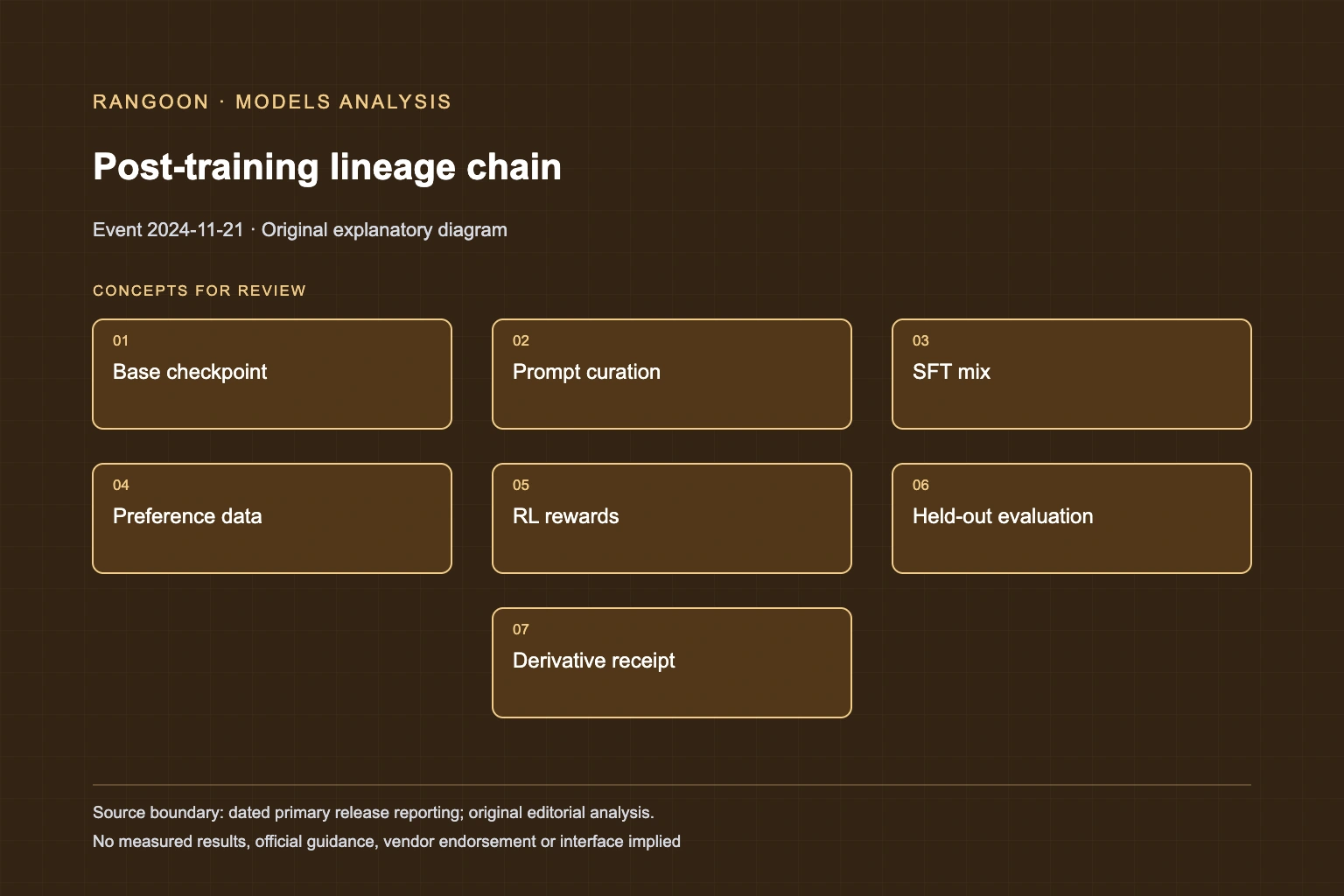
Ai2 published its Tülu 3 technical release on November 21, 2024, describing 8B and 70B models built on Llama 3 Base through a five-part post-training recipe. The post linked model, data, code, evaluation, and decontamination resources and described prompt curation, supervised fine-tuning, preference optimization, and reinforcement learning with verifiable rewards. That release boundary matters because a result can be investigated across artifacts instead of being attributed only to a final model name, and each artifact can be independently versioned with its source and commit. Ai2’s comparison tables remain claims from its stated evaluation suite, prompts, and score definitions, rather than portable scores for a separate task, language, product route, or downstream policy.
The release account names stages that can each change behavior[source 1][source 2]
Ai2 describes Tülu 3 Data, Code, Eval, and Recipe as related parts of the release, with data curation and training infrastructure alongside a reproducible evaluation toolkit. Its five named stages include both off-policy and on-policy Direct Preference Optimization, plus a reinforcement-learning method for skills with verifiable rewards. The linked report is versioned after the launch, so it supplies later technical context and is not used to date or expand the November 21 release facts. A downstream team therefore needs to identify which published stage it retained, changed, omitted, or replaced, along with its data, code, and evaluation revisions, when it describes a derivative.
A post-training change needs its own lineage and test record[source 1]
Tülu 3’s technical interest is that the released recipe makes a derivative easier to explain than a checkpoint alone would. A changed prompt mix, preference source, or reward stage can alter behavior even when the base model name stays the same, because each is part of the five-stage path Ai2 described. That is why an adaptation should identify the stage it changed and compare it with the unmodified path on work held out from the tuning loop. The open chain supports investigation of a result; it does not make two descendants equivalent merely because they begin with the same base checkpoint.
Open release material still requires task-specific confirmation[source 1]
The strongest reproduction exercise isolates one post-training decision at a time. Start with the declared artifact path, then vary a data mix or preference method while keeping the question set and scoring method stable enough to expose the effect of that change. This is especially useful for Tülu 3 because its release connected code, data, evaluation, and decontamination materials instead of presenting a final instruction model as a black box. The November post makes that chain inspectable; it cannot predict how a modified recipe will behave on another product’s inputs or decisions.
Sources
Continue reading