Amazon Nova’s 2024 launch made model-family choice a workload decision
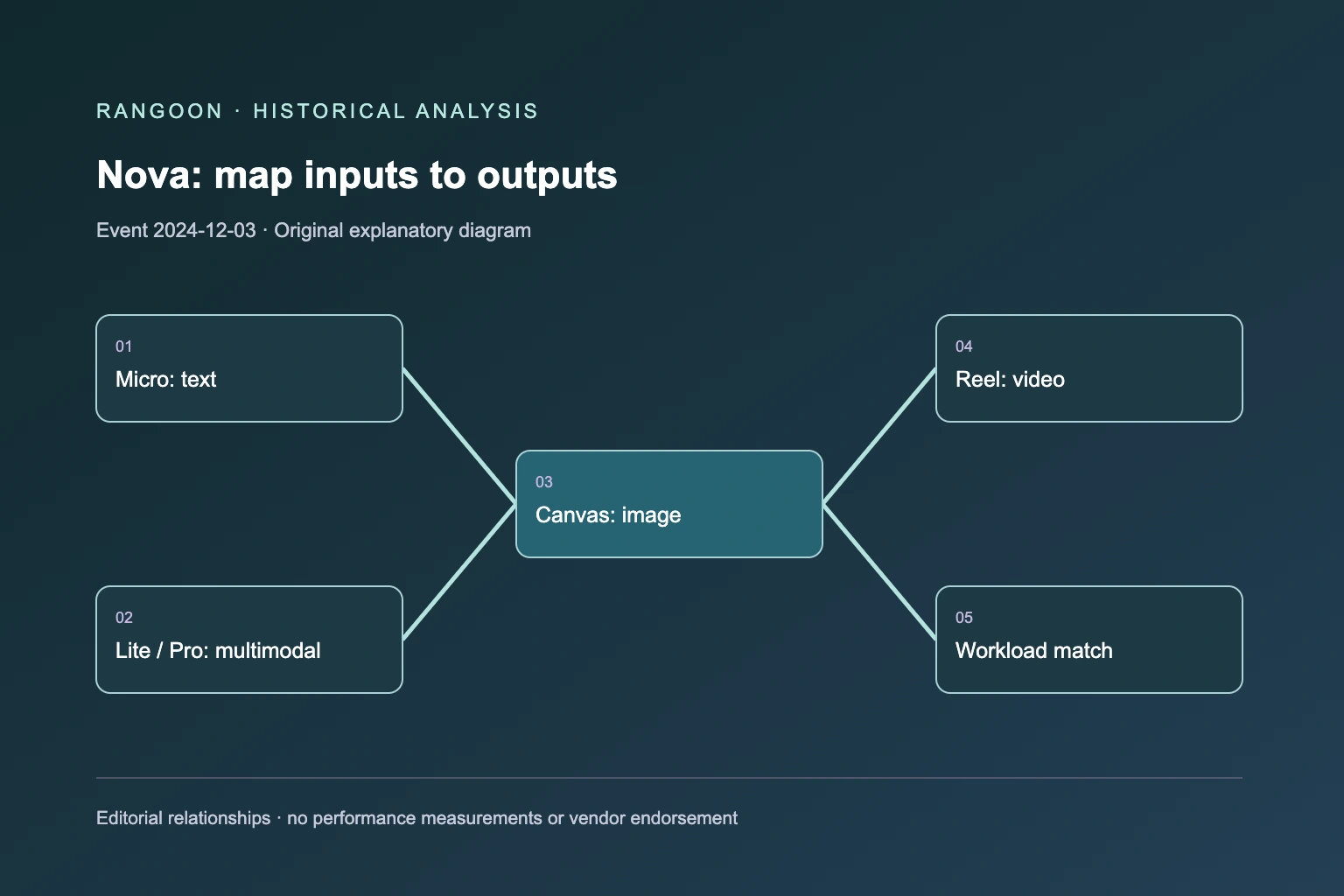
Amazon introduced the Nova family on December 3, 2024. Its text, multimodal, image, and video models made an input-output map more useful than one family label.
Historical reporting: Amazon announced Amazon Nova on December 3, 2024. Amazon’s service-card material describes the text and multimodal family; analysis below is editorial.
Key takeaways
- Amazon introduced Nova as a family whose members had different input and output capabilities.
- A workload should be matched to a specific model capability, not to a family name alone.
- Evaluation fixtures should test the intended modality and reject unsupported input or output paths.
What Amazon announced on December 3[source 1][source 2]
On December 3, 2024, Amazon announced Amazon Nova, a new family of foundation models. Its launch post introduced Nova Micro as a text model and described Nova Lite and Nova Pro as multimodal models that could process text, images, and video to generate text. Amazon also announced Nova Canvas for image generation and Nova Reel for video generation. The announcement placed the family in Amazon Bedrock.
Amazon’s Nova service-card material distinguishes the text-oriented Micro model from Lite, Pro, and Premier, which it describes as taking text, image, and video inputs while generating text completions. Those descriptions explain a family map. They do not establish that every member has the same context, pricing, safety configuration, regional availability, or application fit.
Editorial analysis: a family name is not a capability contract
A model-family label is useful for discovery, but it is too broad for implementation. A document-extraction workflow, a text classifier, an image-creation request, and a video-generation request need different inputs, outputs, validation rules, and downstream handling. Choosing ‘Nova’ without naming the member and expected artifact leaves those boundaries implicit.
A simple capability matrix makes the choice reviewable. For each workload, list input types, expected output type, maximum artifact size, required structured fields, allowed tools, and the fallback behavior. The candidate model is eligible only when its documented interface matches the entire row. A text completion cannot silently stand in for an image artifact, and a video input should not enter a text-only workflow by accident.
Editorial analysis: test the modality boundary
A capability-specific fixture is more revealing than a generic prompt test. For a text-and-image input, include valid files, corrupt files, oversized files, irrelevant images, and a request that should be answered from text alone. For image or video output, inspect the returned artifact type, dimensions, metadata, storage location, and failure state before treating the task as completed.
The test should also record the selected model member and interface revision. That makes it possible to identify whether a changed result follows from a different model, a changed prompt, a different image preprocessor, or a downstream renderer. It prevents a broad family announcement from becoming the only evidence in a production incident report.
Editorial analysis: retain the workload-to-model decision
For each approved use, retain a small selection record: workload purpose, accepted input modalities, output contract, model identifier, evaluation fixture revision, and known exclusions. Review the record when a new family member or interface appears, because a new option may improve a workload without automatically replacing the current one.
The Nova launch’s useful historical lesson is that a portfolio can widen faster than an application’s contracts. Teams get clearer decisions by selecting a narrowly described capability for a narrowly described job, and by keeping the evaluation evidence that justified the match. That evidence should include a rejected candidate when a model’s modality is broader than the workload actually needs.
Sources
Continue reading