Arista’s March 2025 AI suite separated traffic placement from job visibility
Arista introduced its EOS Smart AI Suite on March 12, 2025, pairing Cluster Load Balancing with job-focused observability while separating available and planned software support.
Historical reporting: Arista introduced EOS Smart AI Suite capabilities on March 12, 2025. The company described Cluster Load Balancing (CLB) for RDMA-aware flow placement and CV UNO enhancements intended to combine network, system and AI-job data. Its release separated platform availability, customer trials and scheduled support dates. An Arista data sheet separately describes CLB’s stated flow-placement design. Supplier capability and efficiency language is not an independent customer benchmark or proof of job-completion results.
Key takeaways
- Arista framed CLB as a specific traffic-placement feature and CV UNO as a separate job-observability capability.
- The release distinguished features available that day from customer trials and platform support scheduled later in 2025.
- Supplier statements about efficiency and job outcomes do not establish measured results for a named AI cluster.
The March release paired placement software with a separate visibility layer[source 1][source 2]
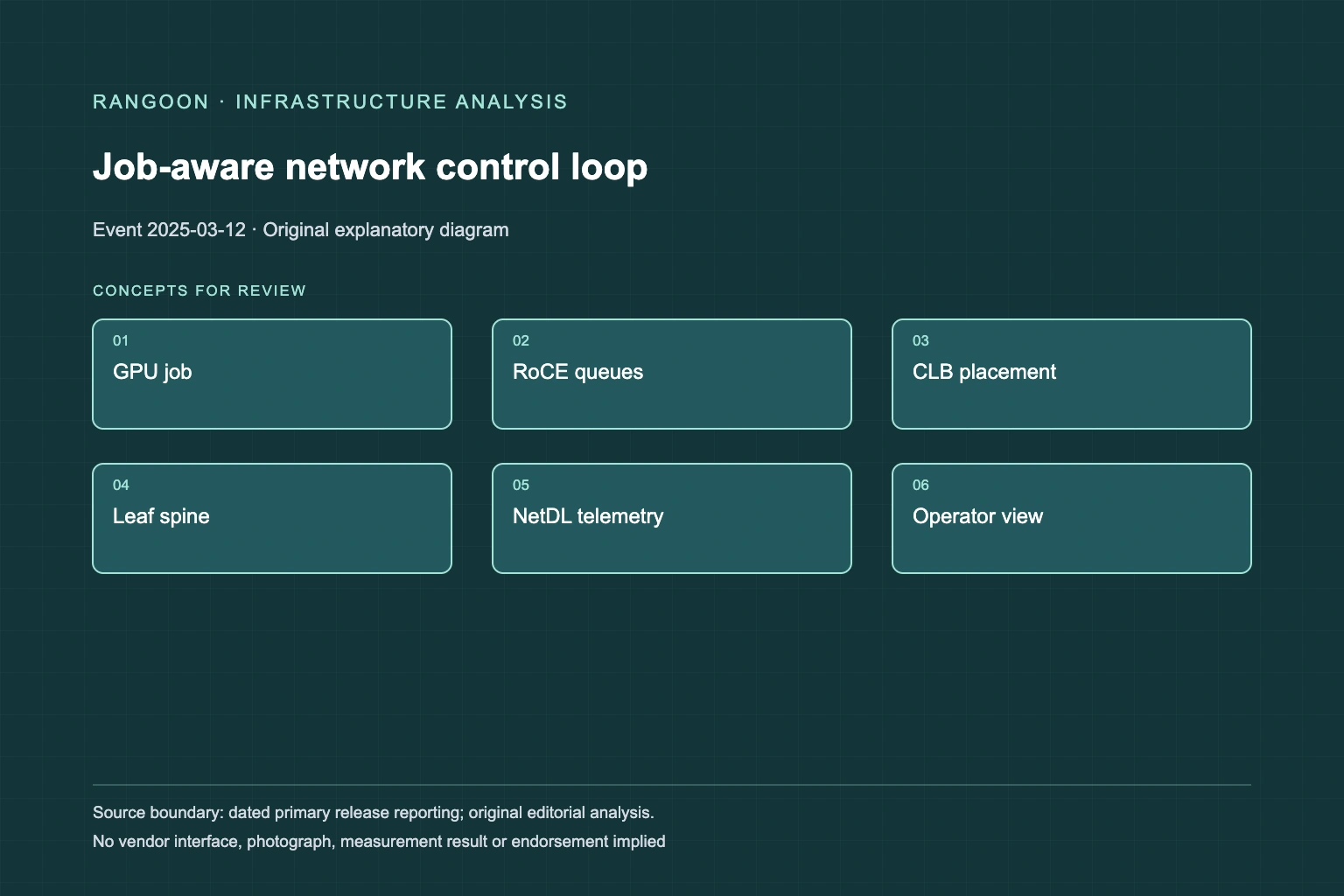
On March 12, 2025, Arista introduced what it called the EOS Smart AI Suite. The release paired Cluster Load Balancing, or CLB, with additions to CloudVision Universal Network Observability, branded CV UNO. Arista described CLB as an Ethernet AI load-balancing feature based on RDMA queue pairs, while it described CV UNO as a way to view network, system and AI-job data together. The pair matters because traffic selection and operations visibility solve related, but distinct, problems in an accelerator cluster.
The launch did not announce a new general-purpose AI platform in isolation. It identified a set of software capabilities around an existing network environment. Arista said its data-lake and telemetry tooling could expose job-health metrics, congestion indicators and device or server signals. Those are supplier descriptions of the intended operating model. They do not establish that a customer had deployed the complete suite, that operators fixed a particular incident through it, or that a job reached a measured completion target.
CLB was described as RoCE-aware flow placement across the fabric[source 1][source 2]
Arista said CLB uses RDMA-aware flow placement to balance large flows in both leaf-to-spine and spine-to-leaf directions. A separate Arista data sheet describes CLB as using RDMA queue pairs for global flow placement. That gives the announcement a more concrete mechanism than a generic promise to make AI networking faster: the feature is tied to the routing of GPU-cluster communication flows.
Mechanism alone does not predict a uniform workload result. A cluster’s behavior also depends on its NICs, drivers, congestion controls, topology, routing settings, model communication pattern and failures. The data sheet describes a feature, not a controlled comparison with alternative fabrics. It cannot show that CLB reduced tail latency, raised throughput or shortened job time for every deployment. The March record supports a bounded statement about the capability Arista announced and documented, while a performance claim needs a named test and method.
Availability varied by platform and by observability feature[source 1][source 2]
The announcement gave different readiness states for different parts of the suite. Arista listed CLB as available that day on several 7260X3, 7280R3, 7500R3 and 7800R3 platforms, while it scheduled support on 7060X6 and 7060X5 for the second quarter of 2025 and 7800R4 for the second half. That is a product-support timetable, not evidence that each listed customer configuration had been qualified or put into production.
Arista also said CV UNO was available, but the AI observability enhancements were in active customer trials, with general availability scheduled for the second quarter. These status distinctions are material. A trial is not general availability, and planned support is not shipment or deployment. Preserving them prevents a later reader from treating a supplier roadmap as a March 12 operating outcome. The source supports an announcement about staged software support, not a claim that all AI-focused functions were ready across every platform.
Supplier outcome language did not replace an independent cluster measurement[source 1][source 2]
Arista used outcome-oriented language about performance, efficiency and troubleshooting. Such statements explain the problem the vendor aimed to solve, but they are not independent benchmarks. A useful comparison would identify the model, framework, collective pattern, accelerator and NIC configuration, fabric size, software versions, fault conditions and measurement method. Without those controls, a reported improvement can reflect the workload or configuration as much as a portable property of one network feature.
The March 2025 event is therefore best understood as a software-and-observability announcement with explicit staging. It announced CLB, described an AI-job visibility direction and named platform support dates. It did not demonstrate a customer’s end-to-end result, establish universal interoperability or replace the need for network design and validation. Later releases, benchmarks and customer deployments can add evidence, but they are separate dated events. This article keeps Arista’s contemporaneous claims, the support documentation and the missing independent measurement in view together.
Sources
Continue reading