

Cisco and NVIDIA proposed a two-silicon route into enterprise AI fabrics
Cisco announced an expanded NVIDIA partnership on February 25, 2025, proposing Cisco Silicon One and NVIDIA Spectrum-X paths under common enterprise networking operations.
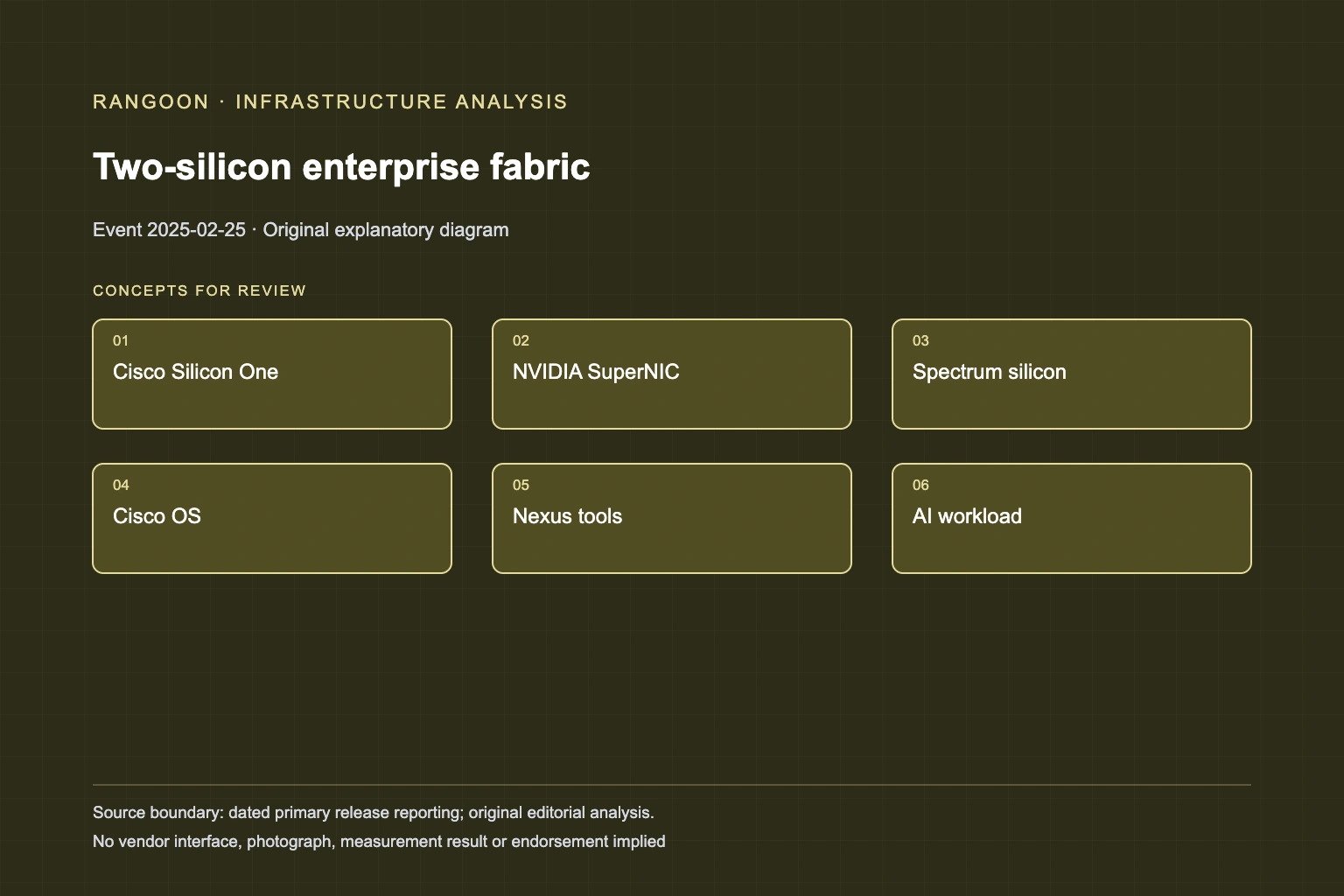
Historical reporting: Cisco announced an expanded partnership with NVIDIA on February 25, 2025. Cisco said the proposed relationship would make Cisco Silicon One with NVIDIA SuperNICs part of the NVIDIA Spectrum-X Ethernet platform and would pair NVIDIA Spectrum silicon with Cisco operating software. A same-day Cisco executive post describes the proposed architecture in more detail. The announcement did not establish a generally available combined product, universal interoperability, a customer deployment or benchmarked AI-network performance.
Key takeaways
- Cisco announced a proposed architecture and partnership path, not a completed enterprise deployment.
- Cisco Silicon One with NVIDIA SuperNICs and Cisco systems with NVIDIA Spectrum silicon were separate implementation options.
- Common operations tooling does not prove that all hardware, software and traffic configurations interoperate without qualification.
The February announcement described a planned enterprise architecture[source 1][source 2]
On February 25, 2025, Cisco announced plans to expand its NVIDIA partnership for enterprise AI technology solutions. Cisco said the relationship would bring Cisco Silicon One and NVIDIA Spectrum-X Ethernet together, giving customers choices around networking silicon and operations. The release used future-oriented language about what the companies would offer. That makes the news a partnership and architecture announcement, rather than evidence that an enterprise had already installed a combined fabric or that the proposed integration was broadly available.
Cisco’s same-day executive post laid out two intended paths. In one, Cisco Silicon One coupled with NVIDIA SuperNICs would become part of the Spectrum-X Ethernet platform. In another, Cisco would build systems combining NVIDIA Spectrum silicon with Cisco operating software. These are related but distinct designs. A shared announcement does not turn their hardware, operating-system, management-plane and support conditions into one interchangeable product. The useful historical fact is the proposed compatibility direction and the components named by Cisco, not a claim that every possible deployment had been validated.
AI fabric behavior depends on more than switch silicon[source 1][source 2]
A high-performance AI network joins accelerators, network interfaces, switches, optics, cables, drivers, routing and congestion-control behavior. Cisco’s announcement focused on how Cisco networking capabilities and NVIDIA Ethernet technology could be combined, including Cisco Silicon One, NVIDIA SuperNICs and NVIDIA Spectrum silicon. Those components establish a design space, but an AI workload experiences the complete system. Packet size, collective-communication library, oversubscription, topology, traffic mix, firmware and failure handling can each change observed throughput or job duration.
The source described flexibility and choice as benefits for enterprise data-center investment. That is a supplier proposition, not a universal performance result. An organization still has to select hardware, establish compatibility across releases, test congestion and failure behavior, and operate the management and security model it chooses. A common Nexus software stack can reduce operational variation for some designs, while it does not by itself show a particular configuration met workload requirements. The distinction matters because “AI networking” can sound like one component when it is a system-level result.
Partnership intent and product availability had different dates[source 1][source 2][source 3][source 4]
The February materials did not establish a generally available Cisco switch using NVIDIA Spectrum-X silicon or a completed Spectrum-X license integration for every Cisco platform. In June, Cisco said it had shown a first technical integration of Cisco G200-based switches and NVIDIA NICs at Cisco Live. In an October post, Cisco separately described a reference architecture and early November orderability for an N9100-based design and Nexus Hyperfabric AI. Those are later Cisco claims and milestones, not February availability. A buyer evaluating a network needs the orderable model, software release, supported NIC, support boundary and validation status for the date of purchase.
This timing distinction also applies to product comparisons. A proposed architecture can name a target design before suppliers publish performance figures, deployment guidance or customer references. Vendor diagrams and planned reference architectures may explain intended data paths, but they do not independently prove end-to-end latency, loss behavior or model-training speed. The February event supports reporting that Cisco and NVIDIA planned to extend their relationship around specified networking components. It does not support a claim that a named enterprise received the promised choice or performance at announcement time.
Enterprise suitability required workload-specific proof after the announcement[source 1][source 2][source 3][source 4]
An enterprise AI fabric has to work with the operator’s security controls, existing network domains, automation practices and application traffic. Those are not resolved by a partnership logo or a supplier’s stated compatibility direction. A test should name the accelerator and NIC versions, switch model and operating software, topology, congestion-control settings, collective library, workload and measurement window. Without those particulars, a claim of better AI performance remains a general supplier assertion rather than a portable operating result.
The February announcement remains important because it documented an attempt to combine Cisco’s enterprise networking estate with NVIDIA AI-networking components. Its practical implication was optionality to be evaluated, not a guaranteed outcome. The June demonstration and October orderability statements are later historical records with their own dates and supplier framing. That sequence prevents a reader from confusing a partnership announcement with a delivered network, and it keeps the difference between a design reference, a qualified system and a customer deployment visible.
Sources
- Cisco: expands partnership with NVIDIA for enterprise AI (February 25, 2025)
- Cisco executive post: Cisco and NVIDIA unite to propel AI into the enterprise (February 25, 2025)
- Cisco: AI-ready data-center announcement (June 10, 2025)
- Cisco executive post: AI networking innovation with NVIDIA (October 28, 2025)
Continue reading
Related reading
 News analysisNVIDIA’s memory codesign post highlights a practical boundary between capacity and usable agent throughput3 min read
 News analysisNVIDIA supply-chain capacity plans make packaging, test and optics explicit infrastructure constraints3 min read
 News analysisThe Ultra Ethernet Consortium released its 1.0 AI-networking specification3 min read