

The Ultra Ethernet Consortium released its 1.0 AI-networking specification
The Ultra Ethernet Consortium released Specification 1.0 on June 11, 2025, defining an Ethernet-based stack for AI and HPC across hosts, switches and links.
Historical reporting: UEC's dated announcement establishes the June 11 Specification 1.0 release. An officially hosted, sponsored UEC 1.0 white paper was freshly read as technical context; publication does not establish multi-vendor deployment or workload performance.
Key takeaways
- UEC 1.0 created a dated public stack specification rather than announcing a single network product.
- Its stated scope spans transport, congestion control, DMA, link/PHY technology and security across an Ethernet system.
- Interoperable specification status still needs component, firmware and collective-workload validation.
UEC 1.0 made an Ethernet communication stack a public record[source 1][source 2]
On June 11, 2025, the Ultra Ethernet Consortium announced Specification 1.0 as an Ethernet-based communication stack for AI and HPC. The announcement says the scope reaches NICs, switches, optics and cables rather than a single device layer. That is the event this archive records. It is meaningful because AI clusters depend on the path between accelerators as well as the accelerators themselves. It does not establish that every Ethernet product is a UEC implementation, that every component interworks, or that an existing cluster changed behavior on the publication day.
The released work reached several interdependent network layers[source 1][source 2]
UEC's announcement names modern RDMA over Ethernet and IP, routing, provisioning, operations, testing, transport protocols, congestion control, direct memory access, Ethernet link and PHY technologies, and network security. The officially hosted sponsored white paper describes UEC 1.0 around a new Ultra Ethernet Transport, sender-based congestion control, and work across physical, link, software, storage, compliance, management and performance/debug groups. This identifies a stack-level change rather than a switch-chip release. The white paper is technical context from a sponsored source, so its performance-oriented language is not treated as an independent result or a conformance statement.
Open interoperability claims require a complete path test[source 1][source 2]
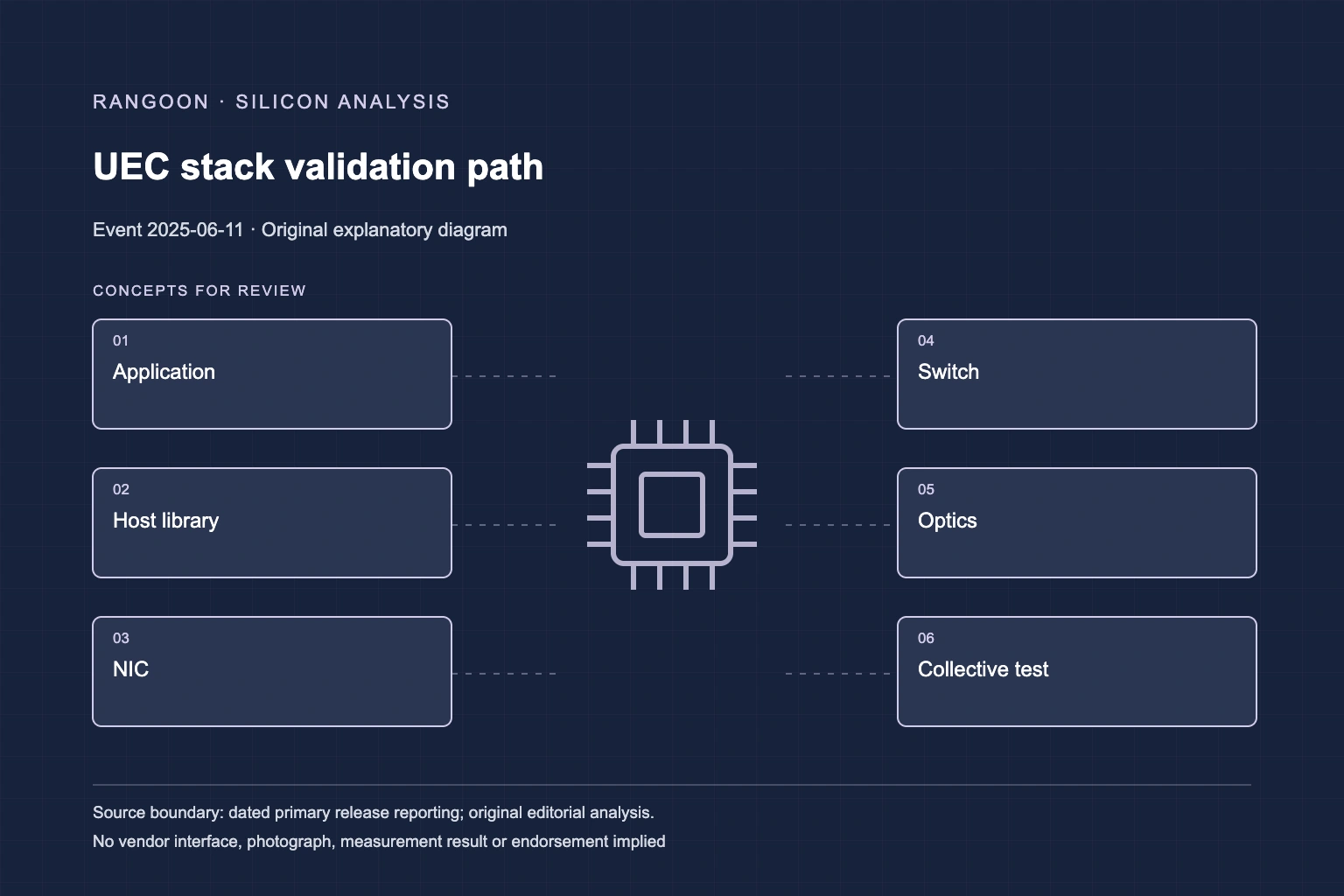
The consortium presents multi-vendor interoperability as a goal and says implementations and compliance work were in progress. That wording distinguishes a public standard from a demonstrated mixed-vendor fabric. A useful test plan selects the NIC, switch, optics, host driver and firmware versions, then exercises congestion, packet loss, path failure, retries and all-reduce-like traffic. It should capture both steady-state throughput and tail behavior because load-balancing and congestion choices can affect distributed jobs differently from ordinary client-server flows. Publication does not remove the need for this system-level evidence.
The release set an interface baseline while implementation work remained active[source 1][source 2]
The June announcement calls 1.0 a public release and says active implementations and compliance programs were already in progress. That is a specific status combination: a published communication-stack baseline with implementation and certification work continuing around it. Its value is not a generic promise of faster Ethernet; it is the definition of a common target across NICs, switches, optics and cables. The white paper's focus on transport, sender-based congestion control and collective-style multi-flow traffic explains why UEC is more than a bandwidth label. It also explains why later product claims must name the applicable UEC release and the implemented layer instead of treating the consortium's publication as a completed system result. The release announcement itself places the work across routing, provisioning, operations and testing, so its scope extends beyond packet forwarding. Security appears in that announced stack as well.
Sources
Continue reading
Related reading
 News analysisNVIDIA’s memory codesign post highlights a practical boundary between capacity and usable agent throughput3 min read
 News analysisNVIDIA supply-chain capacity plans make packaging, test and optics explicit infrastructure constraints3 min read
 News analysisSingapore’s digital minister linked national supercomputing, enterprise compute and quantum research at SCA20253 min read