

Arm’s Lumex launch made on-device AI a CPU, GPU, system-IP and software-stack choice
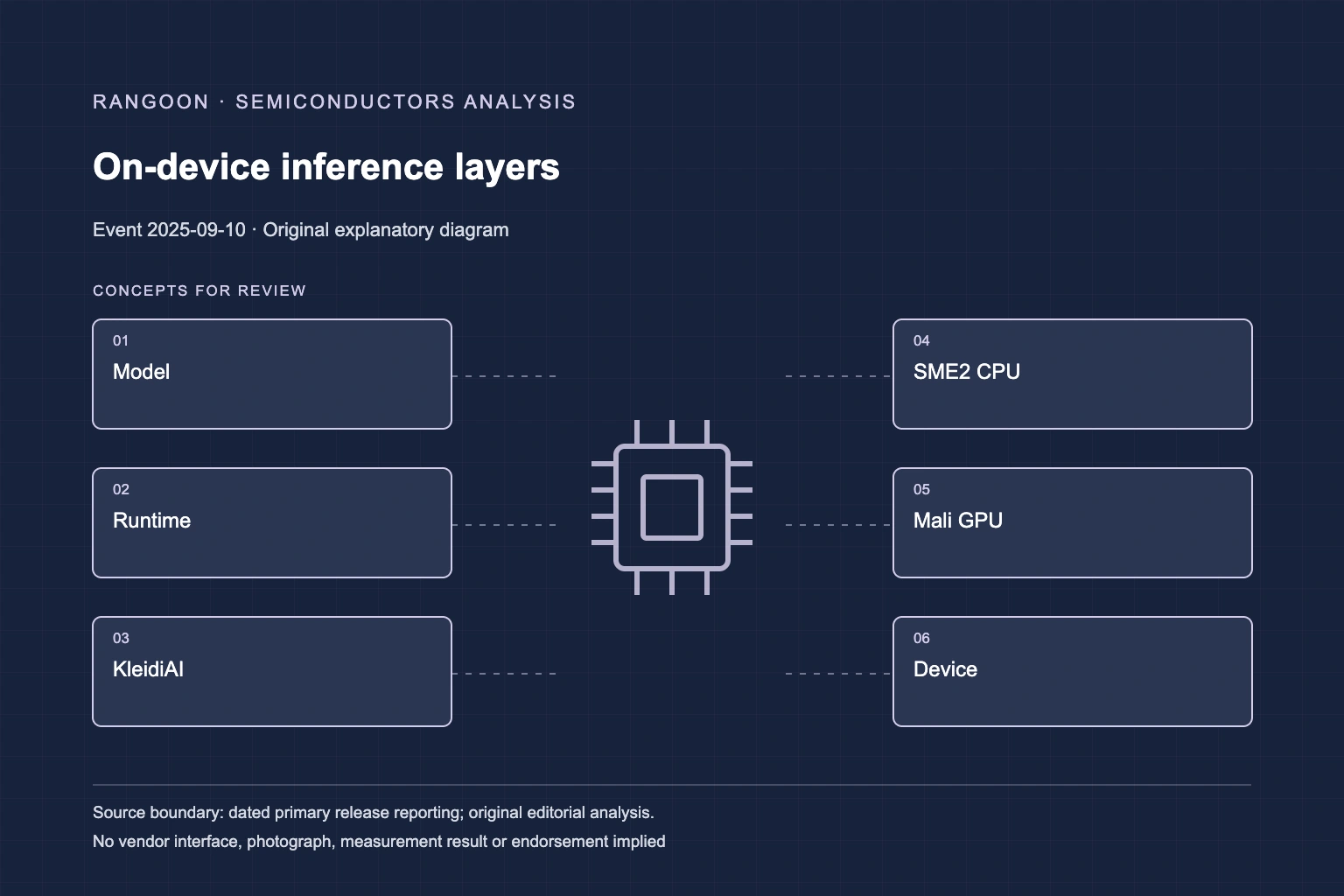
Arm announced Lumex on September 10, 2025, a partner SoC platform joining SME2 C1 CPUs, Mali G1 GPUs and KleidiAI software.
Historical reporting: Arm introduced the Lumex compute-subsystem platform on September 10, 2025. Arm’s same-day C1 technical blog describes the Armv9.3 C1 CPU cluster, SME2 and specific framework paths. Together, the sources describe Mali G1 GPUs, a C1 DSU, 3nm physical implementations and KleidiAI software integration. The sources say partners can use a delivered platform or configure RTL and harden cores for targeted tiers. Arm’s speed, latency, power, application and ecosystem figures are supplier claims under named conditions; the sources did not establish that a particular handset, PC, model, operating system or application had shipped with Lumex or would reproduce those figures.
Key takeaways
- Lumex was a platform-IP announcement for partner SoCs, not a retail device launch or proof that a named phone had the announced hardware.
- The source joined CPU matrix extensions, GPU acceleration, system IP and software libraries, making local AI performance a cross-layer question.
- Arm’s published uplifts remain vendor results tied to stated workloads and comparisons, not a portable performance promise.
Lumex was a compute-subsystem release for partner silicon, not a finished consumer product[source 1][source 2]
On September 10, 2025, Arm introduced Lumex as a compute subsystem, or CSS, platform for flagship smartphones and next-generation PCs. The announcement groups high-performance CPUs with Scalable Matrix Extension 2, GPUs and system IP. That wording is important because Arm was describing a configurable platform that silicon partners could build into their own systems-on-chip, not a named consumer device on a store shelf. Arm said partners could take the platform as delivered or configure the platform RTL for a targeted tier and harden the cores themselves. Those are distinct implementation paths with different physical design and integration work. The release supports reporting a new Arm platform and its declared components. It does not establish which eventual chip, device, operating system or application combination had reached customers on that date.
The announcement put CPU, GPU and shared-system design on one local-inference path[source 1][source 2]
Arm listed an Armv9.3 C1 CPU cluster with SME2, the C1-DSU shared unit and the Mali G1-Ultra GPU as Lumex components. It positioned the CPU cluster for AI work, while also giving the GPU a separate AI-performance role beside graphics and ray tracing. This is a useful architecture boundary: an on-device workload can move through CPU operators, matrix extensions, GPU kernels, shared memory and runtime libraries rather than being defined by a single TOPS figure. Model size, quantization, memory pressure, input modality, thermal envelope and scheduler behavior can all decide which component becomes limiting. A platform announcement says what options a future integrator may have; it does not show an exact execution trace for a particular local model. Teams should measure their real model and device configuration instead of treating a component list as a benchmark result.
KleidiAI and framework integration connected instruction support to application behavior[source 1][source 2]
Arm said developers could access SME2 performance through KleidiAI integrations in PyTorch ExecuTorch, Google LiteRT, Alibaba MNN and Microsoft ONNX Runtime. This makes software availability part of the hardware story. An instruction-set extension may exist in a CPU, but a model benefits only when the selected runtime, operators, build, quantization route and device configuration actually use it. Arm also said applications could benefit without code changes in some integrations, which describes a desired library path rather than a universal compatibility statement. A developer still needs to pin the framework and runtime version, inspect delegated operators, measure fallbacks and test numerical behavior across devices. The September record supports Arm’s stated software integration. It does not prove every graph uses SME2, that all operators are accelerated or that a later platform release preserves the same behavior.
Published speed and efficiency uplift claims stayed within Arm’s named comparisons[source 1]
Arm reported up to five-times AI-performance uplift, 4.7-times lower latency for speech workloads and 2.8-times faster audio generation for the C1 CPU cluster. It also reported specific application and partner figures elsewhere in the release. These are supplier claims about the configurations and comparisons Arm selected, so they should not be collapsed into a device-independent claim about every model. A speech workload may have different prompt lengths, audio preprocessing, model precision, concurrency and thermal behavior from an image model or a background assistant. Device makers can also choose different core mixes and power targets within a platform family. The historical conclusion is narrower: Arm announced a platform with specific claimed results and an intended local-AI direction. Product selection requires model-level testing, sustained-performance measurement and current availability evidence from the actual silicon and device supplier.
Sources
Continue reading
Related reading
 News analysisNVIDIA’s memory codesign post highlights a practical boundary between capacity and usable agent throughput3 min read
 News analysisIntel’s Crescent Island announcement made a future inference GPU a roadmap record, not available capacity3 min read
 News analysisBlackwell Ultra made inference infrastructure a rack-scale planning problem3 min read