

NVIDIA’s memory codesign post highlights a practical boundary between capacity and usable agent throughput
NVIDIA’s November memory overview frames HBM, KV cache and retrieval data as a hierarchy; operators still need workload-level measurement before capacity claims.
Historical reporting: NVIDIA published this product-and-architecture overview on November 5, 2026. Its performance comparisons, platform descriptions and partner references are vendor claims tied to named conditions, not independent results or guarantees for another model, workload, price or deployment.
Key takeaways
- More HBM alone does not establish more useful agent throughput when bandwidth, cache behavior and response targets constrain the workload.
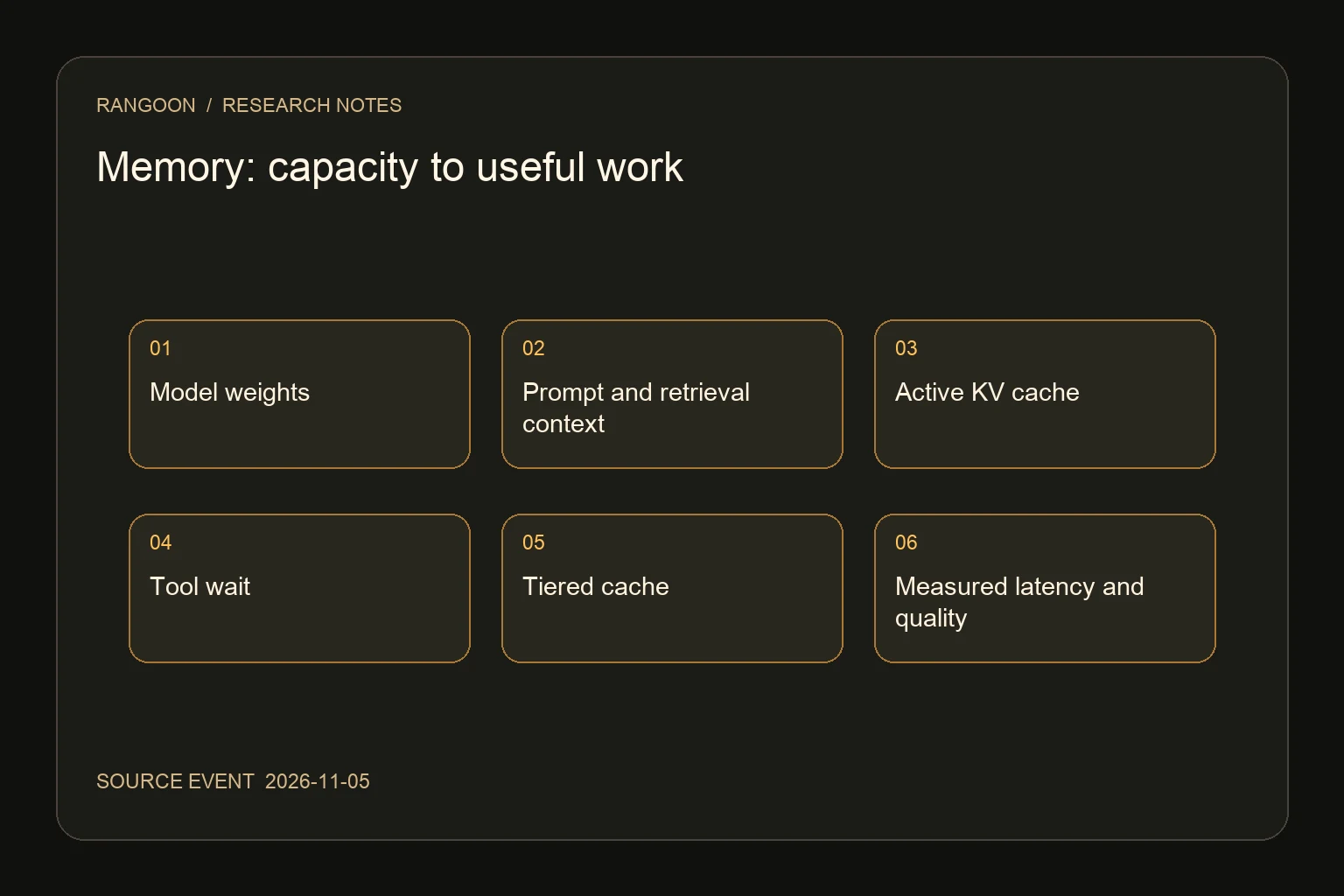
- Measure model weights, active KV cache, retrieval context and offload behavior separately before treating a memory change as an efficiency gain.
- A capacity plan needs an explicit service-level target; tokens per dollar cannot replace latency, failure and data-handling requirements.
What NVIDIA’s overview describes[source 1]
NVIDIA’s November 5 overview describes rising GPU-memory pressure from larger models, longer contexts and repeated agent tool calls. It identifies model weights and KV cache as competing users of high-bandwidth memory during inference, while retrieval workloads add context that must be processed and retained. The post argues for a hierarchy across GPU memory, CPU memory, local or shared storage, plus software that places and reuses data across those tiers. It presents NVFP4 compression, multi-GPU weight distribution, cache movement and retrieval indexing outside HBM as parts of that approach. These descriptions explain NVIDIA’s design position; they do not establish the same behavior for every framework or model.
The post also reports platform-specific comparisons under named SemiAnalysis AgentX workload conditions.
Analysis: platform comparisons need local acceptance tests
Such results can inform a benchmark plan, but they do not answer a buyer’s own concurrency, tool-latency, document-retrieval or cost question. Agent traces vary: one workflow may retain a short chain of tool outputs while another carries substantial evidence, code and retrieved material through many turns. A model server can show ample nominal memory yet fail its response objective because data movement or cache contention becomes the limiting resource.
Analysis: measure memory by workload phase
Treat memory as a workload budget, not a device specification. For each representative request, record weight residency, prompt tokens, generated tokens, active KV-cache bytes, retrieval payload, concurrency, tool-wait time and tail latency. Split the trace into prefill, decode, tool wait and resume phases. That exposes whether an apparent capacity problem is a long prompt, an idle cache during an external call, a retrieval design that sends too much text, or insufficient bandwidth at target concurrency. Without phase-level traces, a hardware upgrade can conceal a software bottleneck until usage grows.
Run changes against a fixed acceptance set. Hold model version, serving configuration, request mix and service objective constant while comparing cache quantization, offload policy or retrieval chunking. Capture quality checks alongside throughput. Aggressive compression or eviction can improve a utilization number while degrading task completion, citation quality or recovery after a tool failure. The result should state workload, hardware, software build, precision, cache policy and failure conditions, so another team can judge transferability.
Sources
Continue reading
Related reading
 News analysisBlackwell Ultra made inference infrastructure a rack-scale planning problem3 min read
 News analysisNVIDIA supply-chain capacity plans make packaging, test and optics explicit infrastructure constraints3 min read
 News analysisNVIDIA introduced NVLink Fusion for semi-custom AI infrastructure3 min read