

Brave launched Ask Brave as a search-and-chat interface with a separate Deep Research path
Brave launched Ask Brave on September 29, 2025, combining web search, conversational follow-ups and optional longer Deep Research sessions.
Historical reporting: Source 0 is Brave’s dated Ask Brave launch announcement. Source 1 is Brave Search’s current help record for conversation sharing and retention, used only as later privacy and storage context. It is not launch-date proof and does not establish that terms were identical on September 29, 2025.
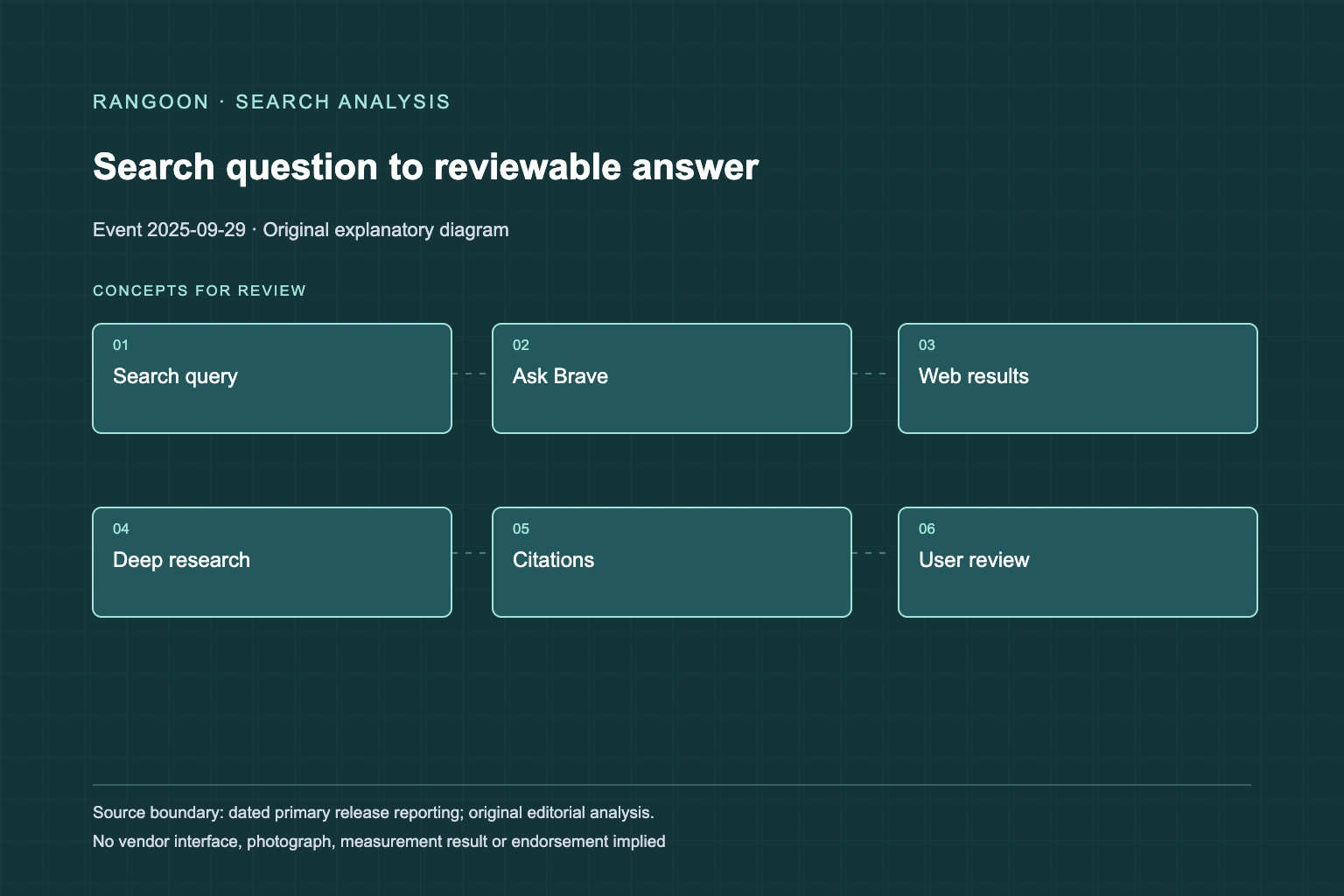
Key takeaways
- Brave launched Ask Brave on September 29, 2025 as a free search-and-chat interface available from the Brave Search homepage and results page on any browser or platform.
- The announcement separated short AI Answers from longer Ask Brave results and described an optional Deep Research method using repeated searches against Brave’s own index.
- Web-grounded responses and temporary chats can aid exploration, but citations, retrieval coverage, privacy and generated recommendations still need task-specific review.
Brave put a chat path beside conventional web search[source 1]
Brave launched Ask Brave on September 29, 2025 as a single interface joining search and AI chat. Its announcement said Ask Brave was available from the Brave Search homepage and at the top of search results, free on any browser or platform. Brave positioned the feature as a route for detailed questions and follow-up exchanges, while retaining AI Answers for quicker summaries. This framing matters because a longer conversational result is not the same product behavior as a compact answer attached to a search result. The announcement establishes the claimed entry points and supplier framing of the feature. It does not establish that every query received the same search coverage, that a conversational response was correct, or that access and behavior would remain constant after the launch rollout.
The product described a distinct longer research path[source 1]
For topics where thoroughness mattered more than speed, Brave described an Ask Brave Deep Research technique. The company said it used multiple rounds of search against its index, designed to issue dozens of queries and analyze thousands of pages while seeking blind spots. It also presented a SimpleQA accuracy figure as a supplier benchmark claim. That is useful technical product context, but it has clear limits. A large retrieval count cannot show which sources were selected, whether their dates and authority fit the question, or whether the synthesis preserved crucial qualifications. The benchmark figure is not a substitute for independent evaluation of a user’s question. For consequential work, the user should still inspect citations, open primary sources and keep the claim boundaries visible in the final document.
Search entry points and opt-out status shaped user control[source 1]
The launch described three routes into Ask Brave: ending a default-search query with double question marks, pressing an Ask button in the search field, or choosing an Ask tab on a results page. It also said all AI features in Brave Search were optional and could be turned off in settings. Those details make the interface a user-invoked search tool, not a background process that silently replaces ordinary search. They do not answer every governance question. A user must still decide what to enter in a prompt, whether the task contains confidential material, and which recommendation deserves verification. Optional use can reduce exposure, but it does not turn a prompt into a harmless input or a generated answer into an approved outcome.
Current help clarifies a retention boundary without rewriting history[source 2]
Brave’s current conversation-sharing help page gives later operating context. It says that requests must be processed on servers, conversation state is kept for the session and automatically erased after 24 hours of inactivity, while a shared conversation can be stored for up to seven days. It also describes encryption and local storage of an encryption key. The page is undated and explicitly later context, so it cannot prove the precise September 2025 implementation. It does show why privacy statements should be recorded with a date and checked before sensitive use. A research feature’s grounding claim, chat retention policy and sharing controls are separate properties. Each needs its own source and cannot be inferred from a launch post alone.
Sources
- Brave: Introducing Ask Brave (September 29, 2025)
- Brave Search Help: Sharing conversations with AI
Continue reading
Related reading
 News analysisAnthropic donated Agent Skills to AAIF: treat open governance as a new supply-chain input3 min read
 News analysisZoom released AI Companion 2.0 as a cross-Workplace context and action surface3 min read
 News analysisZendesk’s 2025 Resolution Platform joined service agents, knowledge, actions and QA3 min read