

Claude Code’s GitHub Actions path made CI a distinct agent execution environment
Anthropic’s May 22, 2025 announcement placed Claude Code background tasks in GitHub Actions, creating a separate automation and review boundary.
Historical reporting: the cited May 2025 Anthropic materials describe GitHub Actions support. This is not a current CI configuration or security review.
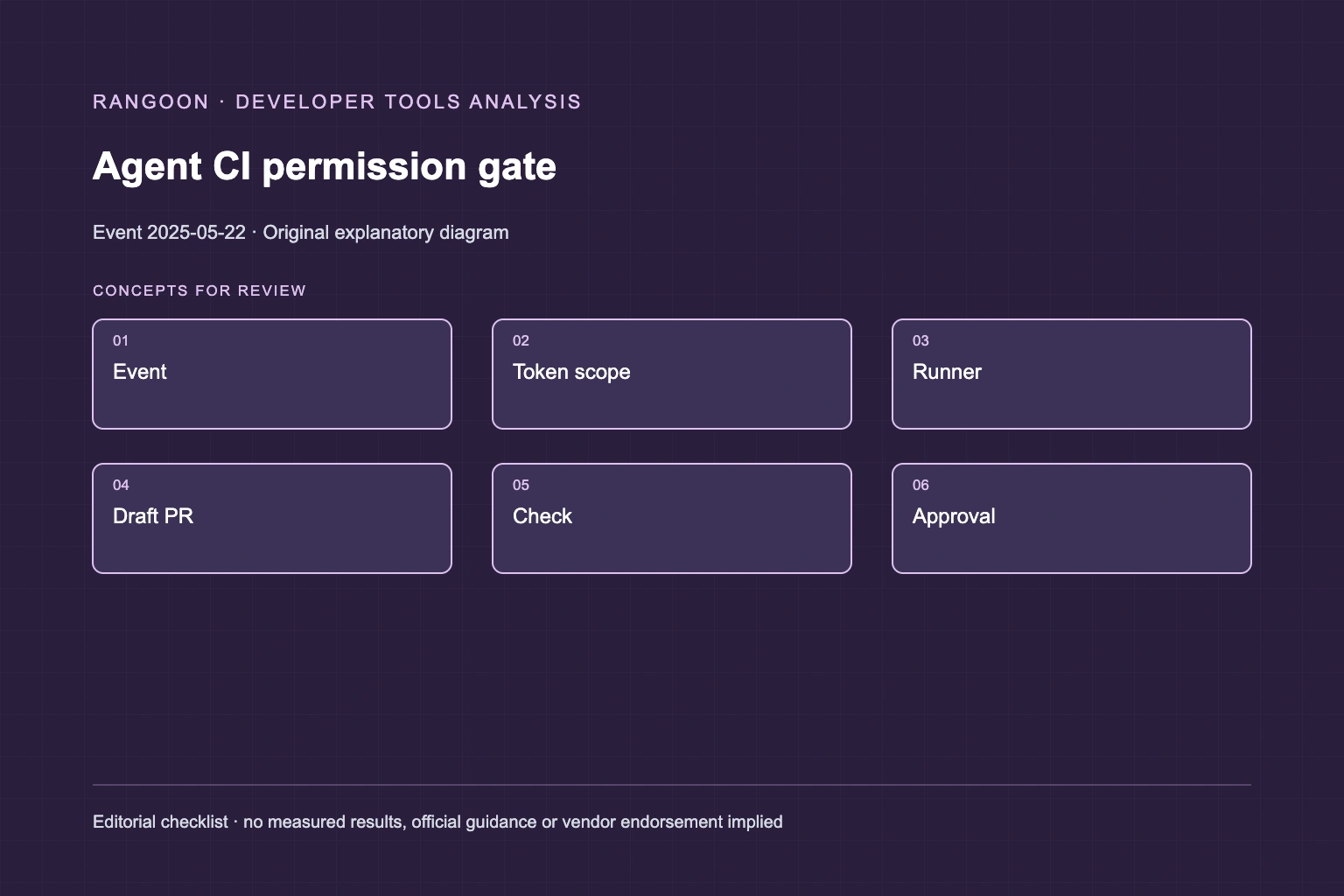
Key takeaways
- CI agents inherit workflow permissions, not developer intent.
- Generated pull requests need ordinary branch protection checks.
- Logs should show the action identity and available secrets.
The launch connected background coding tasks to an automation substrate[source 1][source 2]
Anthropic’s Claude 4 announcement on May 22, 2025 says Claude Code supported background tasks through GitHub Actions. Anthropic’s February announcement had introduced the terminal tool as a limited research preview for delegated engineering tasks. The difference matters because a local terminal and a CI workflow do not share the same identity, filesystem, secrets or network conditions. The announcement documents product scope, not the safety of any workflow assembled later by a repository owner.
A workflow token is an authority boundary, not a convenience detail[source 1][source 2]
A GitHub Actions run may receive repository contents, event data, tokens, caches, artifacts and environment variables. Before wiring an agent to that runner, define its trigger, permissions, branch target, checkout ref, write capabilities and whether it can cause a later deploy. Avoid giving a task-writing agent a token that can merge, release or modify unrelated workflows. The agent’s natural-language instructions are not a substitute for job-level permission restrictions.
Require a dry-run receipt before a write-capable workflow[source 1][source 2]
Start with a pull-request-triggered dry run that reports intended paths, commands and missing prerequisites without changing the branch. Then run a fixed fixture that validates the action cannot read an excluded secret, cannot write outside the task branch and produces a visible failure when tests fail. Store workflow run identifiers with the agent’s proposed patch. An approval step should occur before any workflow that can alter protected references, publish artifacts or contact external services.
Analysis: CI turns a code assistant into part of the delivery system[source 1][source 2]
Editorial analysis: the relevant question is less whether an agent can emit a patch and more which trusted automation will execute around that patch. Keeping the Actions job narrow makes failures diagnosable and rollback straightforward. A well-designed integration lets an agent prepare a change while repository policy, code owners and release controls remain independent decision points.
The May announcement placed Claude Code beside Claude Opus 4 and Sonnet 4, and described extended thinking with tool use plus parallel tool calls. In an Actions workflow, those capabilities run within the permissions, checkout and network reach of the job, not inside a separate product boundary. A precise workflow design must therefore set event-specific token permissions, pin the action revision, and distinguish a pull-request event from a trusted branch event before an agent receives repository write access.
The job should expose its checked-out SHA, command transcript and produced diff so a reviewer can reproduce the exact candidate. A cache is another execution input: key it to the repository and dependency lockfile, then avoid sharing it across trust levels. The release establishes capability; the workflow file defines what that capability can reach.
Background tasks through Actions therefore inherit runner images, checkout depth and artifact retention, each of which can alter a reproducibility claim.
Sources
- Anthropic: Introducing Claude 4 (May 22, 2025)
- Anthropic: Claude 3.7 Sonnet and Claude Code (February 24, 2025)
Continue reading
Related reading
 News analysisClaude Code’s general availability joined a model launch to a developer workflow claim3 min read
 News analysisClaude 3.7 Sonnet made thinking budget a product control3 min read
 News analysisAWS said Project Rainier became operational, separating a running Trainium2 cluster from its next scaling target3 min read