

Claude 3.7 Sonnet made thinking budget a product control
Anthropic announced Claude 3.7 Sonnet and Claude Code on February 24, 2025. Its hybrid reasoning design made compute limits an operational control.
Historical reporting: Anthropic announced Claude 3.7 Sonnet and Claude Code on February 24, 2025. Its accompanying extended-thinking article and system card describe the feature and release considerations; analysis below is editorial.
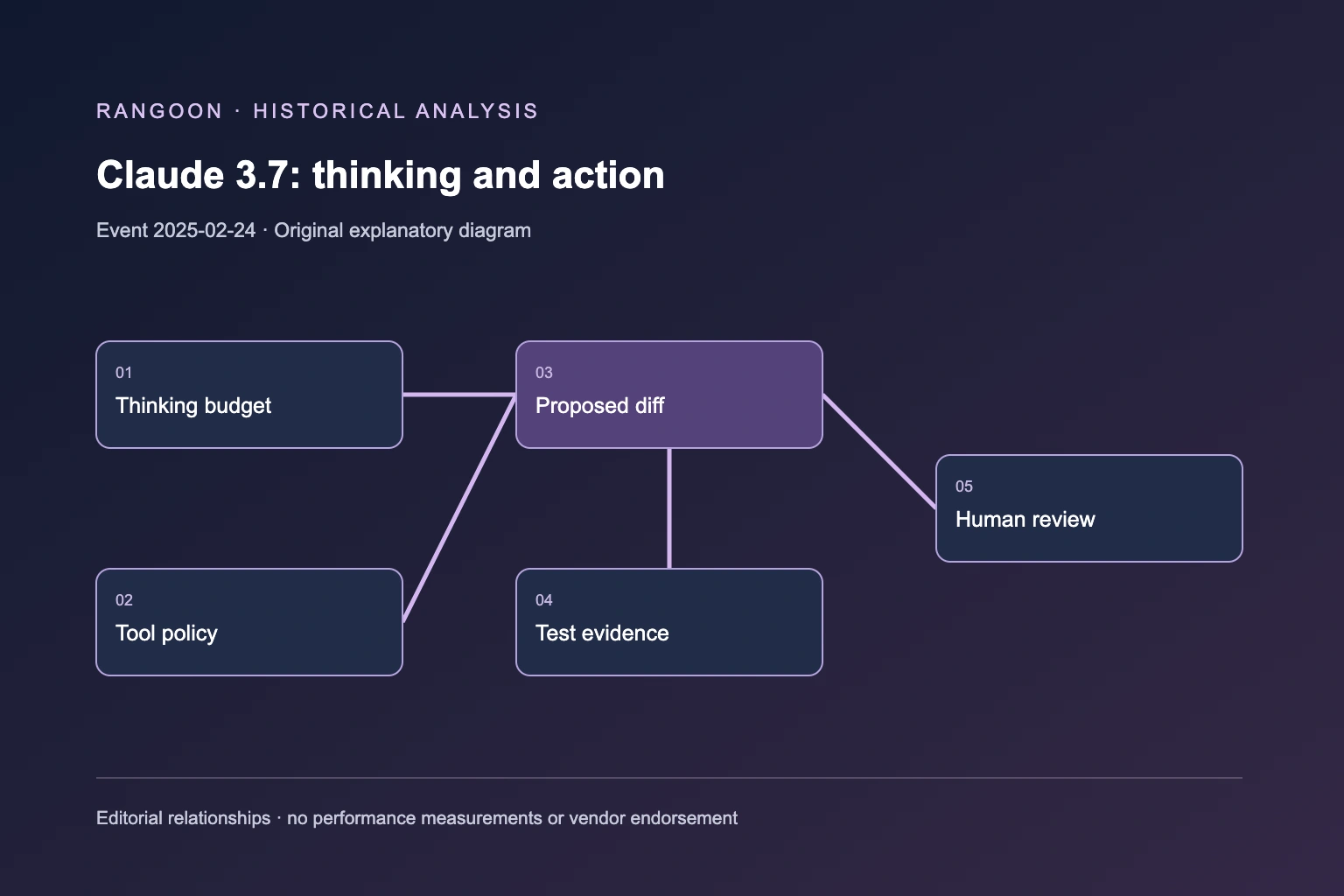
Key takeaways
- Anthropic presented Claude 3.7 Sonnet as a hybrid reasoning model with standard and extended-thinking modes.
- A thinking budget controls one dimension of a run; it does not authorize a tool call or external change.
- Coding-agent evaluation should preserve proposed changes, commands, tests, and the human decision to accept them.
What Anthropic announced[source 1][source 2][source 3]
On February 24, 2025, Anthropic announced Claude 3.7 Sonnet and Claude Code. The company described Claude 3.7 Sonnet as a hybrid reasoning model that could provide near-instant responses or extended, visible step-by-step thinking. It said API users could control how long the model thinks, and introduced Claude Code as a command-line agentic coding tool in a limited research preview.
Anthropic’s companion extended-thinking article said users could turn the mode on or off and developers could set a thinking budget. Its system card describes the release as a hybrid reasoning model and discusses extended-thinking mode. These are historical claims about that release, not evidence that every later Claude surface has the same controls or behavior.
Editorial analysis: a budget changes one run boundary
A thinking budget is useful because it makes deliberation effort a declared configuration value. An operator can compare a faster path with a deeper one, set limits for a task class, and investigate an outlier with more context than a model name alone. It also makes a hidden tradeoff visible: an answer that needs more reasoning time may be unsuitable for a latency-sensitive interaction. This leaves compute, latency, and task-risk choices visible for later review.
The control is narrow, however. It does not determine whether a proposed shell command, file edit, network request, or publication is allowed. Those effects arise through tools and surrounding systems. Counting thinking tokens or selecting an extended mode cannot replace an approval boundary for a consequential action.
Editorial analysis: code agents need a change record
For an agent that can inspect and modify a repository, preserve the task objective, repository revision, allowed paths, tool permissions, proposed diff, commands run, and test outcomes. A reviewer then has a concrete record to assess. If the agent suggests a command beyond its allowed scope, the correct state is a stop or escalation, even if the model’s reasoning appears persuasive.
The same record supports reproducibility. A failed test can be linked to the exact workspace and change, while an accepted patch can be linked to its review and validator evidence. This is more reliable than asking a later reader to infer what happened from a conversation or a final status sentence.
Editorial analysis: tune and test separately
Choose a reasoning budget through representative tests, not by treating a larger value as automatically better. Include simple tasks, difficult tasks, malformed requests, unavailable tools, and requests that should halt for approval. Record latency, output quality, tool proposal quality, and correction effort at each configuration. Keep the test suite stable enough to identify a real configuration effect.
Then test authority controls independently: a low-budget run and a high-budget run should both be unable to modify a protected path or trigger an unapproved external action. The February 2025 announcement is a useful historical marker for configurable reasoning. The operational lesson is to keep model-effort configuration, tool policy, and release approval as distinct controls.
Sources
- Anthropic: Claude 3.7 Sonnet and Claude Code (February 24, 2025)
- Anthropic: Claude’s extended thinking (February 24, 2025)
- Anthropic: Claude 3.7 Sonnet System Card
Continue reading
Related reading
 News analysisClaude Code’s general availability joined a model launch to a developer workflow claim3 min read
 News analysisClaude Code’s GitHub Actions path made CI a distinct agent execution environment3 min read
 News analysisAnthropic donated Agent Skills to AAIF: treat open governance as a new supply-chain input3 min read