

Cursor’s web and mobile agents moved code tasks outside the desktop session
Cursor announced web and mobile access for its agents on June 30, 2025, bringing background code tasks and review flows to browsers.
Historical reporting: Cursor’s June 30, 2025 announcement described web and mobile access. It is not evidence about current client behavior or authorization defaults.
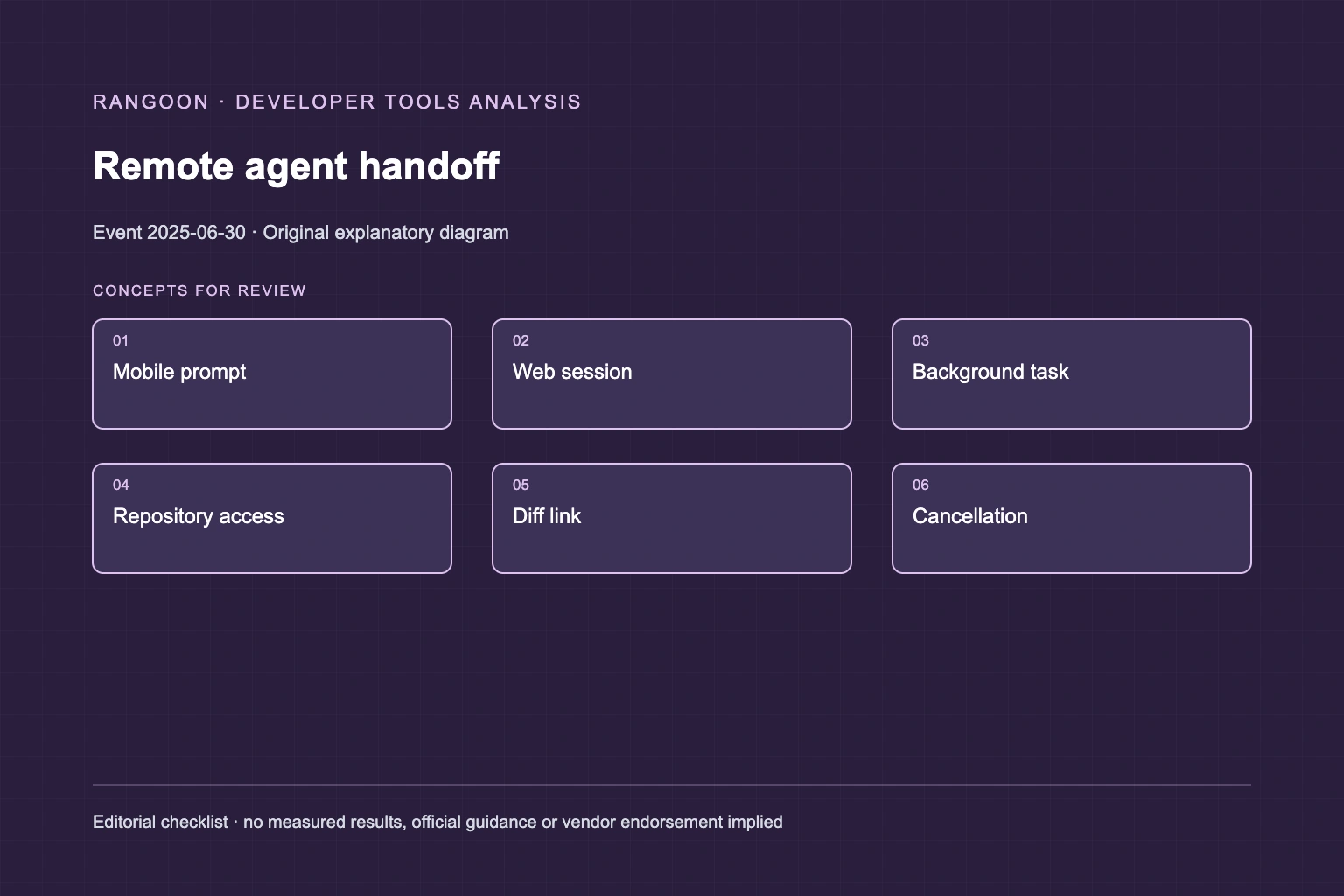
Key takeaways
- Mobile task dispatch needs a compact, reviewable scope statement.
- Repository access must be checked again outside the desktop client.
- A pull request is a handoff artifact, not release approval.
The June announcement made asynchronous work reachable from browsers[source 1][source 2]
Cursor’s June 30 post said users could start agents from web and mobile, launch background bug fixes or features, and review diffs and pull requests through a browser interface. Its 1.0 changelog, earlier that month, had already expanded Background Agent availability. Read together, the records establish a shift in where work could be initiated and observed. They do not prove that a browser session carries the same repository, organization or device controls as a configured desktop environment.
Remote task initiation separates intent capture from local code context[source 1][source 2]
A mobile request can be useful for a clear defect or question, but it often lacks the surrounding terminal state that exposed a problem. The prompt should therefore include a repository revision, acceptance check, forbidden paths and expected stopping point. The agent must discover any missing context from allowed repository files, not from assumptions about the requester’s device. Access to a web dashboard should also be treated as a new identity surface with its own session, approval and audit requirements.
Asynchronous work needs an explicit return-to-owner path[source 1][source 2]
When a task finishes away from the desktop, route it to a named owner with a concise receipt: base commit, changed paths, tests attempted, failed checks and a pull-request or diff link. Set a timeout for unattended work and a cancellation path if the issue is reclassified. If the task touches credentials, deployment configuration or an external API, require the agent to stop and ask rather than silently extending scope because a human is offline.
Analysis: portable supervision is different from portable authority[source 1][source 2]
Editorial analysis: web and mobile visibility can shorten the time between a question and a review decision, especially for triage. It should not turn a notification into permission to merge or publish. The best mobile workflow is often a small one: inspect status, assign a bounded investigation and make the final code decision on a surface where the diff, test evidence and repository policy are visible together.
Cursor’s June post described a web queue at cursor.com/agents, access from desktop, tablet and mobile browsers, and a PWA installation path for iOS and Android. It said a user could start bug fixes, feature work or codebase questions while away, add images and follow-up instructions, and run several agents to compare results.
The same release exposed team review through agent diffs and pull requests in the web interface, then added Slack notifications and an @Cursor trigger. That makes task state, not merely terminal state, a product surface: the web view needs to show which repository and revision an agent used, while Slack is a notification and dispatch channel rather than proof that a patch was accepted. The PWA packaging also means an organization should document how browser-session identity maps to repository permissions.
Its kanban view made coding and research tasks visible together, so task type and repository target should remain explicit in that shared queue.
Sources
- Cursor: Cursor on web and mobile (June 30, 2025)
- Cursor changelog: 1.0 (June 4, 2025)
Continue reading
Related reading
 News analysisGitHub Copilot coding agent put a draft pull request at the center of agent delivery3 min read
 News analysisCursor 2.0 framed parallel coding agents as a worktree coordination problem3 min read
 News analysisCursor 1.0 turned code review and background execution into one editor release3 min read