CXL 4.0 doubled its link rate and introduced bundled ports
The CXL Consortium released CXL 4.0 on November 18, 2025, doubling the link rate to 128 GT/s and adding bundled ports, retimer reach and memory RAS work.
Historical reporting: the CXL Consortium's dated release establishes CXL 4.0 publication on November 18, 2025. A public consortium webinar deck was freshly read for technical context. Consortium feature claims do not prove deployed latency, capacity or interoperability.
Key takeaways
- CXL 4.0 was a public specification release with 128 GT/s signaling, bundled ports and memory RAS changes.
- The consortium retained earlier protocol features and stated backward compatibility, but neither fact certifies a platform.
- Coherent-memory designs need firmware, RAS and failure-path validation on the selected host and devices.
The November announcement fixed the CXL 4.0 publication event[source 1][source 2]
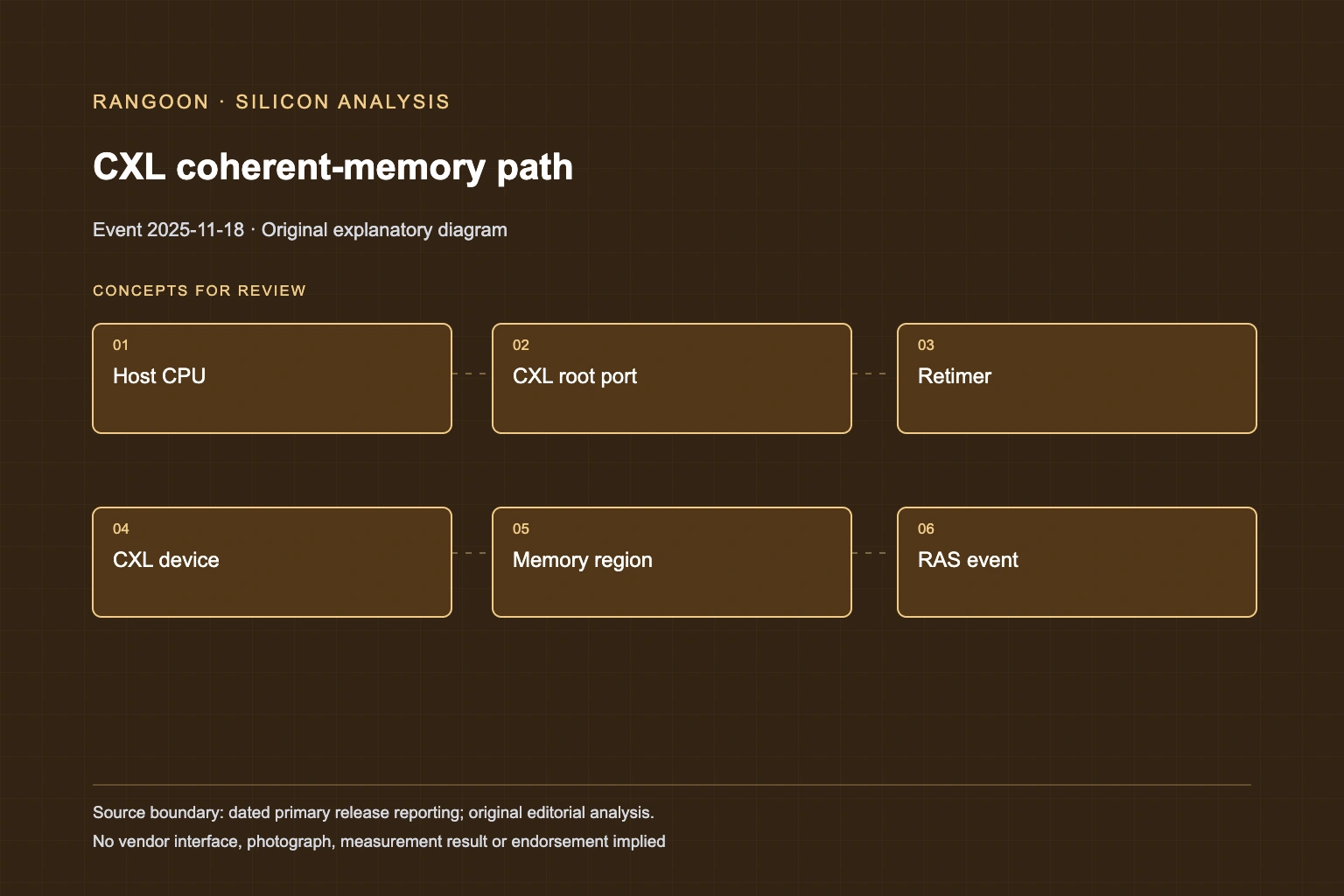
On November 18, 2025, the CXL Consortium announced CXL 4.0 and described it as a public specification release. The release lists a link-rate increase from 64 GT/s to 128 GT/s, bundled ports and memory reliability, availability and serviceability enhancements. CXL is a coherent interconnect between a host and devices such as accelerators, memory buffers and smart I/O. That defines the scope of this event. It does not demonstrate a specific host, memory expander or accelerator using CXL 4.0 in a production workload.
Rate, width and reach changed the physical connection options[source 1][source 2]
The consortium says CXL 4.0 preserves the 256-byte flit format from CXL 3.x, introduces native x2 width for greater fan-out and permits up to four retimers for increased channel reach. It also introduces bundled ports, which can combine ports between a host and Type 1 or Type 2 CXL accelerators. These statements describe the specification's design options. They do not show what aggregate bandwidth, latency or failure behavior a specific port bundle achieves. Those outcomes depend on the selected devices, lane configuration, routing, retimers and software stack.
Memory RAS features make system management part of the interface story[source 1][source 2]
CXL 4.0's release also calls out improved reliability, error visibility and maintenance efficiency for memory. The later consortium webinar frames CXL around coherent memory semantics and heterogeneous compute, where host software, runtime-managed accelerator memory and device behavior meet. This means a feature list alone cannot establish data integrity or serviceability in an installed system. Validation should include error injection where supported, event collection, firmware activation, recovery and a defined isolation path. It should also distinguish a demonstrated CXL topology from a general claim about pooled-memory capacity.
CXL 4.0 paired faster links with width, reach and memory-management changes[source 1][source 2]
The November release identifies several layers of change: 128 GT/s signaling while retaining the 256-byte flit format, native x2 width for fan-out, up to four retimers for reach, bundled ports for a host and Type 1 or Type 2 accelerators, and memory RAS improvements. These features are related but not interchangeable. Native x2 and retimers concern the physical and link path; bundled ports concern a connection arrangement; RAS concerns error visibility and maintenance. The release also scheduled live CXL demonstrations at SC25 and a December 4 technical webinar, marking public outreach around the new revision. Its SC25 session specifically named memory pooling and sharing for AI and HPC. The Consortium said earlier CXL generations remained compatible. That is the published interface position, not a report of a particular accelerator or memory device operating at 128 GT/s. The event therefore marks a broader CXL specification surface than a rate increase alone.
Sources
- CXL Consortium: CXL 4.0 specification release (November 18, 2025)
- CXL Consortium: Introducing the CXL 4.0 Specification webinar (December 4, 2025)
Continue reading