

PCI-SIG released PCIe 7.0 to members at 128 GT/s
PCI-SIG released PCIe 7.0 to members on June 11, 2025, setting a 128 GT/s transfer rate while keeping the full specification behind member access.
Historical reporting: PCI-SIG's public release page dates member availability to June 11, 2025. The complete specification remained member-only during this reading; this analysis uses only public rate and feature-goal descriptions, not an independent implementation result.
Key takeaways
- PCIe 7.0's dated event was member release, not proof of deployed 128-GT/s hardware.
- The public record set a 128-GT/s raw rate and x16 bandwidth target while preserving a member-access boundary around the complete text.
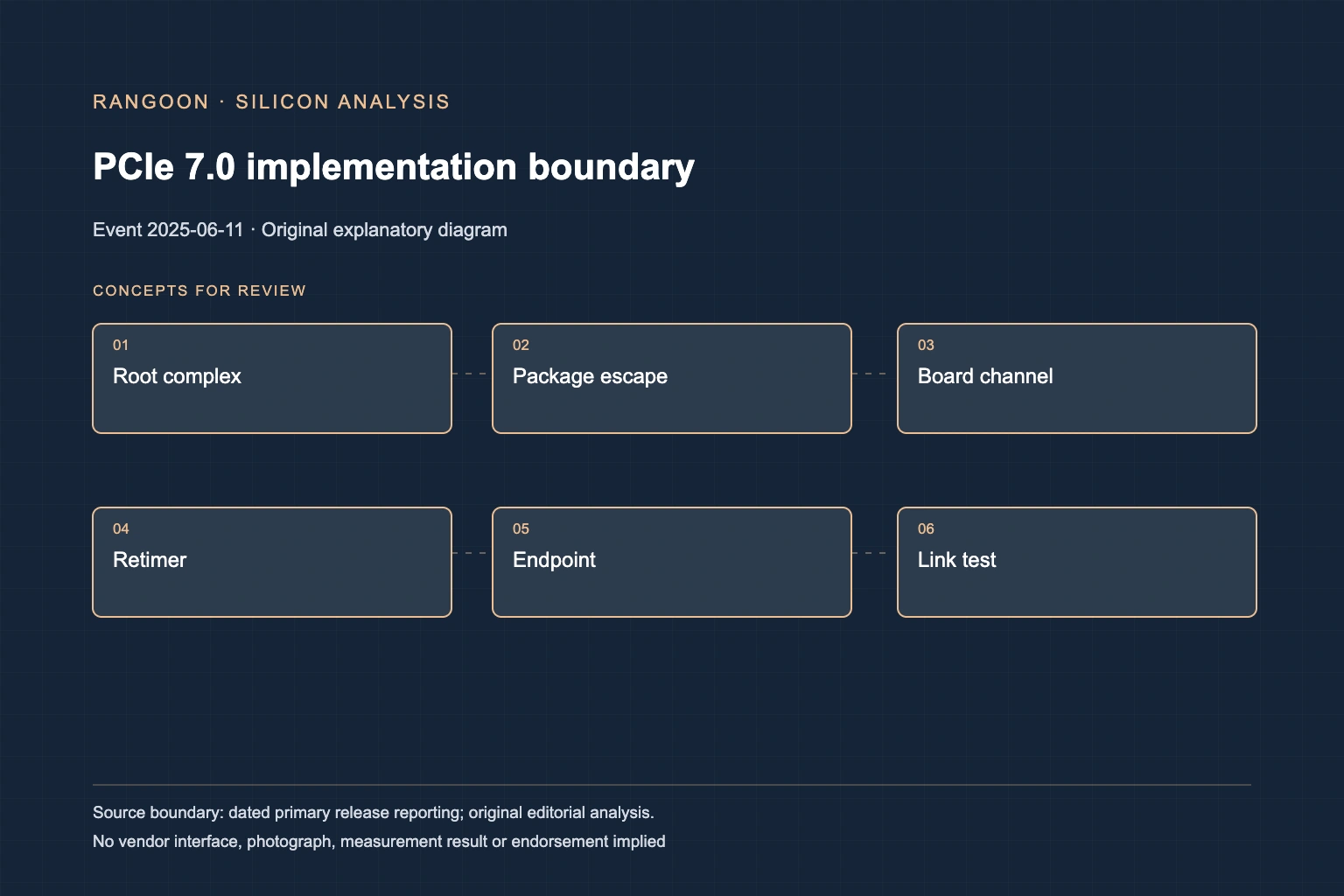
- A platform claim needs endpoint, root-complex, channel, retimer and workload evidence beyond a standards release.
The June release made a new PCIe revision available to members[source 1][source 2]
PCI-SIG says PCIe 7.0 was officially released to its members at the June 11, 2025 Developers Conference. Its public release page identifies a 128 GT/s raw bit rate, double PCIe 6.x's 64 GT/s, and names AI/ML, high-speed networking, cloud and HPC among the intended markets. This is a standards milestone: it establishes the version and member-release date. It does not say that a given server, accelerator or storage device shipped with PCIe 7.0, nor does it turn a future-compatible design into an operating link.
The public materials describe goals while the full text stayed member-only[source 1][source 2]
The same PCI-SIG page links the PCIe 7.0 document through a members site. That access boundary matters. The archive uses only the public description: 128 GT/s, optical-interconnect feature goals, extended reach, and mapping across electrical and optical domains. It does not infer undisclosed protocol behavior, compliance requirements or implementation options from a member document that was not read. The listed public FAQ corroborates the 128 GT/s raw rate and says a sixteen-lane configuration can reach up to 512 GB/s bidirectional bandwidth. Those public facts establish the scale of the stated interface target without supplying a normative protocol reading.
Rate targets make the physical channel a first-class system constraint[source 1][source 2]
A nominal transfer rate is only one part of an interconnect. The public material's attention to reach and optical paths signals that electrical loss, connectors, package escape, board routing, retimers and cable choices remain part of the design. An x16 bandwidth figure aggregates lanes under specified assumptions; it is not an application throughput measurement. System builders need to establish the selected link width and generation, verify equalization and error behavior on the actual channel, then measure the traffic pattern that matters. A faster fabric can still leave a workload gated by memory, software queues or device scheduling.
Version 1.0 established a member release while later revision text continued[source 1][source 2]
PCI-SIG's release supports a narrow historical conclusion: members received PCIe 7.0 Version 1.0 on June 11, 2025. The same public page says Revision 7.1 is the later draft containing 7.0 plus errata and approved engineering-change notices. That wording is useful historical context: Version 1.0 marked the published baseline, while later maintenance text did not convert the original release into a deployed product. The announcement also names optical technologies, extended rack and pod reach, and electrical-to-optical data mapping as feature goals. Those goals describe where PCI-SIG expected the revision to matter, not a reported outcome from an installed AI cluster. It specifically lists AI/ML, 800G Ethernet, cloud and quantum computing among intended markets. The event remains a specification milestone with a documented member-access boundary.
Sources
Continue reading
Related reading
 News analysisNVIDIA introduced NVLink Fusion for semi-custom AI infrastructure3 min read
 News analysisNVIDIA’s memory codesign post highlights a practical boundary between capacity and usable agent throughput3 min read
 News analysisNVIDIA supply-chain capacity plans make packaging, test and optics explicit infrastructure constraints3 min read