

DeepSeek-V3.1 joined thinking modes, long context, and tool calls in one release
DeepSeek released DeepSeek-V3.1 on August 21, 2025, describing Think and Non-Think modes, 128K context, updated tokenizer materials, and beta strict function calling.
Historical reporting: DeepSeek announced V3.1 on August 21, 2025. This does not claim current API aliases, pricing, context limits, or tool behavior.
Key takeaways
- Mode and tokenizer changes require a fresh regression suite.
- Function calling needs schema validation outside the model.
- A long context limit is not a factuality or retrieval guarantee.
Release record[source 1][source 2]
DeepSeek announced DeepSeek-V3.1 on August 21, 2025, describing Think and Non-Think modes, 128K context for named API routes, updated tokenizer and chat-template materials, open-source weights, and beta strict function calling. The release page and linked model-artifact resources are separate primary evidence: the announcement defines the event while the artifact identifies what a local evaluator may inspect. Neither source proves that a later API alias, client library, or locally converted model behaves identically.
Technical design[source 1][source 2]
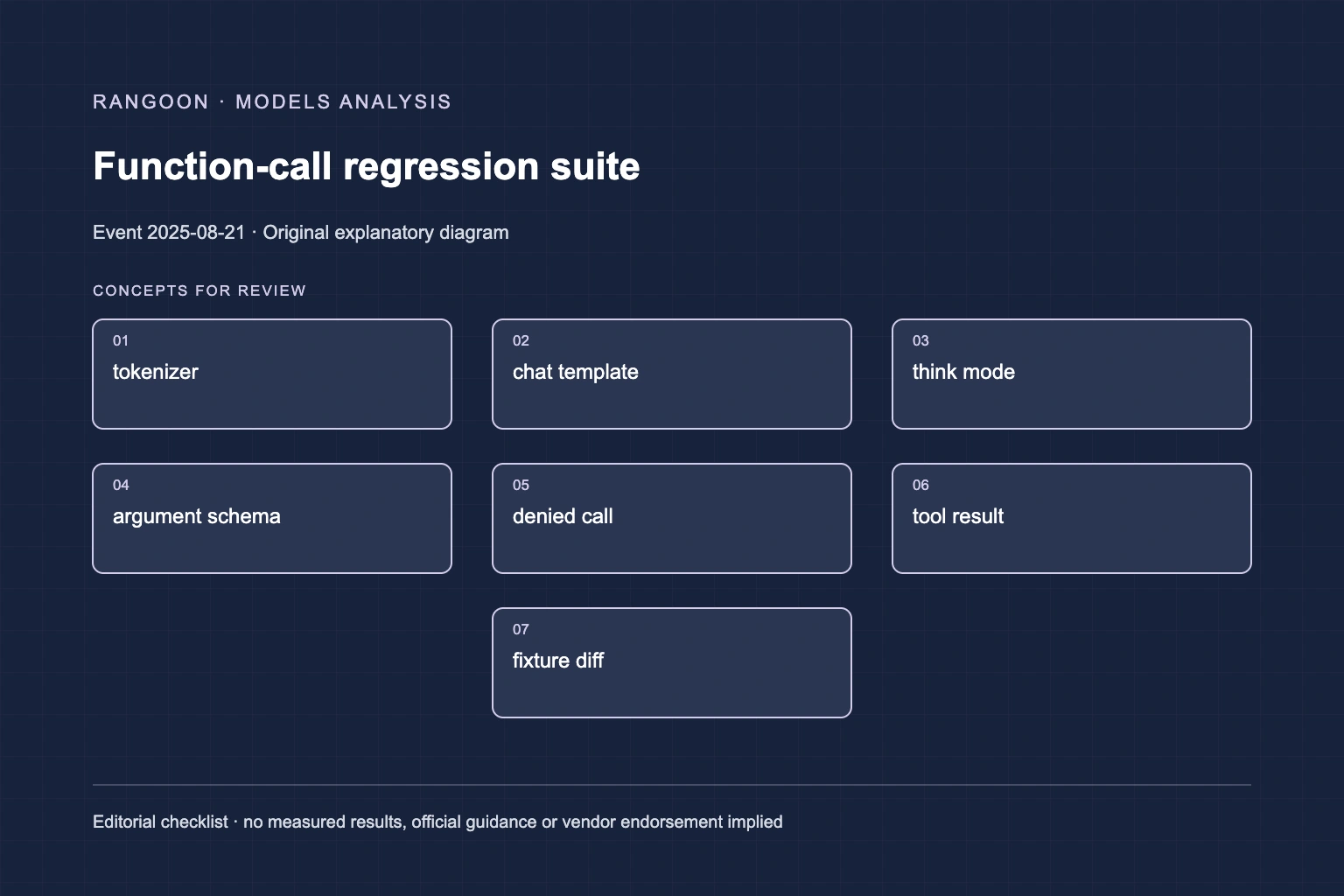
The combination of mode, context, tokenizer, and function-calling changes makes regression testing necessary. A tokenizer or chat-template shift can change prompt boundaries and structured output even when an application’s visible text is unchanged. Before an upgrade, freeze a fixture set with multilingual text, long context, tool calls, invalid tool arguments, structured extraction, and requests that should be refused.
Operating boundary[source 1][source 2]
After the change, compare valid output, schema violations, latency, truncation, and review outcomes. Report failures by category rather than masking them with an average score. Strict function calling is useful only if the host treats it as one validation layer.
Evaluation evidence[source 1][source 2]
Define a schema, reject unexpected fields, scope credentials, sanitize arguments, check side effects, and retain the tool result. A structured function call can be syntactically valid while still requesting an unauthorized account change or using stale data. Long context similarly needs boundaries: record what documents entered the prompt, which ones were relevant, whether retrieval was current, and what the model could not confirm.
Historical implication[source 1][source 2]
Context capacity does not guarantee recall, truth, or policy compliance. For open weights, track the exact base and instruction artifacts, tokenizer configuration, template, inference engine, quantization, and revision. This enables a later investigation to distinguish a provider event from a local stack change.
DeepSeek announced V3.1 in August 2025. It should not be translated into a current price, compatibility, or benchmark claim. Its operational significance is the convergence of several mutable layers. Treat every layer as a versioned input, test the entire request-to-tool path, and keep execution authority in deterministic validation rather than in a model’s formatted output.
Store a negative tool-call fixture with every function-calling integration. It demonstrates that the application rejects an unauthorized but well-formed request, which is stronger evidence of control than a successful demonstration that happened to use a safe argument. That negative case should be replayed after every parser, template, or runtime update, since safety regressions often appear at integration boundaries rather than in ordinary success examples.
Treat the model’s generated call as an untrusted proposal until downstream validation confirms both its structure and its permission to affect the requested resource. This establishes a clear separation between useful model assistance and the application controls that determine whether a requested action is allowed, correctly targeted, and fully reversible. The release therefore requires an end-to-end fixture that records the selected mode, template, parsed call, and host decision.
Sources
- DeepSeek: DeepSeek-V3.1 release (August 21, 2025)
- DeepSeek: DeepSeek-V3.1 model artifact (August 21, 2025)
Continue reading
Related reading
 News analysisDeepSeek-R1-0528 made reasoning updates a token-budget decision3 min read
 News analysisTencent released Hunyuan-A13B under a territory-limited community license, separating open weights from universal permission3 min read
 News analysisDeepSeek-V3.2-Exp put sparse attention into an experimental API upgrade3 min read