

DeepSeek-R1-0528 made reasoning updates a token-budget decision
DeepSeek released R1-0528 on May 28, 2025 with stated benchmark, function-calling, and hallucination changes. A reasoning gain can also change tokens, latency, and tool behavior.
Historical reporting: DeepSeek’s May 28, 2025 release record introduced DeepSeek-R1-0528; its model card is a separate primary artifact record. The analysis below is original editorial analysis; it does not claim present availability, performance, or support.
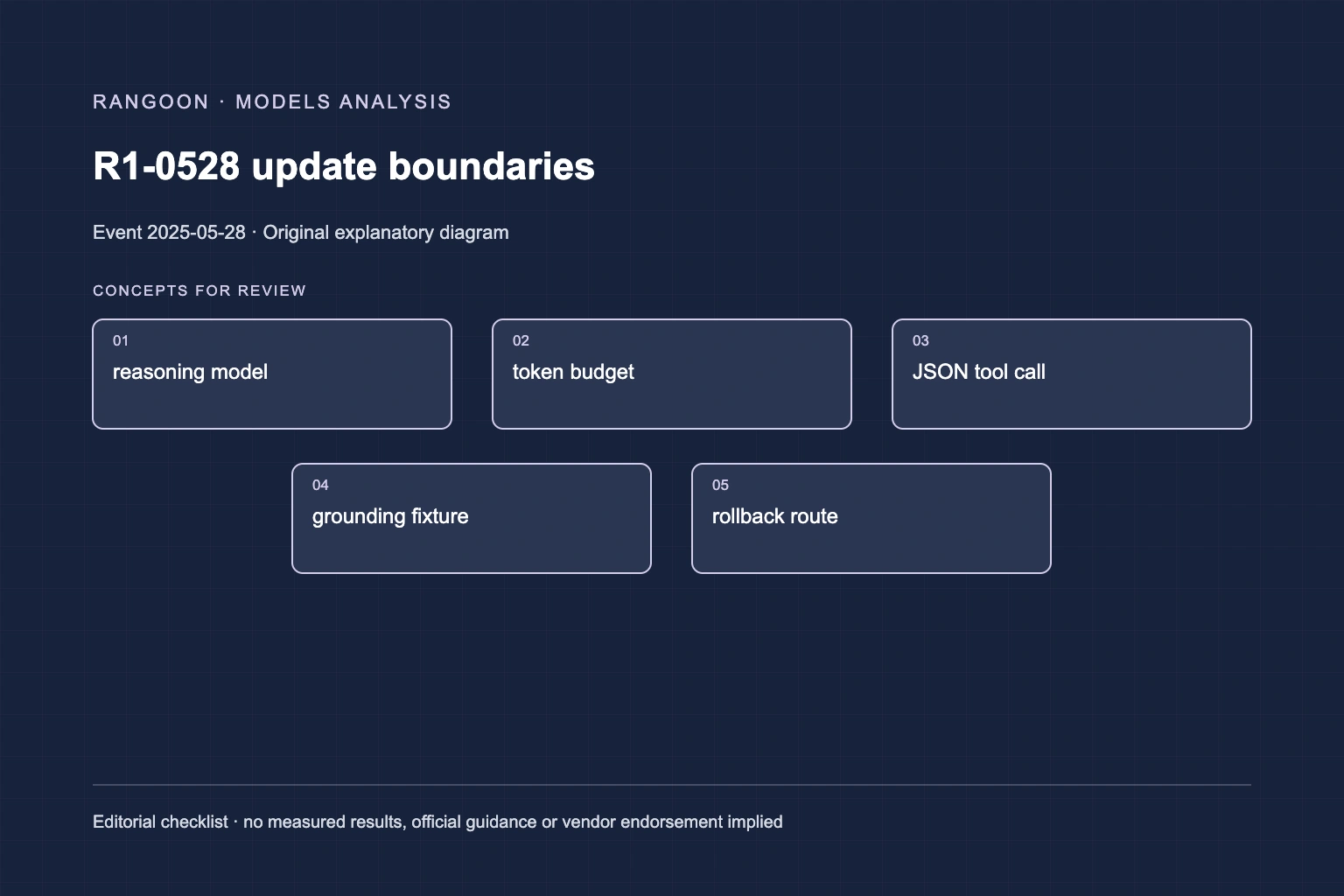
Key takeaways
- On May 28, 2025, DeepSeek announced DeepSeek-R1-0528.
- Measure token use and elapsed time per successfully completed task, rather than comparing only tokens per response.
- DeepSeek’s May 2025 documentation reports a named update and its stated conditions. It does not prove current pricing, current API behavior, or independent hallucination rates.
What DeepSeek announced[source 1][source 2]
On May 28, 2025, DeepSeek announced DeepSeek-R1-0528. Its release material listed supplier-reported improvements on reasoning benchmarks, reduced hallucinations, front-end work, JSON output, and function calling, while also warning that complex reasoning tasks could use more tokens than the legacy R1 version. That warning is as operationally material as the score claims.
The R1-0528 model card is an independent artifact document for the named release. It can identify the checkpoint and declared materials, but it does not validate vendor benchmark measurements in a different runtime or prove that a JSON-capable model will satisfy an application’s schema.
Editorial analysis: price reasoning by completed task
Measure token use and elapsed time per successfully completed task, rather than comparing only tokens per response. A longer trace may improve a hard case yet increase queue time or fail an interactive latency target. Include retries and tool-error recovery in the denominator.
Function calling needs a negative suite: unknown tools, malformed parameters, ambiguous choices, stale identifiers, and permission-denied results. A tool-call benchmark may not expose the safety and recovery behavior required by a real action surface.
Editorial analysis: test claimed hallucination changes directly
For grounding work, create fixtures with answerable questions, deliberately absent facts, conflicting sources, and stale records. Score citation or evidence selection separately from fluent prose. This reveals whether a claimed reduction changes the failure mode that matters to the user.
For reasoning tasks, retain both outcome and path controls. A correct answer reached after forbidden tools, excessive turns, or an unverified assumption may still be an unacceptable system result.
Editorial analysis: make model upgrades reversible
Before switching a reasoning model, capture cost limits, timeout behavior, tool schemas, and a cohort of existing tasks. Keep the prior route available until the new record meets its acceptance criteria. That provides a recoverable decision, not a one-way vendor update.
The historical release should remain bounded to its dated statements. Later releases or current service labels cannot be used to rewrite what R1-0528 claimed in May 2025.
Editorial analysis: retain the release boundary
DeepSeek’s May 2025 documentation reports a named update and its stated conditions. It does not prove current pricing, current API behavior, or independent hallucination rates.
For a hypothetical research assistant, a reduced-hallucination claim should be checked with a source packet containing an answerable fact, a plausible but absent fact, and two contradictory statements. The accepted output must distinguish citation, inference, and uncertainty. Then run the same packet with a fixed token ceiling. If the model finds the answer only by exceeding the ceiling, the workflow has learned a capacity tradeoff rather than a simple quality gain. For tool calls, include an unavailable search result and a malformed tool response. These cases show whether the system reports limits faithfully. They are original evaluation examples, not evidence that R1-0528 passed or failed them.
Keep an explicit stop rule: when cited evidence is insufficient or a tool result conflicts, the system should report that state rather than spend an unbounded reasoning budget seeking a fluent answer.
Sources
- DeepSeek-R1-0528 release (May 28, 2025)
- DeepSeek-R1-0528 model card
Continue reading
Related reading
 News analysisDeepSeek-V3.1 joined thinking modes, long context, and tool calls in one release3 min read
 News analysisDeepSeek-V3.2-Exp put sparse attention into an experimental API upgrade3 min read
 News analysisDeepSeek separated stable V3.2 tool use from the temporary V3.2-Speciale endpoint3 min read