

DeepSeek-V3.2-Exp put sparse attention into an experimental API upgrade
DeepSeek updated its chat and reasoner endpoints to V3.2-Exp on September 29, 2025, presenting DeepSeek Sparse Attention as a long-context experiment.
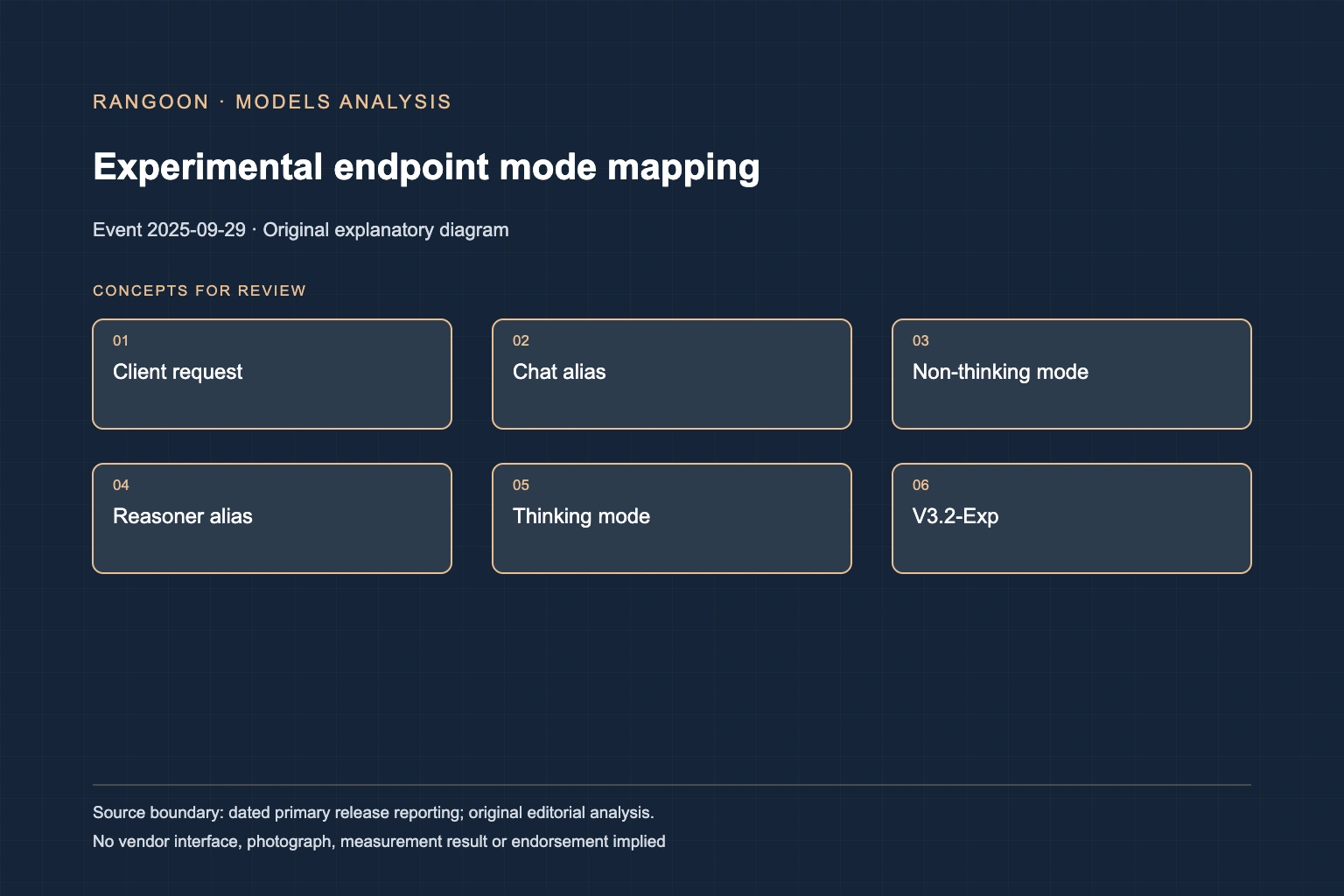
Historical reporting: DeepSeek’s official API change log dates the V3.2-Exp upgrade September 29, 2025. The company described DeepSeek Sparse Attention for lower long-context training and inference cost, and mapped `deepseek-chat` to non-thinking mode and `deepseek-reasoner` to thinking mode. The December stable V3.2 release is a separate event and is not treated as an Exp feature bundle.
Key takeaways
- V3.2-Exp was an experimental endpoint update, so its endpoint mapping and pricing context were part of the event.
- Sparse-attention efficiency claims depend on context length, workload, serving stack, and model configuration.
- The later V3.2 and V3.2-Speciale release did not retroactively make the September experiment a stable model release.
The September event changed the models behind existing endpoint names[source 1][source 2]
On September 29, 2025, DeepSeek’s API change log recorded an upgrade of both `deepseek-chat` and `deepseek-reasoner` to DeepSeek-V3.2-Exp. The log mapped the chat endpoint to non-thinking mode and the reasoner endpoint to thinking mode. This matters because a familiar endpoint name can hide a changing model version; an API integration needs the event date and mode mapping to make a claim about which experimental behavior was being evaluated.
DeepSeek’s news index described V3.2-Exp as debuting DeepSeek Sparse Attention, or DSA, for faster and more efficient long-context training and inference. The announcement is a supplier statement about a named architecture experiment. It does not establish a fixed latency, throughput, or cost reduction for another provider, a different prompt distribution, or a downstream agent that adds tools and retries around the model.
An attention change does not define end-to-end application cost[source 1][source 2]
Sparse-attention designs reduce which relationships are computed or retrieved during long-context processing. Their value depends on how an implementation selects information and how the rest of the model, cache, batching policy, and hardware handle the request. DSA therefore belongs to the model and serving configuration, not to every workload that happens to send a long prompt. A short prompt, a cache hit, or a tool-heavy workflow can have a different bottleneck.
The September source described V3.2-Exp as experimental. That label is operational evidence, not a minor naming detail. An evaluation should retain the exact endpoint, mode, request shape, date, and failure behavior. A result from an experimental alias cannot safely be projected onto a later stable checkpoint merely because both carry the V3.2 family name.
Thinking mode and non-thinking mode were distinct request paths[source 1][source 2]
The changelog’s endpoint mapping made thinking versus non-thinking a selected mode of the same experimental API update. A thinking response may consume a different token budget and time profile than a non-thinking response even when the visible user prompt is identical. That changes what should be recorded in a comparison: input and output length, reasoning setting, tool policy, system prompt, retries, and any max-token limit can all affect cost and observed quality.
The source does not turn a mode switch into a guarantee of agent competence. Tool use is a whole-system behavior involving schemas, permissions, service responses, error recovery, and a caller’s approval path. DeepSeek’s subsequent December announcement introduced a specific thinking-in-tool-use claim for stable V3.2; that is a later feature event, not proof that September V3.2-Exp already carried the same supported tool-use behavior.
The experiment needs a separate historical record from December V3.2[source 1][source 2]
DeepSeek later announced V3.2 and V3.2-Speciale on December 1. The company called V3.2 the official successor to V3.2-Exp, a relationship that confirms continuity while preserving a release boundary. The September article should therefore report the experimental API upgrade and DSA claim on its own terms rather than importing December availability, agent-data synthesis, or Speciale access conditions into the earlier event.
For teams tracking a moving hosted model, the useful receipt is small but specific: endpoint alias, date, selected mode, documented experiment status, and the provider source. It says what was announced without claiming a universal capability gain. Public benchmark results or pricing announcements from the vendor can be added only with their stated configuration; they are not a substitute for a workload-specific measurement.
Sources
- DeepSeek API change log: V3.2-Exp (September 29, 2025)
- DeepSeek research and news index
Continue reading
Related reading
 News analysisDeepSeek separated stable V3.2 tool use from the temporary V3.2-Speciale endpoint3 min read
 News analysisDeepSeek-V3’s December 2024 API update made a checkpoint date operational3 min read
 News analysisDeepSeek-V3.1 joined thinking modes, long context, and tool calls in one release3 min read