

DeepSeek separated stable V3.2 tool use from the temporary V3.2-Speciale endpoint
DeepSeek launched stable V3.2 and the API-only V3.2-Speciale on December 1, 2025, separating tool-enabled modes from a temporary reasoning variant.
Historical reporting: DeepSeek announced stable V3.2 and V3.2-Speciale on December 1, 2025. V3.2 became the successor to V3.2-Exp across app, web, and API; Speciale was API-only, had no tool calls, and used a temporary endpoint scheduled to expire December 15. DeepSeek’s later model card is current artifact context only; launch claims come from the dated announcement.
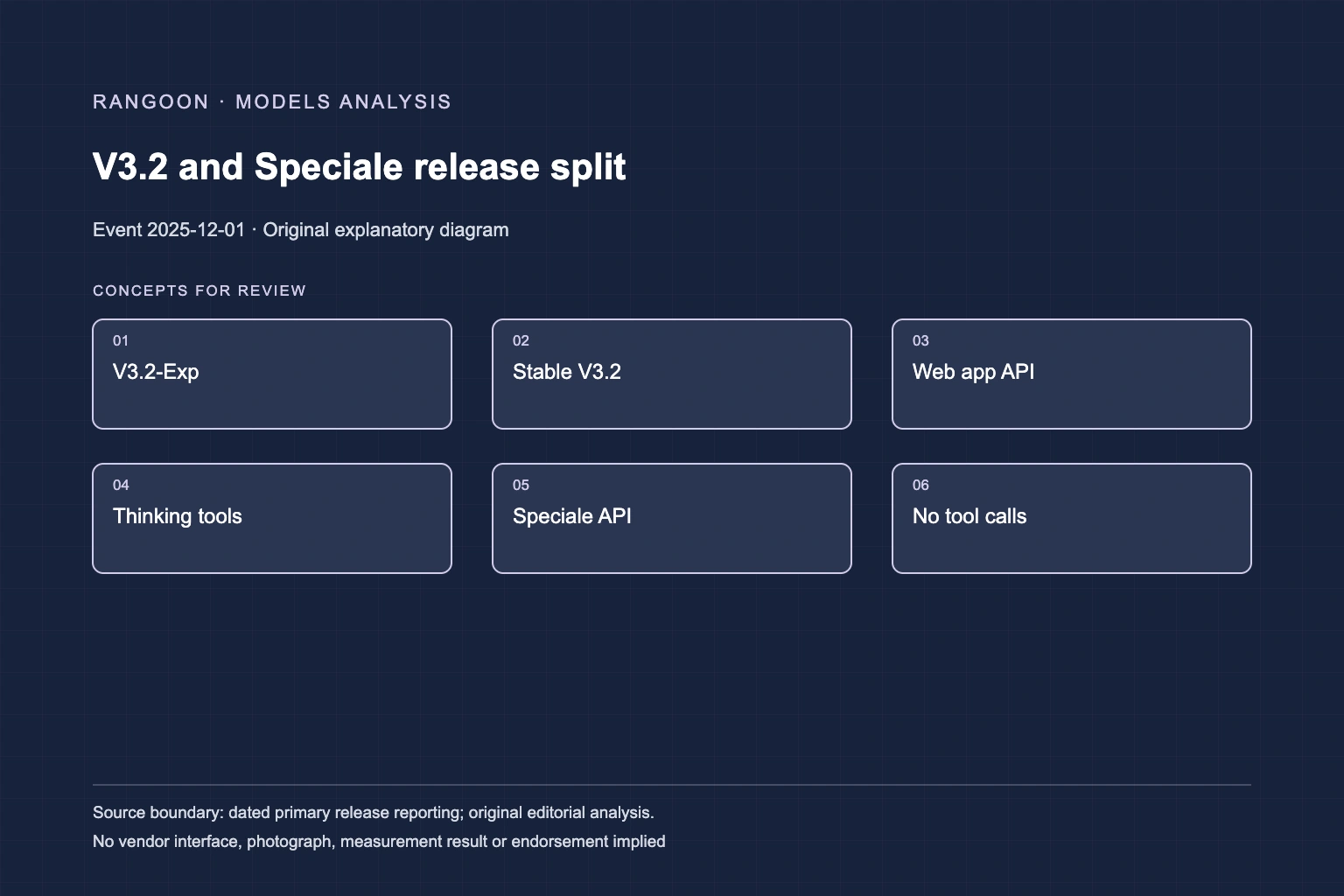
Key takeaways
- V3.2 and V3.2-Speciale were distinct release artifacts with different availability and tool-use conditions.
- DeepSeek’s thinking-in-tool-use claim applied to V3.2, while Speciale’s temporary API did not support tool calls.
- Vendor benchmark and reasoning claims need the named model, mode, token budget, and access path beside them.
One date introduced a stable successor and a constrained companion[source 1]
On December 1, 2025, DeepSeek announced DeepSeek-V3.2 as the official successor to V3.2-Exp and made it available through its app, web product, and API. The same announcement introduced DeepSeek-V3.2-Speciale as an API-only reasoning variant. The paired launch did not make the two names interchangeable. One was presented as the regular V3.2 offering, while the other had a separate access path and operational constraints.
DeepSeek described V3.2 as balancing inference and output length, and it presented Speciale as a higher-token reasoning option. Those are provider characterizations. A model-family label alone cannot show how much a particular task costs or how well it performs, because prompting, context size, output cap, sampling, tools, and the caller’s surrounding agent loop change both the work and the measurement.
Tool use was an explicit boundary between the two variants[source 1]
The announcement says V3.2 integrated thinking directly into tool use and supported tool use in thinking and non-thinking modes. It also says Speciale had no tool calls. That contrast is central to the release: a reasoning score from Speciale should not be read as a demonstration of its ability to drive a tool protocol, and a tool-using V3.2 run should identify whether thinking mode was enabled.
DeepSeek specified that Speciale used a temporary API endpoint ending December 15, 2025 at 15:59 UTC. Temporary access affects reproducibility. A developer could evaluate a particular hosted variant during that window, but later requests cannot assume the same endpoint or model remains available. Historical reporting should preserve the expiry condition instead of treating a transient endpoint as a permanent API feature.
The training-data claim described a vendor method, not a deployment result[source 1]
DeepSeek said V3.2 used a synthesized agent-training method covering more than 1,800 environments and 85,000 complex instructions. That describes the company’s training-data construction claim, not an inventory of tools available to an API caller. A production agent still needs its own tool definitions, credentials, authorization policy, timeout behavior, and human escalation rules. Those controls are external to a model’s reported training environment count.
The announcement’s benchmark statements, including Speciale’s competition-style reasoning results, are likewise vendor-reported. They can be useful comparison data if their protocol and token usage remain attached. They do not establish a model’s performance on private code, changing web information, safety-sensitive decisions, or a task where tool errors and side effects dominate the outcome.
Open release did not erase version and license distinctions[source 1]
DeepSeek linked V3.2, V3.2-Speciale, and a technical report as open-source release materials. A user selecting a weight artifact needs the exact repository revision and its stated terms; “open-source” in an announcement is not enough to infer every redistribution, hosted-service, or downstream-model obligation. The launch page did not make one universal rights claim for all surrounding code, API service, and third-party components.
The historical release is clearest when stable V3.2, Speciale, and V3.2-Exp remain separate records. Their common lineage explains why developers compare them, but it does not transfer every endpoint, tool mode, pricing condition, or benchmark claim across dates. That separation keeps an experimental evaluation from being reported as a stable production result, and a temporary reasoning endpoint from being treated as a durable service commitment.
Sources
- DeepSeek: V3.2 and V3.2-Speciale launch announcement (December 1, 2025)
- DeepSeek API change log
Continue reading
Related reading
 News analysisDeepSeek-V3.2-Exp put sparse attention into an experimental API upgrade3 min read
 News analysisNVIDIA Llama Nemotron Super made model-family labels insufficient for agents3 min read
 News analysisKimi K2-0905 made context, tool parsing, and serving configuration one release surface3 min read