

NVIDIA Llama Nemotron Super made model-family labels insufficient for agents
NVIDIA announced Llama Nemotron reasoning models on March 18, 2025, including Super. A family benchmark needs the exact size, quantization, tools, prompts, and agent harness.
Historical reporting: NVIDIA’s March 18, 2025 developer announcement introduced the Llama Nemotron reasoning family; the Super model card supplies a separate artifact record. The analysis below is original editorial analysis; it does not claim present availability, performance, or support.
Key takeaways
- On March 18, 2025, NVIDIA announced the Llama Nemotron reasoning-model family, including Nano, Super, and Ultra variants, and described benchmark results for reasoning and agentic tasks.
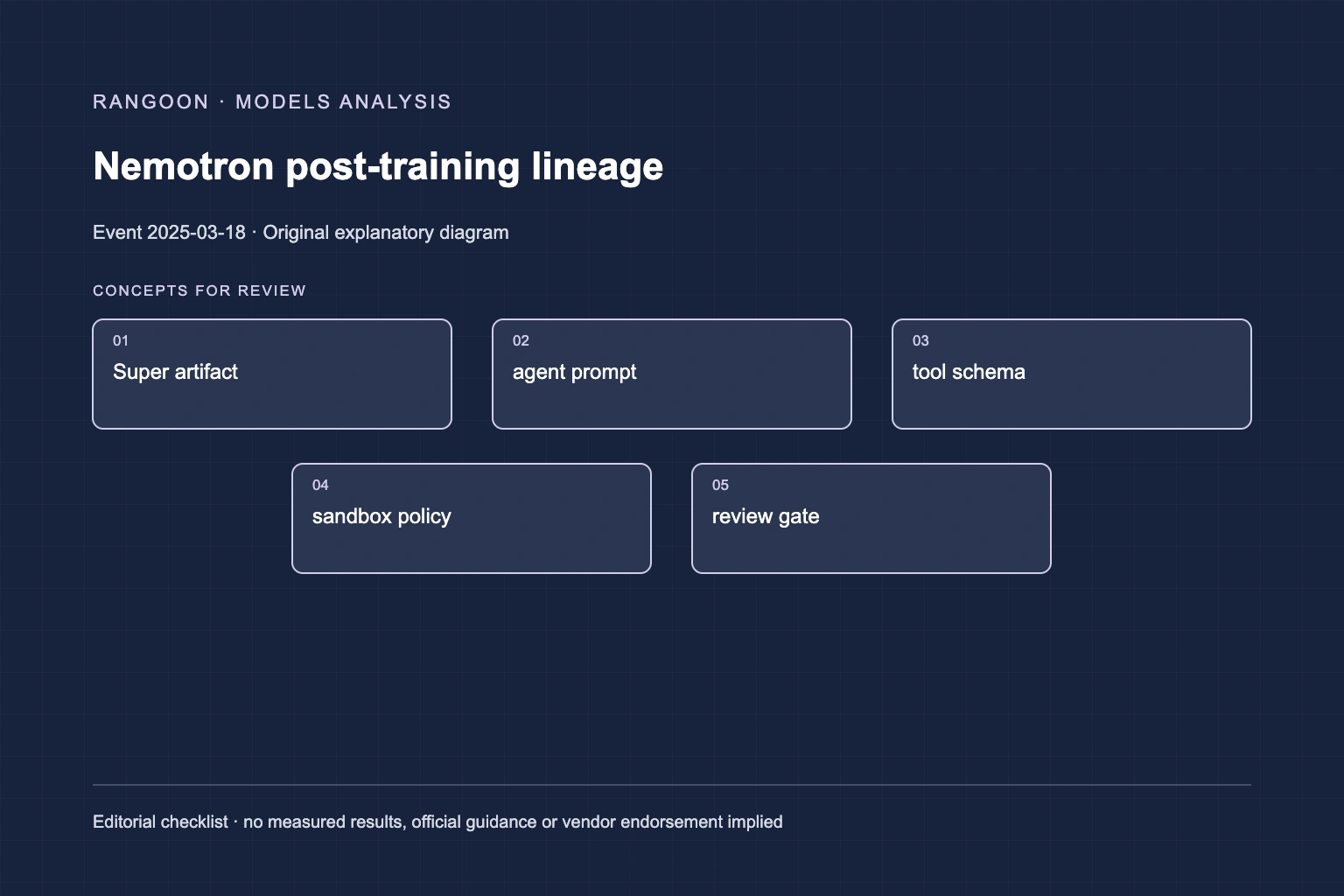
- An agent evaluation record should include model artifact, quantization, tokenizer, system prompt, reasoning policy, tool schema, sandbox, task set, retry policy, and stop condition.
- NVIDIA’s March 2025 material supports its stated family launch and reported comparisons. It does not establish current model availability or an untested agent’s performance.
What NVIDIA announced[source 1][source 2]
On March 18, 2025, NVIDIA announced the Llama Nemotron reasoning-model family, including Nano, Super, and Ultra variants, and described benchmark results for reasoning and agentic tasks. A family announcement creates a naming problem for operators: ‘Nemotron Super’ is not enough to reproduce a result unless the size, version, format, prompt, and harness are also identified.
The NVIDIA Llama Nemotron Super model card is a separate primary source for a specific artifact. It can state declared model characteristics and intended use. It does not prove a family-level benchmark transfers to another agent framework, tool inventory, task distribution, or hardware profile.
Editorial analysis: name the full agent configuration
An agent evaluation record should include model artifact, quantization, tokenizer, system prompt, reasoning policy, tool schema, sandbox, task set, retry policy, and stop condition. Each can change success rate and cost. A model-family label alone cannot support a release decision.
Measure action safety as well as task completion. Include blocked paths, invalid credentials, destructive commands, unavailable resources, and ambiguous requests. An agent that completes a benchmark but ignores an action boundary is not acceptable for every environment.
Editorial analysis: separate inference speed from agent throughput
Tokens per second is only one component of agent throughput. Tool latency, context growth, retries, test execution, user review, and queueing all contribute to task completion time. Report the complete path for the target workload.
Benchmark results should retain the task suite and harness version. Agent benchmarks are especially sensitive to repository snapshots, browser state, tool availability, and scoring rules, so a number without those fields has limited transfer value.
Editorial analysis: keep authority outside the model
Define what the agent may read, propose, execute, and escalate. Require deterministic checks for code changes and explicit human approval for external state where appropriate. Store the trace and final reviewer decision with the result.
This makes the historical announcement useful without overstating it: NVIDIA’s March 2025 record identifies a reasoning-model family; deployment authority comes from the surrounding system and operating policy.
Editorial analysis: retain the release boundary
NVIDIA’s March 2025 material supports its stated family launch and reported comparisons. It does not establish current model availability or an untested agent’s performance.
A family-level reasoning benchmark can obscure an agent’s weakest interface. Test a hypothetical incident workflow that has one read-only diagnostic step, one action requiring approval, and one unavailable tool. The agent should collect evidence, form a bounded recommendation, request approval before the action, and report the unavailable tool without inventing a result. Score this policy behavior separately from reasoning answers. Include the exact Super artifact, prompt, tool schema, and sandbox in the test record. This exercise turns an agentic-model announcement into a reviewable systems test and makes no claim about NVIDIA Llama Nemotron Super’s results on the scenario.
Reviewers need the rejected actions as well as the completed ones. They show whether the system upheld the same authority boundary when a task became inconvenient or uncertain.
Sources
Continue reading
Related reading
 News analysisNVIDIA’s Llama-Embed-Nemotron-8B paper documented an instruction-aware multilingual retriever3 min read
 News analysisNVIDIA Riva 2.18 added Canary NIM options for offline multilingual speech work3 min read
 News analysisNVIDIA released Parakeet-TDT-0.6B-v3 for 25-language speech-to-text3 min read