

ElevenLabs released Scribe as its first speech-to-text model
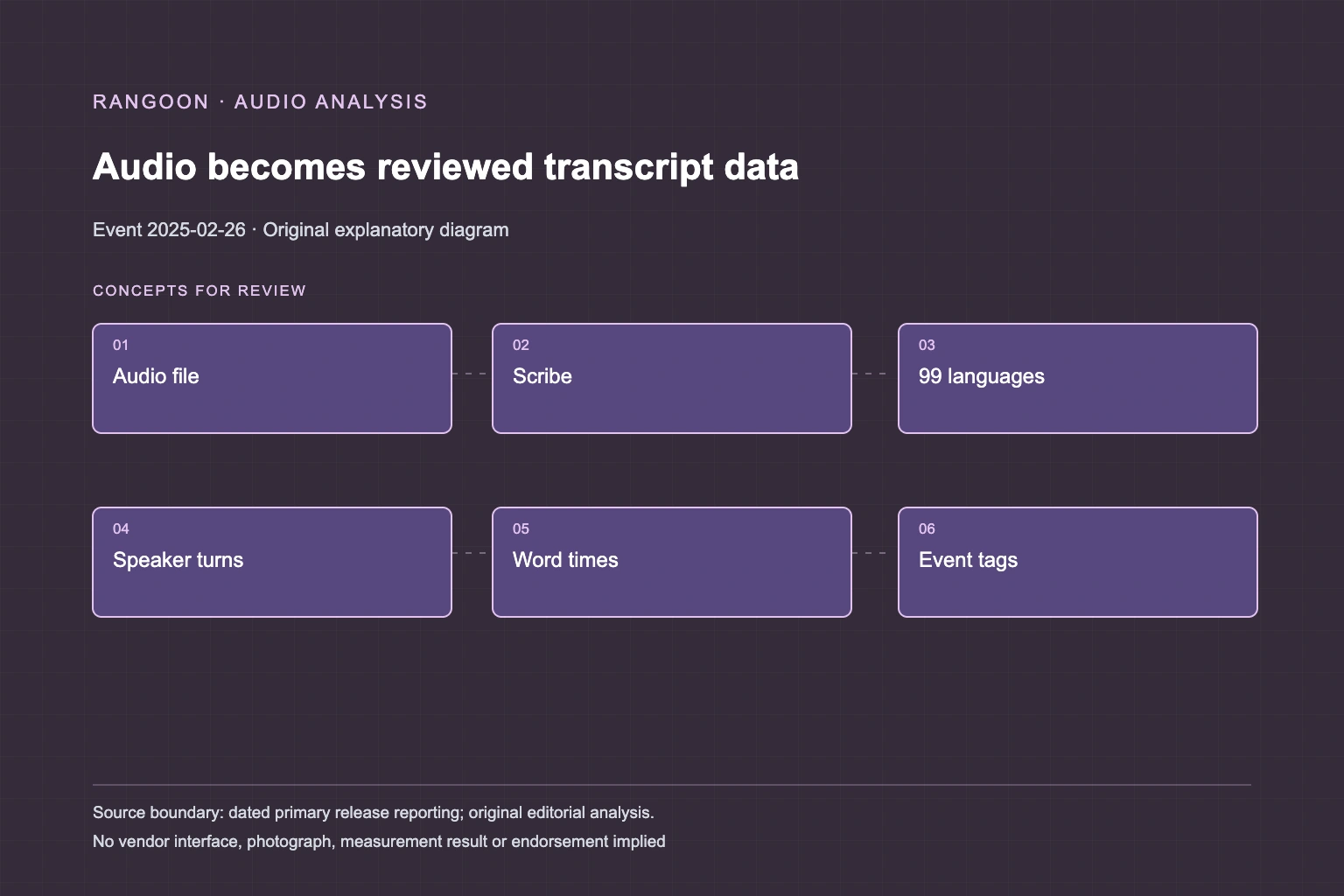
ElevenLabs released Scribe on February 26, 2025, adding a 99-language speech-to-text model with structured transcripts, diarization, word timestamps and audio-event tags.
Historical reporting: Source 0 is ElevenLabs’ dated Scribe release. Source 1 is its current transcription documentation, read for present workflow context and marked as later documentation; it is not launch-date proof for Scribe v1.
Key takeaways
- ElevenLabs announced Scribe, its first speech-to-text model, on February 26, 2025.
- The release named 99 languages, structured JSON, speaker diarization, word-level timestamps and non-speech event markers.
- ElevenLabs reported benchmark results for FLEURS and Common Voice; those measurements do not establish transcription performance for every recording, language mix or correction workflow.
A transcription product joined a speech-generation platform[source 1]
On February 26, 2025, ElevenLabs introduced Scribe as its first Speech to Text model. The company said the model handled real-world audio and transcribed speech in 99 languages. Its launch surface extended beyond a plain text field: developers could use a Speech to Text API, while creators and businesses could upload audio or video through the dashboard for formatted transcripts. This distinction matters because the event was a new modality in the company’s platform. A text-to-speech vendor adding transcription creates a possible input side for captioning, search, review and conversation workflows, but the announcement does not say that every audio format, account plan or application path had the same feature set. The dated source establishes the supplier’s announced Scribe scope; a current account and API contract are needed to determine an actual implementation path.
The model returned timing and speaker structure with text[source 1]
ElevenLabs specified structured JSON transcripts with speaker diarization, word-level timestamps and markers for non-speech events such as laughter. Those fields describe different uses of a transcript. Diarization can separate named or numbered speakers only after a workflow chooses how to identify and review them. Word timestamps can support caption alignment, search positioning or audit views. Audio-event tagging can preserve material that is not spoken language. None of those fields makes a transcript self-validating. Overlap, distant microphones, code switching, domain terms, noisy recordings and ambiguous speaker identity can each change the value of a result. The release also said a low-latency real-time version would arrive soon, so the February event should not be rewritten as proof that the initial Scribe release itself provided real-time transcription. It supplied a batch-oriented API and dashboard path with stated structured output.
Published benchmark claims need their dataset boundary[source 1]
The launch compared Scribe with Gemini 2.0 Flash, Whisper Large V3 and Deepgram Nova-3 in FLEURS and Common Voice tests across 99 languages. ElevenLabs characterized its own result as lower automated transcription word error rate and highlighted Italian, English, Serbian, Cantonese and Malayalam. Those claims identify a model, named comparison set and benchmark families, which is more useful than an unsupported accuracy superlative. They remain ElevenLabs’ reported benchmark measurements. A word-error result depends on the dataset, reference transcript, language, normalization policy and decoding setup; it does not predict a correction rate for a meeting, a medical recording, a song, a call center, or a file containing several speakers and languages. Historical reporting can retain the company’s result while keeping an application’s quality threshold separate from a supplier benchmark.
Later docs show transcription became a broader workflow[source 1][source 2]
The current transcription documentation now centers Scribe v2 and describes automatic language detection across 90 or more languages, keyterm prompting, entity detection and transcript editing. It is useful context because it shows how ElevenLabs later documented broader production controls around transcription. It is not evidence that Scribe v1 had those same capabilities in February 2025, nor evidence that a current model’s behavior applies to its predecessor. The page’s evolution is exactly why the dated release and current guide need separate roles. Source 0 records the first Scribe launch, its 99-language claim and its declared output fields. Source 1 describes an updated product family and current workflow concepts. Teams looking backward should preserve version, model identifier and date before using a current documentation feature list to characterize an older release.
Sources
- Official Scribe release (February 26, 2025)
- ElevenLabs transcription documentation
Continue reading
Related reading
 News analysisNVIDIA positioned Parakeet v2 as an English speech-recognition research model, not a universal transcription result3 min read
 News analysisKyutai released Hibiki’s French-to-English voice-translation research artifacts with a narrow language boundary3 min read
 News analysisKyutai presented Unmute as a modular speech wrapper for text models, while deferring its open-source release3 min read