

The AI Act’s first February 2025 rules made inventory and literacy operational work
EU AI Act prohibitions, definitions and AI-literacy provisions started applying on February 2, 2025, creating a dated review point for providers and deployers.
Historical reporting: the Joint Research Centre stated on February 2, 2025 that the first AI Act rules had started to apply. This article records that milestone; it does not determine whether a particular system, organisation or jurisdictional fact is covered.
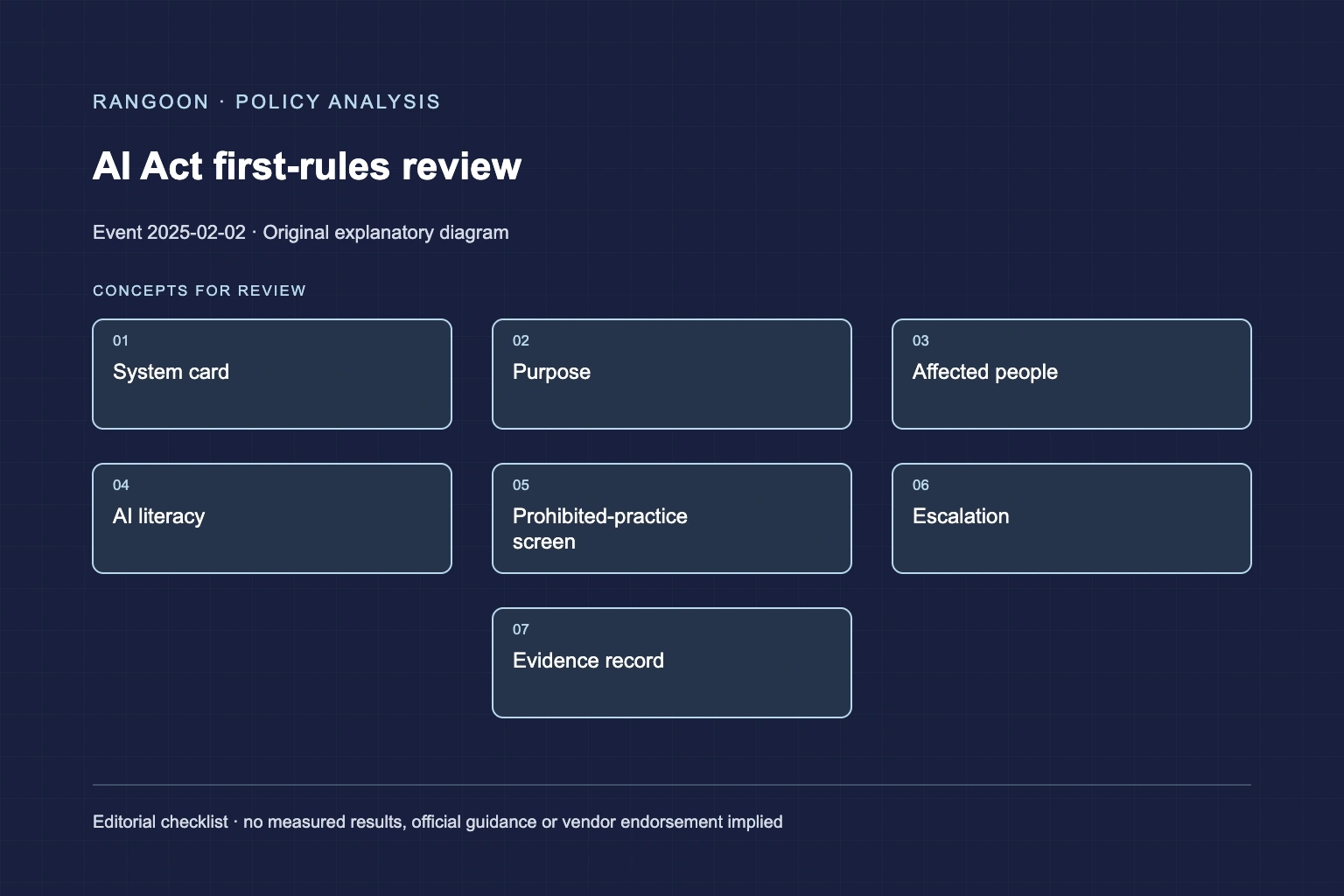
Key takeaways
- February 2 was an application milestone for defined provisions, not a finding about every AI product.
- AI literacy is a work-and-context question, so attendance alone is weak evidence.
- A prohibited-practice screen needs declared purpose, users, data and decision path.
The first application date covered a bounded set of rules[source 1][source 2]
On February 2, 2025, the European Commission Joint Research Centre published a notice saying the first rules under the Artificial Intelligence Act had started to apply. It named the AI-system definition, AI literacy and a limited set of prohibited AI use cases. The Commission’s next-day press release described the same transition as applying from Sunday, February 2. That chronology matters: the release date of a notice and the legal application date are different facts, and this article treats February 2 as the historical milestone.
The notice did not turn every AI deployment into the same category. It pointed to limited prohibited use cases that pose unacceptable risks in the EU, while later AI Act requirements have their own timelines. A team reading the 2025 event should avoid converting a risk-based legal framework into a generic claim that all generative AI was banned, approved or fully regulated on that day.
AI literacy called for evidence tied to actual use[source 1][source 2]
The Commission connected AI literacy to people operating or using AI systems on behalf of providers and deployers. Its notice also described a future repository of literacy practices. That is useful historical context, but a repository example is not a certificate for an organisation. The record should instead identify the people involved, the system’s intended function, material limits, escalation route and the date the instruction was delivered.
Training can be proportionate without being generic. A person approving a high-consequence output needs a different exercise from a person using a bounded drafting tool. Practical evidence can include a short scenario, a known failure mode, an explicit stop condition and a route for reporting uncertainty. This is editorial operations analysis, not a legal interpretation of Article 4 or a claim that a particular training programme satisfies it.
Analysis: classify a use before promising a control[source 1][source 2]
Start a review with a compact system card: purpose, affected people, operator, inputs, outputs, decision recipient, deployment geography and whether the output changes access, treatment or enforcement. Then compare the actual workflow with the described prohibited-practice categories and seek qualified advice where a legal conclusion is needed. A model label, a vendor assurance or a policy PDF cannot substitute for the workflow facts.
The screen should include negative examples. Ask what happens if an operator repurposes a score, joins data from another source, changes the audience or removes human review. Those changes can alter the relevant facts even when the model stays the same. Preserve the evidence, decision owner and unresolved questions so a later reviewer can see what was assessed rather than infer coverage from a dashboard label.
Analysis: keep application, supervision and present status separate[source 1][source 2]
A historical article can establish that specified provisions began applying on February 2, 2025. It cannot establish current enforcement priorities, national procedures, penalties, later guidance or an organisation’s compliance position. Those questions depend on current law, facts and competent authorities. The Commission’s public materials themselves distinguish provisions and implementation phases, which is a reason to date every conclusion.
For an operational programme, make the review repeatable: inventory the use, store the system card, assign an owner, record literacy measures and schedule a reassessment when the purpose, model, data or deployment changes. That approach makes a regulatory milestone useful without presenting editorial analysis as legal advice.
Sources
Continue reading
Related reading
 News analysisEU GPAI guidelines separated model-provider scope from the July code of practice3 min read
 News analysisUK’s third-party AI assurance roadmap mapped professionalization, information access and a planned innovation fund3 min read
 News analysisUK’s AI Playbook expanded government guidance to ten principles across selection, deployment and assurance3 min read