

GitHub Spark’s 2024 introduction made app building a reviewable prompt-to-preview loop
GitHub introduced GitHub Spark on October 29, 2024 as an AI-native natural-language application-building tool, distinct from Copilot’s multi-model developer choice.
Historical reporting: GitHub announced Spark at Universe on October 29, 2024. This article separates the app-builder introduction from the same-day Copilot multi-model announcement and does not claim present availability or deployment behaviour.
Key takeaways
- Spark was introduced as a natural-language application builder, a different surface from model selection in Copilot.
- A generated preview is evidence of rendered output, not proof of security, data handling or release readiness.
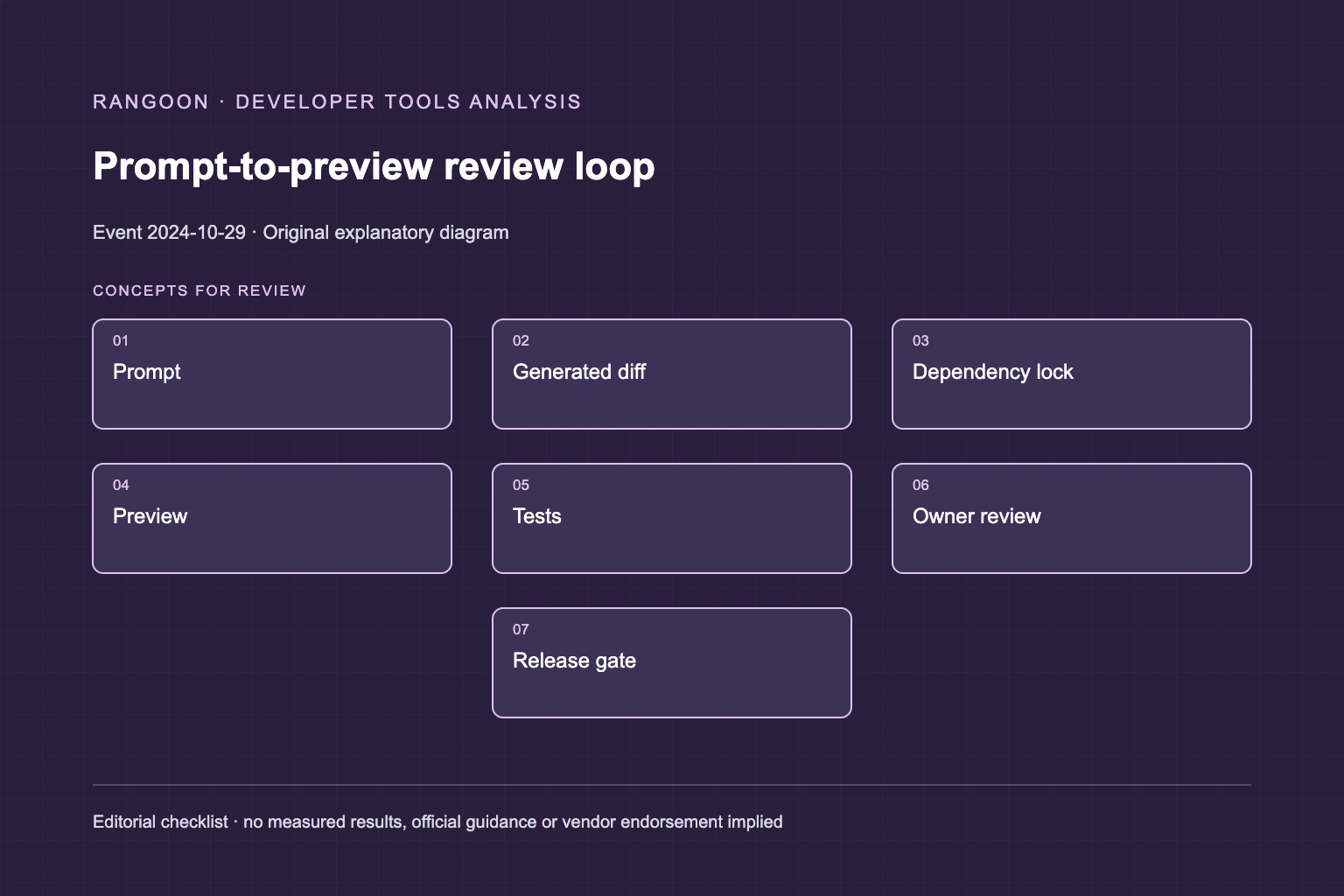
- Prompt, generated files, dependencies and deployment settings need one review record.
Spark was introduced as an app-building surface[source 1][source 2]
On October 29, 2024, GitHub’s Universe product post introduced GitHub Spark as a natural-language tool for personal micro apps, with live history, previews and direct code editing. GitHub’s Copilot product post described Spark as a first glimpse of multi-model choice in an app-building context. Both sources date the introduction to the same event, but the source distinction matters: Spark concerned building and previewing an application, while Copilot model choice concerned selecting a foundation model in developer workflows.
The announcement established an introduced product concept and described intended capabilities. It did not demonstrate that every natural-language specification becomes secure, accessible, licensed, deployable software. Generated interfaces and working previews can be valuable design artefacts, but they are not acceptance evidence for the whole delivery chain.
A prompt-to-preview loop needs versioned review[source 1][source 2]
Treat each app-generation request as a change proposal. Save the prompt, selected model or mode, generated files, package versions, configuration changes and preview address or screenshot. Review the diff before treating it as a product decision. This creates a way to distinguish what a human asked for from what the system inferred and from what was actually accepted.
The review should include negative cases. Check an unauthorised user path, invalid input, missing environment value, failed external request and a small-screen or keyboard workflow. If the system can create a connector or deployment configuration, inspect permissions and target identity separately. A visually successful page does not prove that its data boundary or side effects are correct.
Analysis: separate prototyping from release authority[source 1][source 2]
A prototype can show content hierarchy, form fields or interaction flow quickly. Release authority needs more: source ownership, test evidence, security review, accessibility checks, licence review, secrets handling and an approved target. Make the handoff explicit by labelling a generated result as prototype, candidate change or released artefact. Do not let a convenient preview silently become a production path.
For generated applications, pin the repository, dependency lockfile and build command. Run a clean build and inspect generated assets. Capture known limitations and the person who accepted each risk. This is original engineering analysis and does not describe GitHub Spark’s current features or controls.
Analysis: an introduction is not present product proof[source 1][source 2]
This article reports GitHub’s October 29, 2024 introduction. It does not claim current product availability, pricing, model catalogue, hosting route or enterprise policy. Those are time-sensitive facts and require current GitHub documentation and account-specific confirmation.
The lasting lesson is narrower: app generation becomes more useful when prompts, generated changes and approvals remain inspectable. That is a delivery pattern, not a promise supplied by an announcement. Record browser, build and source evidence separately, because a preview can be correct while the eventual packaged application differs. Preserve the original prompt even when later editing hides it from the interface.
Sources
Continue reading
Related reading
 News analysisGoogle Jules public beta separated asynchronous coding from in-editor assistance3 min read
 News analysisGitHub previewed Copilot Spaces as a shared context layer for code and project knowledge3 min read
 News analysisGitHub Copilot coding agent put a draft pull request at the center of agent delivery3 min read