

Google Jules public beta separated asynchronous coding from in-editor assistance
Google put Jules into public beta on May 20, 2025 as an asynchronous coding agent with cloud execution, plans and GitHub integration.
Historical reporting: Google’s May 20 public-beta post and August availability post document product milestones. No present availability or quality claim is made.
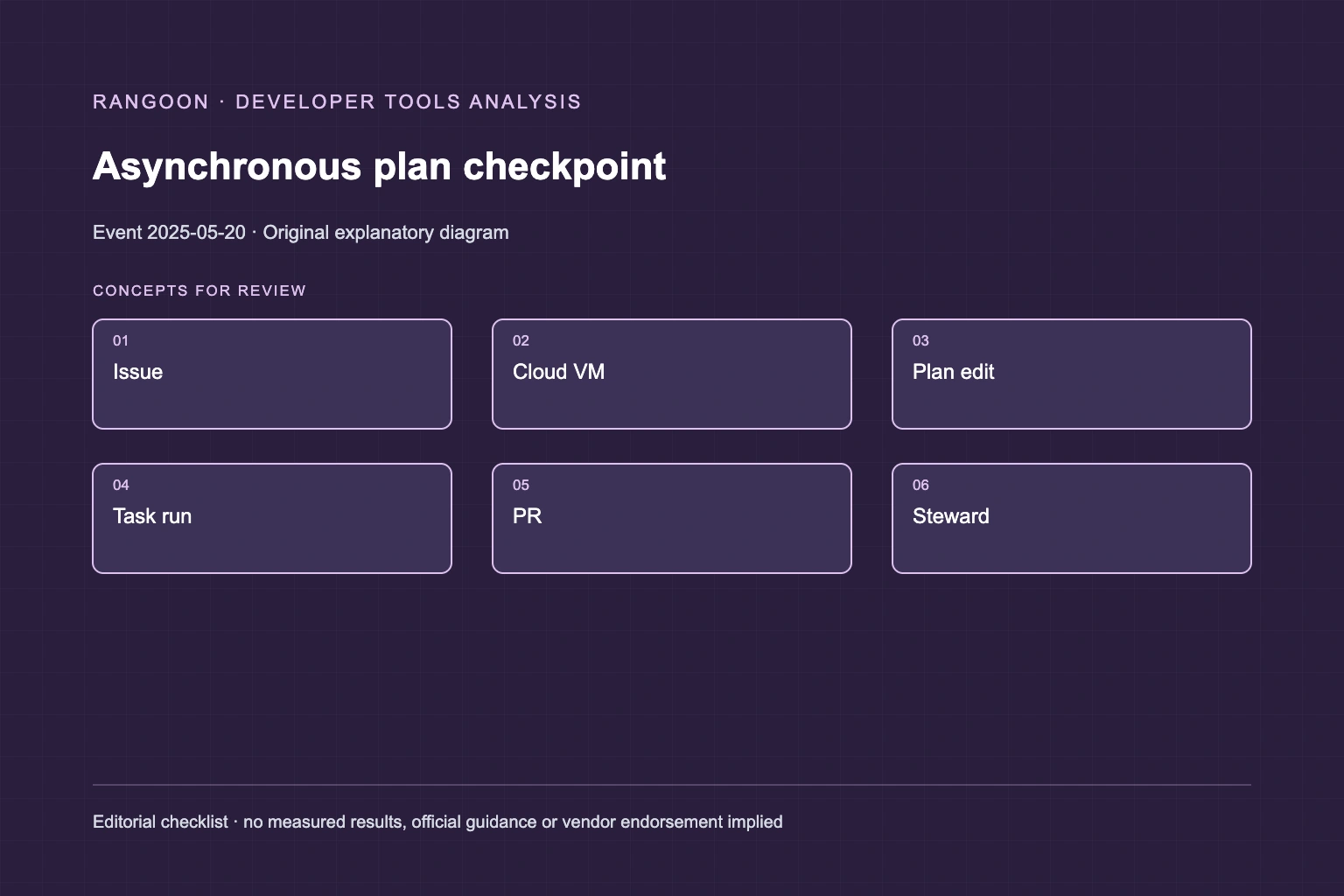
Key takeaways
- A visible plan needs an owner-approved scope before execution.
- Cloud execution needs a separate repository and data-access review.
- Audio or narrative summaries cannot replace a diff review.
Jules entered public beta as an asynchronous coding agent[source 1][source 2]
Google’s May 20, 2025 post says Jules entered public beta as an asynchronous agent that worked with existing repositories in a cloud VM, showed a plan and integrated with GitHub. An August 6 Google post records that Jules later left public beta and added features such as reused setups and issue integration. The two publications establish a product timeline. They do not demonstrate that every generated change was correct or that a cloud execution context had the same constraints as a developer machine.
An asynchronous plan is a proposal until its repository effect is reviewed[source 1][source 2]
Showing a plan before edits begins creates a useful checkpoint, but the plan must name the base revision, paths in scope, tests and stopping conditions. Cloud execution should be treated as an external environment: confirm what repository data is copied, how credentials are injected, whether network access exists and who can retrieve logs. GitHub integration simplifies handoff, but does not make an issue description sufficient acceptance criteria for a change.
Use plan edits as a formal change-control moment[source 1][source 2]
Require the requester or code owner to approve the agent’s plan when it expands beyond a one-file repair. Keep a record of plan revisions, because a final diff can conceal a mid-task change in objective. The acceptance fixture should include a test failure and an ambiguous issue; the agent should stop with a question rather than choose an interface or policy by itself. Any pull request should identify the source issue and the exact command results.
Analysis: asynchronous execution improves focus only when escalation is cheap[source 1][source 2]
Editorial analysis: longer-running coding tasks are attractive because they remove waiting from a developer’s foreground work. The tradeoff is delayed detection of wrong assumptions. Teams should bias toward small assignments with a clear human escalation channel, then expand task duration only after they have evidence that plans, tests and review habits catch the important failure modes.
Google’s public-beta post described Jules as an asynchronous coding agent that reads code, writes tests and fixes bugs in a secure cloud environment, with GitHub integration and audio changelogs. The key architecture fact is that task execution occurs away from the developer’s local machine. A repository that needs a private local service, uncommitted fixture or hardware token can therefore produce a different result from a developer workstation even if the Git branch matches.
Jules’ plan should be treated as a mutable task artifact: retain the plan shown before execution, any user edit, the cloud environment assumptions and the resulting pull request. Audio changelogs are a narrative convenience, not a source of truth; compare them with commits, diff and test results. This turns the product’s asynchronous model into concrete review inputs rather than a generic promise of autonomy.
Its public-beta description distinguishes the secure cloud environment from GitHub integration, so both execution environment and repository event history need inspection.
Sources
- Google: Build with Jules, your asynchronous coding agent (May 20, 2025)
- Google: Jules is now available for everyone (August 6, 2025)
Continue reading
Related reading
 News analysisGitHub Copilot coding agent put a draft pull request at the center of agent delivery3 min read
 News analysisOpenAI introduced SWE-Lancer to test coding agents against freelance software work3 min read
 News analysisGoogle’s Gemini Robotics On-Device put a vision-language-action model on the robot3 min read