Google’s AI co-scientist made hypothesis ranking an auditable research step
Google Research introduced an AI co-scientist on February 19, 2025, describing a Gemini-based system for generating and ranking research hypotheses and plans.
Historical reporting: Google Research announced its AI co-scientist on February 19, 2025; the associated paper was posted later that month. Hypothesis generation and ranking do not demonstrate experimental truth, clinical utility or scientific authorship.
Key takeaways
- The AI co-scientist was presented as a hypothesis and research-plan assistant.
- A ranked proposal needs source checks, novelty checks and an experiment designed by accountable researchers.
- An eloquent rationale is not evidence that a biological mechanism is true.
The release described a multi-agent research-assistance system[source 1][source 2]
Google Research announced an AI co-scientist on February 19, 2025, describing a Gemini-based system intended to help scientists develop hypotheses and research plans. The associated paper explains a system that generates, debates and ranks candidate ideas against a scientist-provided objective. This is a release record for an assistive research workflow. It is not proof that the system discovered a fact independently, that its citations are complete or that an idea ranked highly by internal agents will survive an assay, replication attempt or peer review.
Ranking ideas requires an explicit evidence and novelty ledger[source 1][source 2]
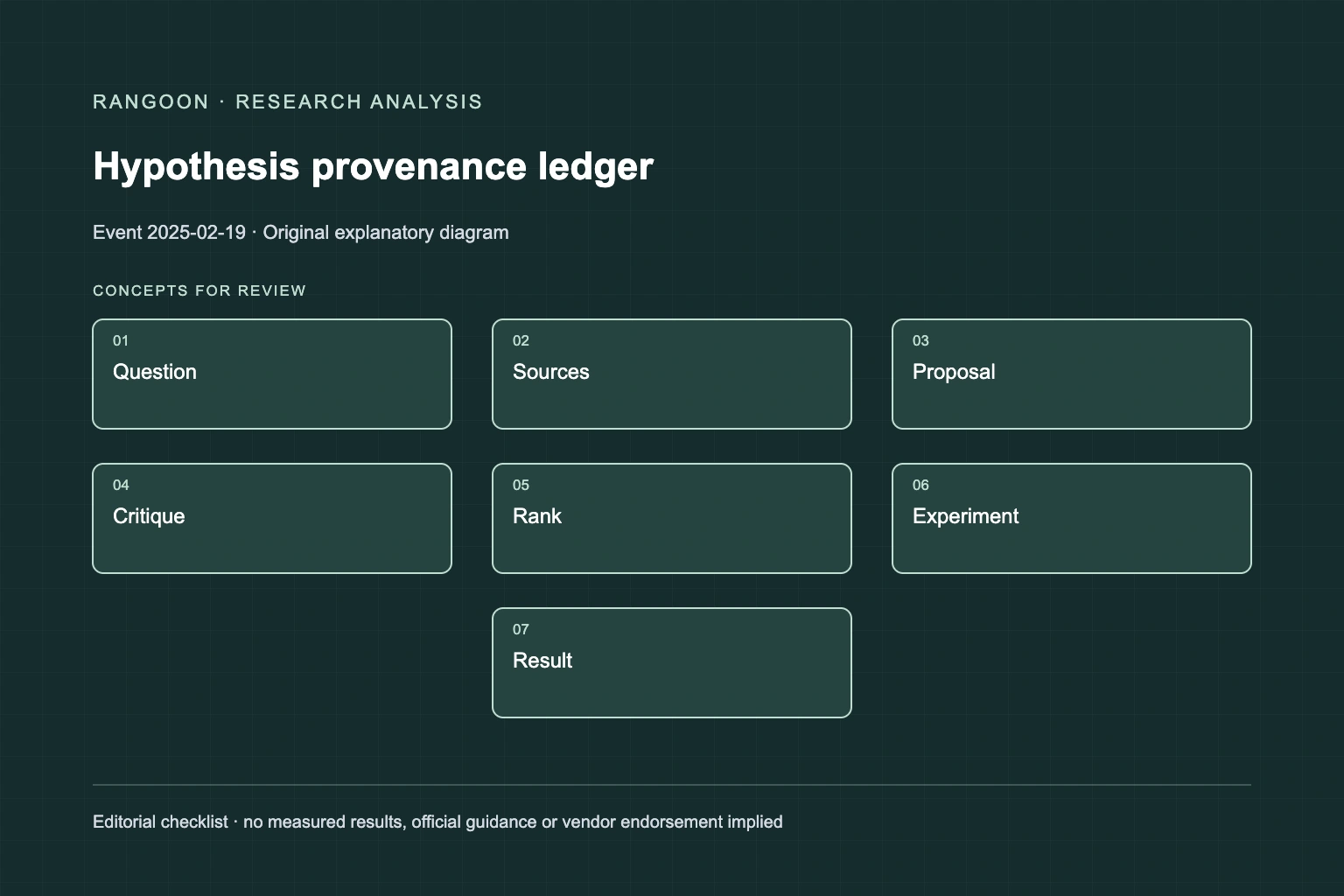
A system can generate a plausible research proposal by combining literature patterns, but plausibility differs from novelty and both differ from truth. The paper’s agent roles make the process more inspectable than a single answer, yet the output still depends on retrieved evidence, prompts, evaluation criteria and model behavior. A scientific user needs to see what sources were considered, which claims are inferred, which alternatives were rejected and where knowledge is missing. Without that ledger, a polished proposal can hide unsupported citations, a familiar result dressed as novelty or a premise that no experiment can test.
In-silico proposals should not inherit laboratory or clinical authority[source 1][source 2]
The system’s proposed mechanisms and protocols are research objects for expert review. They are not laboratory instructions to run without safety, ethics and institutional oversight, and they do not diagnose disease or recommend treatment. A hypothesis can be valuable even when it fails, provided the failure is recorded against a meaningful test. Claims about biomedical relevance require the relevant experimental evidence. This article deliberately treats generated proposals as provisional artifacts; it does not repeat unverified claims of breakthroughs from a model-generated research plan.
Evaluation should include unseen evidence and failed hypotheses[source 1][source 2]
A useful assessment begins with questions whose answers and supporting records were withheld from the model workflow, then compares generated proposals with domain-expert baselines. Check citations line by line, identify whether the core claim was already known, and pre-register an experiment capable of falsifying it. Include cases where the right outcome is abstention or a request for missing data. Preserve rejected and failed hypotheses alongside apparent matches; otherwise selection can make a ranking system look more reliable than the full candidate set warrants.
Analysis: research agents need provenance before they need autonomy[source 1][source 2]
The important system-design lesson is provenance. A co-scientist can help expand and organize a hypothesis space when each proposed link remains traceable to sources and each test has an accountable human owner. That is original editorial analysis, not a claim about Google’s live product behavior. The February 2025 announcement and paper document an early research system. They do not transfer experimental authority to an agent, establish general scientific creativity or support clinical guidance. A research record should always distinguish model proposal, human judgment, experimental result and replicated finding.
The hard part of agent-assisted research is not producing an idea. It is preserving enough provenance that another scientist can test, reject or refine that idea.
Sources
- Google Research: AI co-scientist launch (February 19, 2025)
- arXiv: Towards an AI co-scientist (February 26, 2025)
Continue reading