Imagen 4 launch made image review a product contract, not a prompt contest
Google announced Imagen 4 on May 20, 2025, presenting a new image-generation model and stating its inclusion in SynthID watermarking coverage.
Historical reporting: Google announced Imagen 4 on May 20, 2025. It does not assert current availability, rights status, or visual accuracy for any generated image.
Key takeaways
- Image acceptance needs a rubric for facts, labels, and visual defects.
- Watermark presence does not resolve ownership or consent.
- A delivery record should identify the final asset, not only its prompt.
Release record[source 1][source 2]
Google announced Imagen 4 on May 20, 2025 in a media-model release that also covered Veo 3, Lyria 2, and Flow. The launch document states that Imagen 4 was available across named Google products at that time, while a separate I/O recap describes its use in producing material for the event. These are dated primary accounts of a product launch.
Technical design[source 1][source 2]
They are not warranties about a later interface, a generated image’s truthfulness, or a user’s permission to publish it. Image generation has a deceptively simple input-output surface. A prompt may be short, but the resulting asset can carry factual claims, visible text, logos, people, locations, and visual cues that a downstream audience interprets as evidence.
Operating boundary[source 1][source 2]
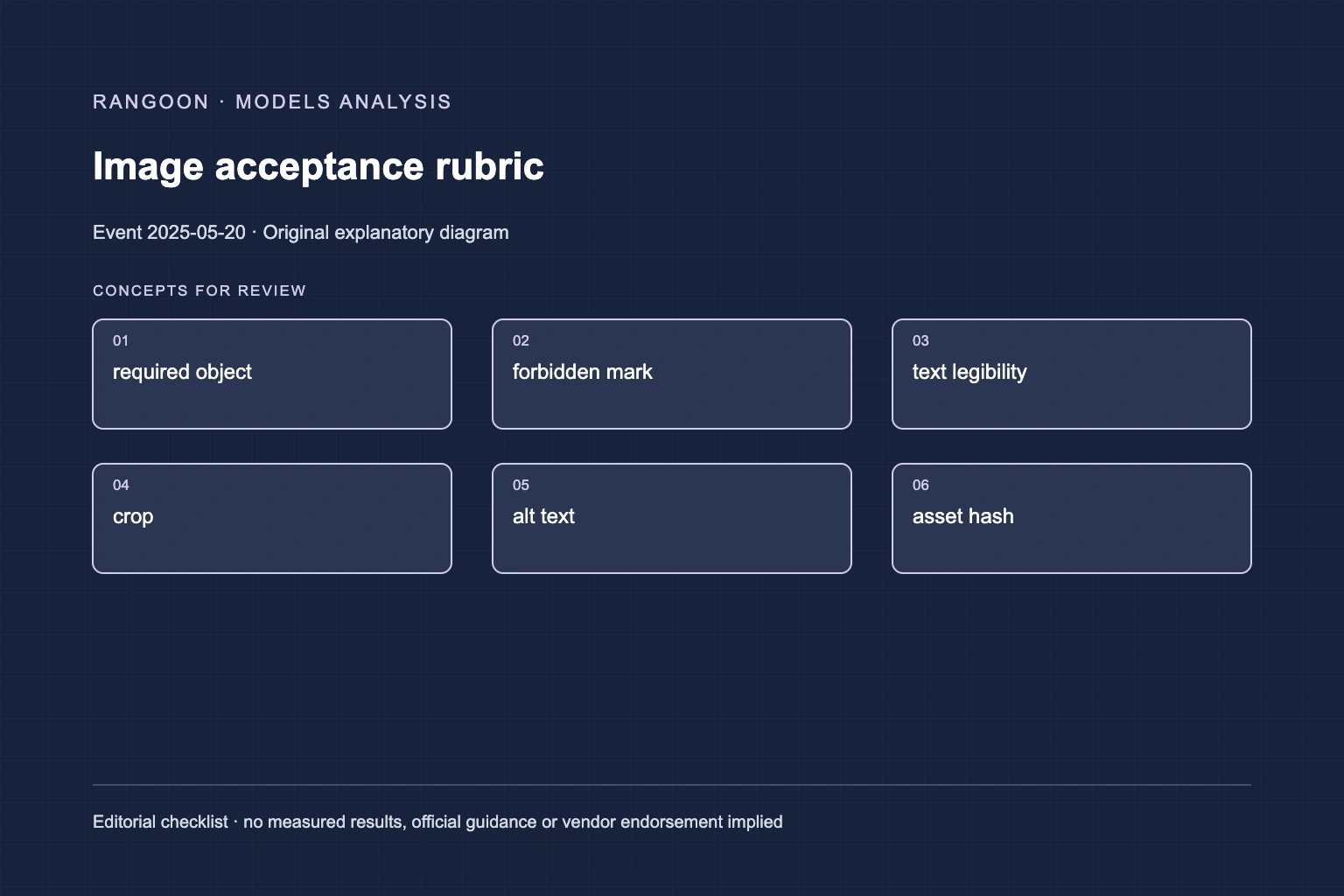
Review the rendered image, not only the instruction. A practical acceptance rubric checks required objects, prohibited objects, legible text, countable elements, geographic or historic claims, manipulated-looking regions, accessibility description, and intended crop. Record the model version, prompt digest, reference inputs, candidate identifier, final file hash, and approvals.
Evaluation evidence[source 1][source 2]
Google’s May materials say outputs from Imagen 4 would carry SynthID watermarks. Treat that as a provider-described provenance feature, not a substitute for a custody record. A watermark result should be stored with its detector version and date; it should not be used to infer authorship, legal clearance, or whether another tool participated in the image’s creation.
Historical implication[source 1][source 2]
Operationally, keep a split between concept images and documentary images. A concept illustration may be clearly labeled as generated, whereas a visual used to support a news claim needs separate primary evidence for the underlying fact. Never let photorealism become evidence by appearance.
Evaluation should include adversarial requests for misleading labels, false signage, sensitive individuals, and source images that should not be retained. For each rejected case, confirm that the system stops before distribution. The historic launch supports a narrow account: Google presented Imagen 4 in May 2025 and connected it to its media and watermarking work.
The useful editorial lesson is that an image generator produces an asset requiring normal publishing controls. Define acceptance before generation, validate the finished pixels, preserve the final identity, and make only the provenance statements the record can support. Keep rejected candidates long enough to explain a decision when policy permits, but do not make them a general asset library.
The review record should say why the selected image passed its rubric and which evidence supports any accompanying factual caption. A clear asset ledger also lets a newsroom replace or withdraw one image without confusing it with nearby candidates generated from similar text. A final caption should be reviewed independently from the pixels.
It can introduce a factual claim that image generation neither verifies nor preserves in its asset metadata. This keeps synthetic media within an ordinary editorial asset process: source note, review, approved file, publication context, and an accountable human decision.
Sources
- Google: Generative media models and tools at I/O 2025 (May 20, 2025)
- Google: How generative AI was used at I/O 2025 (May 20, 2025)
Continue reading