Lyria 2 put music generation inside a provenance and creator-control workflow
Google expanded access to Lyria 2 on May 20, 2025, describing music-generation tools and SynthID watermarking alongside its generative-media announcements.
Historical reporting: Google described expanded Lyria 2 access on May 20, 2025. This is not a claim about copyright status, current access, or output provenance for any file.
Key takeaways
- Generated audio needs prompt, model, edit, and export provenance.
- A watermark signal is not a complete rights or authorship record.
- Creator review must happen before distribution decisions.
Release record[source 1][source 2]
Google’s May 20, 2025 generative-media announcement said it was expanding access to Lyria 2 and described Music AI Sandbox, YouTube Shorts, Vertex AI, and Lyria RealTime in the same launch context. A second Google I/O recap confirms that Lyria 2 was part of the broader media-model event. These are primary records of Google’s description, not a determination of what a particular audio file contains or may be used for.
Technical design[source 1][source 2]
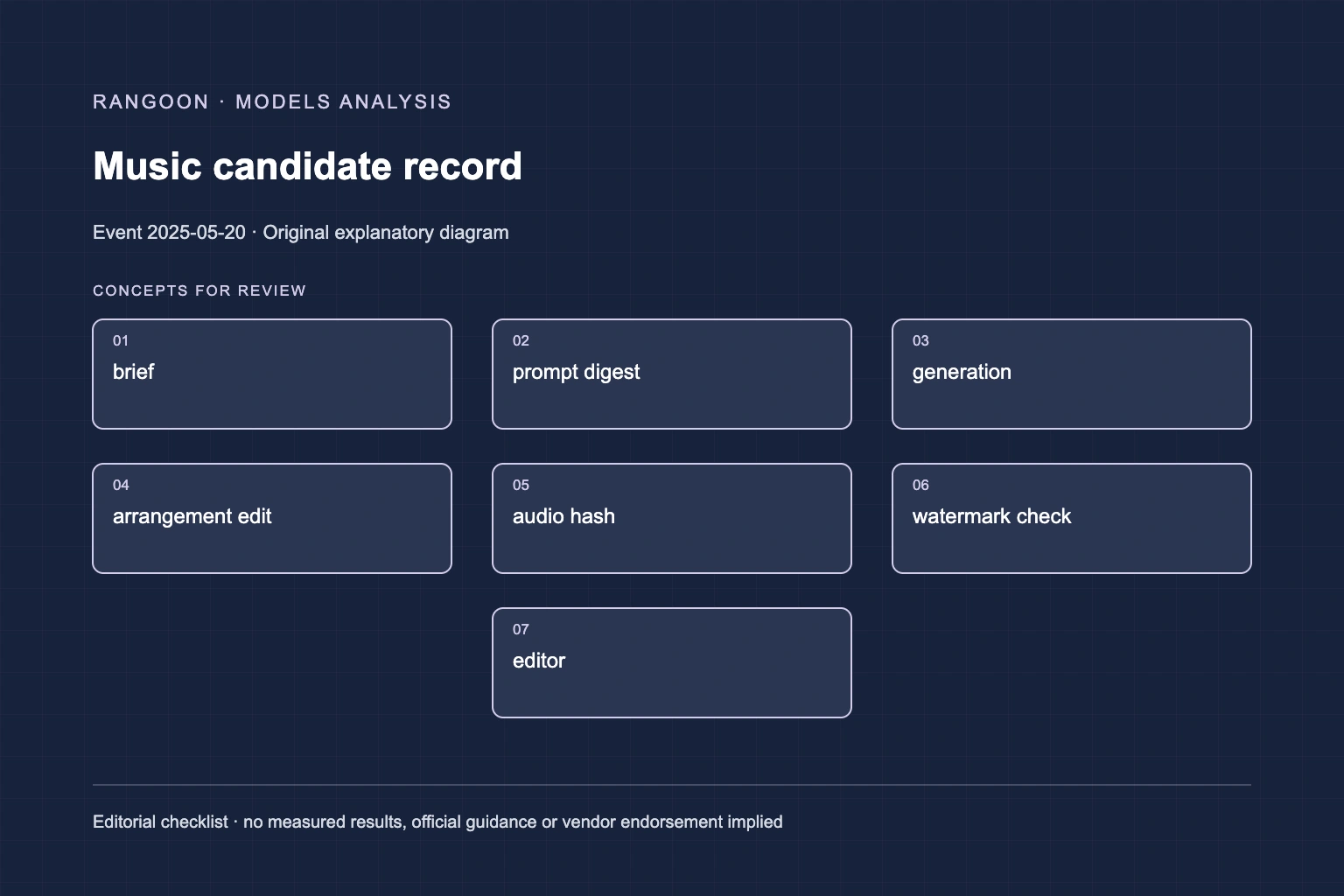
The release is useful because it links music generation with workflow controls. A music-generation operation has more stages than the prompt: source material selection, user instruction, model setting, candidate generation, edits, arrangement, export, metadata, and publication review. Each stage can affect what a listener hears and what an organization can later explain.
Operating boundary[source 1][source 2]
Preserve a compact provenance record that includes a safe prompt digest, declared inputs, model and date, edit history, output hash, and reviewer decision. Do not infer authorship or rights from a generated sound alone. Google’s announcement also mentioned SynthID watermarking.
Evaluation evidence[source 1][source 2]
A watermark can contribute to provenance detection, but it is not a complete custody chain and does not resolve identity, consent, licensing, or a downstream platform’s policy. Treat it as one signal among several. A workflow should handle absent, altered, or inconclusive signals without silently labeling a file.
Historical implication[source 1][source 2]
For evaluations, divide creative quality from operational reliability. Creative reviewers may assess fit, structure, and intended mood; technical checks can assess duration, loudness, clipping, format, metadata, and whether a file matches the requested export. Neither group should rely on a vendor launch claim as a substitute for their own criteria.
Keep test prompts distinct from distribution material, especially where the task references identifiable performers, protected catalog, or user-supplied audio. An approval should name the exact file hash and output version, because an edit after approval creates a different artifact. The historical event does not make a legal conclusion.
It documents that Lyria 2 featured in Google’s May 2025 media release and was discussed with creator-facing tools and watermarking. The practical lesson is that generative audio needs a versioned editorial workflow: clear inputs, explicit review, machine-readable output identity, and claims limited to evidence actually retained. For collaborative music work, preserve which human made each editorial choice after generation.
That record separates a candidate suggested by a system from an arrangement intentionally selected by a creator, and gives later reviewers a factual account of the release workflow. That distinction protects both creative credit and factual reporting, while allowing a team to explain the role of generation without overstating what any watermark can prove. Editorial notes should describe generated music as generated where that fact matters to an audience, and should avoid using provenance tooling as a shortcut for human judgment. Such a record is compatible with creative experimentation while preserving the evidence needed to explain where an asset came from and who approved it.
Sources
- Google: Generative media models and tools at I/O 2025 (May 20, 2025)
- Google: How generative AI was used at I/O 2025 (May 20, 2025)
Continue reading