Google added Deep Research to NotebookLM as a background source-collection workflow
Google rolled out NotebookLM Deep Research on November 13, 2025, pairing a user-guided plan and hundreds of web pages with a report and selectable sources for notebook import.
Historical reporting: Source 0 is Google’s dated November 13, 2025 NotebookLM Deep Research announcement. Source 1 is current Google Help for source discovery and Deep Research, used only for later workflow and limit context. Neither record validates a report’s conclusions, source coverage, current quota or any account’s access.
Key takeaways
- Google announced NotebookLM Deep Research on November 13, 2025 as a user-guided workflow that plans research, browses hundreds of websites and returns a source-grounded report.
- Google said users could add the report and its sources into a notebook while Deep Research continued in the background, and distinguished Fast Research from the deeper mode.
- Current Help says source limits can cause partial imports and that unimported results are discarded, making selection and retention separate operational steps.
A report and source list entered the notebook workflow[source 1]
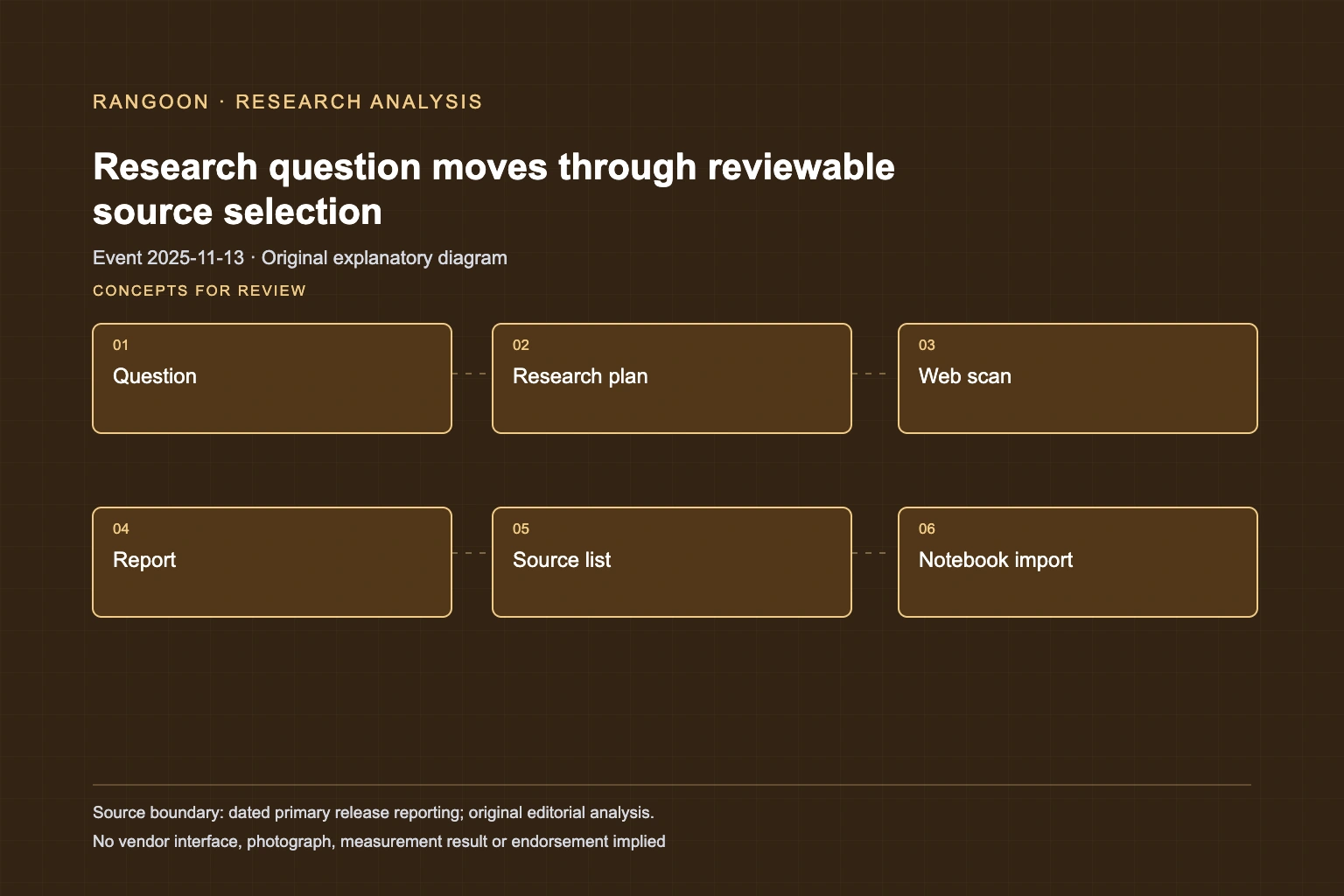
Google announced Deep Research for NotebookLM on November 13, 2025 alongside support for additional source types. The company described it as a way to automate complex online research: given a user’s question, the feature creates a research plan, browses hundreds of websites, refines its search as it learns, and returns an organized, source-grounded report after a few minutes. Google also said users could direct the researcher toward specific places. This established a research-collection workflow inside a source notebook, rather than an ordinary chat answer based only on already imported material. It remains a supplier description of the feature. It does not demonstrate that every website was accessible, that the browsing set was comprehensive, or that a resulting synthesis reached a correct conclusion.
Background work and notebook import were distinct stages[source 1]
Google’s announcement emphasized that the report was not the endpoint. A user could add both the Deep Research report and its sources directly into the notebook, while continuing to add other material as the research task ran in the background. The same page distinguished two styles in the Sources panel: Fast Research for a quick search and review-and-import path, and Deep Research for a fuller briefing with more intensive analysis. This distinction matters operationally. A background report may aid collection, but the user still determines which output and source pages become part of the notebook’s working evidence. A report can summarize a path through the web; it does not itself preserve the availability, version, authorship or legal reuse status of every page it mentions.
Current Help makes review and limits explicit[source 2]
Google’s current Help gives later implementation context. It says a user enters a research question in the Sources panel, turns on Web and Deep Research, waits while results load, then either imports all results or expands the view to select them. The documented result set contains the report plus relevant sources, including cited and uncited ones. The page says the feature is only available to users over 18 and warns that source limits can produce a partial import; results that are not imported are discarded. These details should not be projected onto November 2025 as unchanged terms. They do show why a team needs a deliberate export or evidence record for material it intends to retain and review.
Automated collection did not remove editorial responsibility[source 1][source 2]
Deep Research made the first pass across many pages faster, but it did not make a generated report a primary source. For a procurement memo, scientific summary or policy brief, important propositions still need their original publisher, date, version and context checked. A user should also ask whether the research plan excluded dissenting material, whether a site was blocked or stale, and whether selected pages support the wording in the final report. Google’s launch called the report source-grounded, a claim about intended workflow rather than an assurance of completeness. The historical event is a documented November product rollout. The practical lesson is to treat the report as a research artifact that must be inspected, then preserve selected original sources and the human decision trail before a result is shared or acted on.
Sources
Continue reading