

Google added Discover Sources to NotebookLM for web-source recommendations
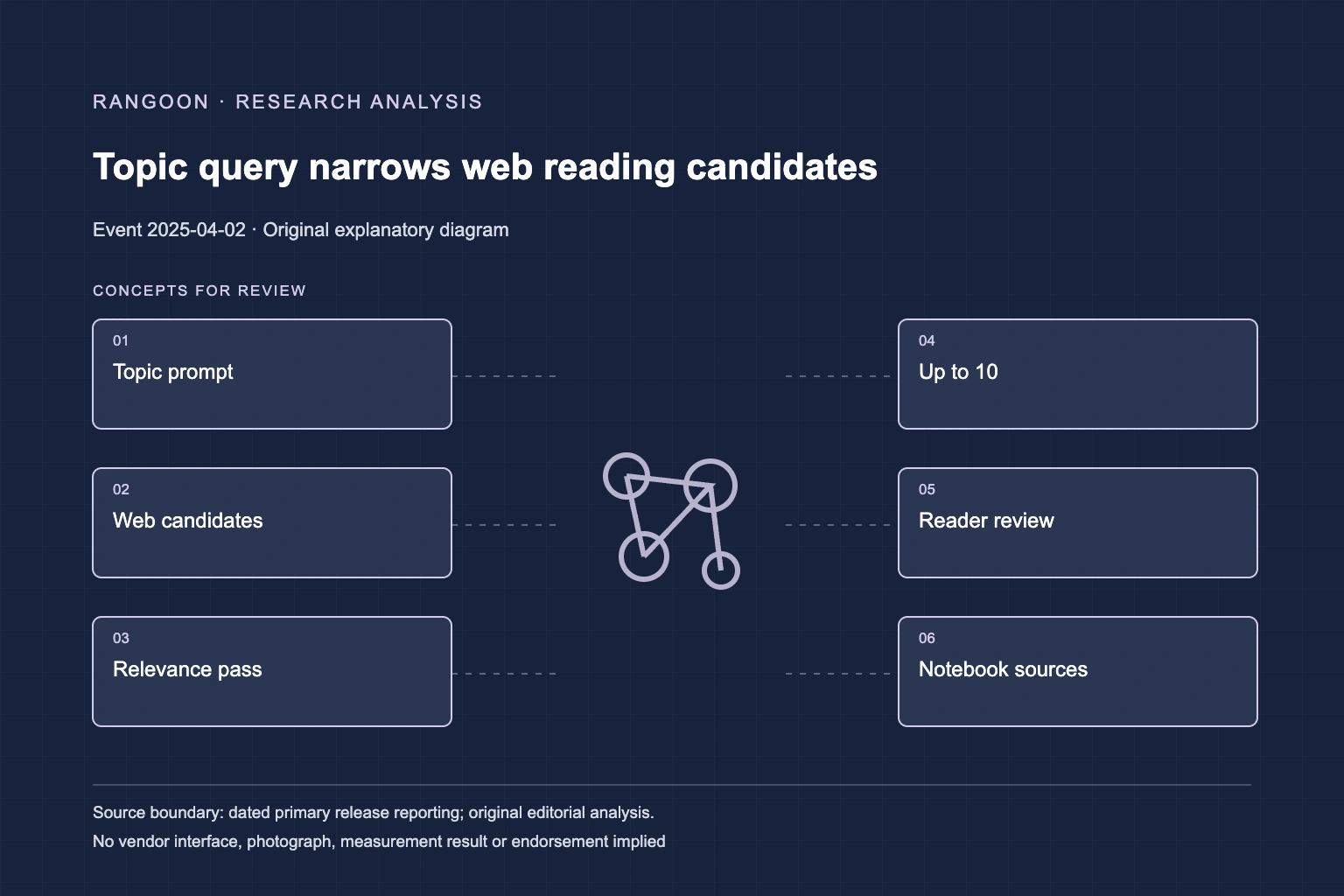
Google introduced Discover Sources in NotebookLM on April 2, 2025, letting users describe a topic, review up to 10 annotated web recommendations, and import selected sources.
Historical reporting: Source 0 is Google’s dated April 2, 2025 Discover Sources announcement. Source 1 is current Google Help for adding and discovering notebook sources, used only for later source-selection and import context. The records describe Google’s workflow, not independent source-quality assessment or a user’s current entitlement.
Key takeaways
- Google dated Discover Sources to April 2, 2025 and said it would roll out to all NotebookLM users over roughly the following week.
- The announced workflow gathered hundreds of candidate web sources, showed up to 10 annotated recommendations and let users import selected sources with one click.
- Recommendation and import reduce collection work; they do not validate a source, preserve an author’s context or establish that a notebook answer is correct.
From manual uploads to a web-discovery path[source 1]
Google announced Discover Sources on April 2, 2025 as a new way to add material to NotebookLM. Its release contrasted the feature with a prior workflow in which users manually uploaded sources for projects such as papers, travel planning or interview transcription. In the new path, a user described a topic after selecting Discover in the Sources panel. NotebookLM then returned a curated collection of web sources that the user could add to the notebook. Google said the feature started rolling out to all NotebookLM users that day and expected the rollout to take about a week. That is an availability statement with a rollout window, not a record that an individual account, region or managed domain received the feature immediately.
Candidate gathering and source import were separate actions[source 1]
The detailed release makes the workflow more specific. Google said NotebookLM gathered hundreds of potential web sources in seconds, analyzed them against the stated topic, and presented up to 10 recommendations with annotated summaries explaining relevance. The user could then add a selected source with one click. Once imported, Google said sources stayed in the notebook, where a reader could open originals, ask chat questions, and use citation and note-taking features. This establishes a two-part process: recommendation reduces the first-pass search set, while explicit import decides what becomes notebook material. It does not say that all candidate sources were read in full by a human, that recommendations were exhaustive, or that an annotation confirmed a source’s authority.
Current Help keeps user review in the import loop[source 2]
Google’s current Help page describes a broader source-search surface and is useful only as later operating context. It says a user can choose Web or Drive, review the result list, expand a result, then select one or more sources to import. The documented result view includes a title, a description of its relation to the query and a link that opens the full webpage. That design makes inspection possible, but it does not perform the inspection for the user. The page also states that Drive results reflect files a user has access to. These present-day details should not be treated as evidence that the April 2025 release had every current source type, research mode or access rule.
Discovery did not turn recommendation into verification[source 1][source 2]
The news value of Discover Sources is that NotebookLM added a collection layer before its source-grounded notebook features. It can help an analyst move from a vague subject to a manageable reading list, but quality work still has separate gates: open the original page, identify the publisher and date, compare primary evidence, and record why a source was admitted. A recommendation list can favor relevance signals without resolving conflicts, commercial incentives, changing pages, jurisdiction or rights to reuse the material. Google’s release itself marked AI-generated summaries as experimental. A research team should therefore retain the selected URLs and review notes, distinguish Google-generated annotations from source content, and avoid representing an imported web page as peer-reviewed or independently verified merely because it appeared in a notebook.
Sources
Continue reading
Related reading
 News analysisGoogle introduced NotebookLM Video Overviews as narrated slide outputs3 min read
 News analysisGoogle added interactive Mind Maps to NotebookLM for navigating notebook topics3 min read
 News analysisGoogle added Deep Research to NotebookLM as a background source-collection workflow3 min read