

Google Research outlined a Personal Health Agent research prototype
Google Research outlined a Personal Health Agent research prototype on September 30, 2025, pairing wearable and health data with specialist subagents in a non-product study.
Historical reporting: Google Research dates the Personal Health Agent post to September 30, 2025. The linked Google Research publication record was freshly read for the research framework; the post expressly says it is not a public product description.
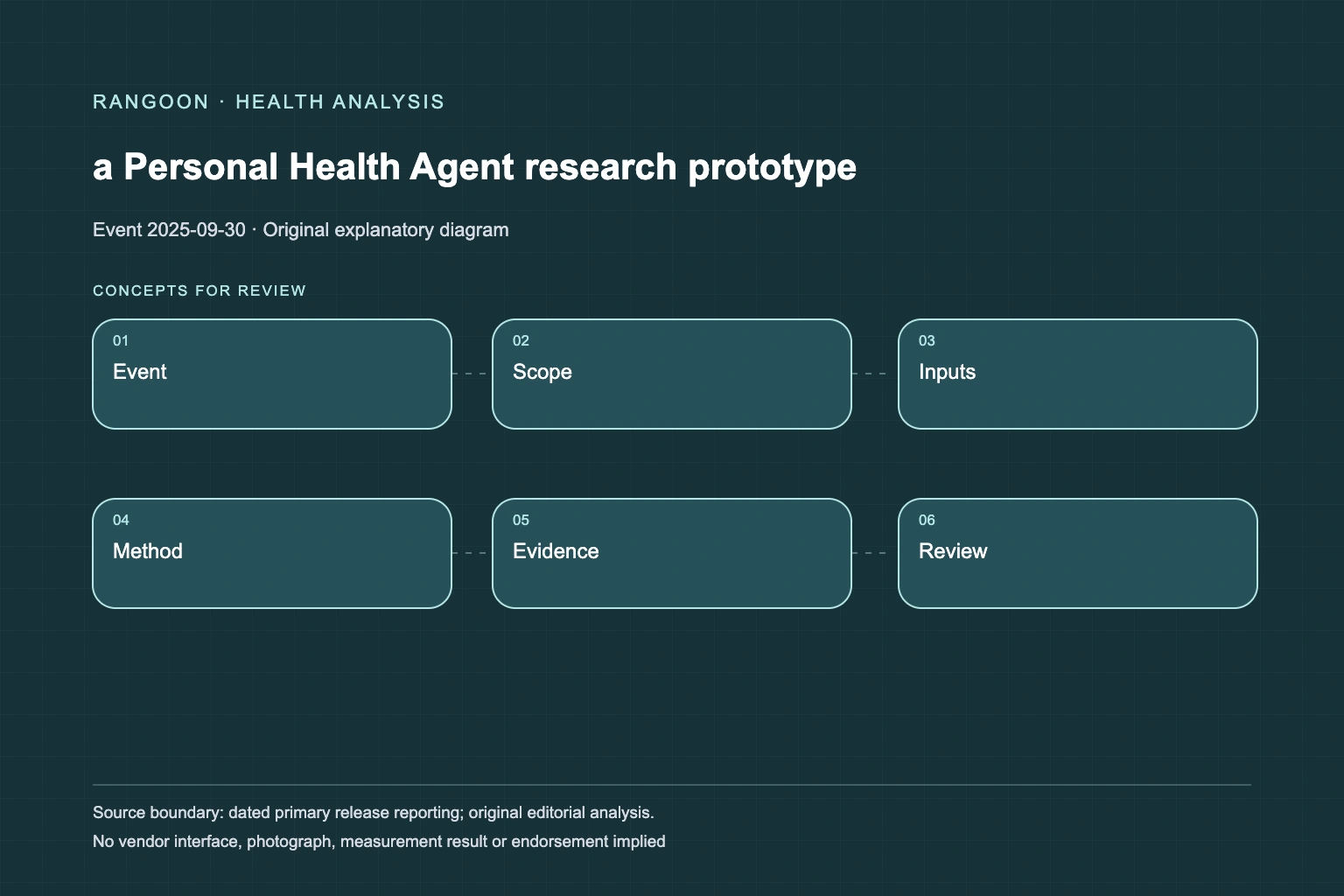
Key takeaways
- The Personal Health Agent record described a research framework, not an available health service.
- Its three specialist roles separated data analysis, health-domain reasoning and coaching within a multi-agent design.
- Consent, evaluation design and a future validation process remain distinct from an individual health recommendation.
The September post explicitly described a research prototype[source 1][source 2]
On September 30, 2025, Google Research described a Personal Health Agent, or PHA, as a research framework for reasoning over multimodal data from consumer devices and personal health records. The post explicitly says the work is not a description of a specific product, service or public feature. That sentence controls the historical reading: the event is publication of a research concept and evaluation approach. It is not evidence that a person could use a released Google health agent, receive a diagnosis or rely on the system for medical care. The article therefore reports the stated research boundary rather than giving health guidance.
Three specialist roles were the core system-design claim[source 1][source 2]
The accompanying publication record describes three subagent roles: a data-science agent for time-series and population-level information, a health-domain expert for contextualized insights, and a health-coach agent for multi-turn interaction and goals. This is a division of work inside the proposed framework, not evidence that each role is independently safe or clinically approved. Google also described a user-centered design process and an IRB-reviewed study with consenting participants contributing wearable, questionnaire and blood-test data. Those details identify research inputs and consent context; they do not confer rights to use other data or validate another application.
The evaluation describes research effort rather than care outcomes[source 1][source 2]
Google says the work used ten benchmark tasks and combined automated and human evaluation, including annotations and hours from health experts and end users. This is stronger than an unsupported product claim because it names a study structure, yet it remains a research evaluation. The public records do not establish a randomized clinical trial, an approved device indication, medical accuracy for an individual or a real-world deployment. Results from a specified dataset cannot automatically transfer to a different wearable, record format, population or question. The archive keeps the source’s research framing visible rather than converting wellness-agent language into medical advice.
The publication created a design record with a clear future-work boundary[source 1][source 2]
The source-specific news is the public description of PHA’s multi-agent design and its evaluation framework. It is useful for comparing later health-agent work because it names roles, multimodal inputs and study boundaries. It is not a product availability record, an authorization decision or proof of clinical benefit. Any later implementation would need its own design, privacy, validation and review evidence, as the post itself notes. The archive’s conclusion is narrow: a research prototype entered the public record in September 2025; what a deployed system may do remains a separate, evidence-dependent question. The September post’s roughly 1,200 consenting participants, ten tasks and three role design make its empirical boundary legible. They do not make the framework a released assistant for people outside the study.
Sources
Continue reading
Related reading
 News analysisOpenAI released HealthBench for rubric-based evaluation of health conversations3 min read
 News analysisGoogle released MedASR as a 105M medical-dictation speech-to-text foundation model3 min read
 News analysisGoogle introduced MedGemma at I/O as an open starting point for medical text and image work3 min read