

Gradio’s MCP updates treated hosted applications as agent tool endpoints
Hugging Face detailed Gradio MCP-server improvements on July 17, 2025, including file handling and hosted Spaces integration.
Historical reporting: Hugging Face’s July 2025 Gradio MCP posts document product capabilities. They do not certify any individual remote server.
Key takeaways
- A hosted UI becoming a tool needs a stable input/output contract.
- Remote file transfer needs explicit origin and retention handling.
- MCP protocol support is not evidence of trustworthiness.
Hugging Face recorded Gradio MCP-server work in July[source 1][source 2]
Hugging Face’s July 17, 2025 article described improvements to Gradio MCP servers and said Gradio-powered servers were hosted on Spaces. A July 9 article explained an earlier MCP-server pattern for Gradio apps and discussed remote-file handling. These first-party posts establish the product direction: an interactive application could be exposed to an agent as a tool. They do not turn every Space into a reviewed dependency or establish a universal security posture.
A UI contract and a tool contract are not automatically the same[source 1][source 2]
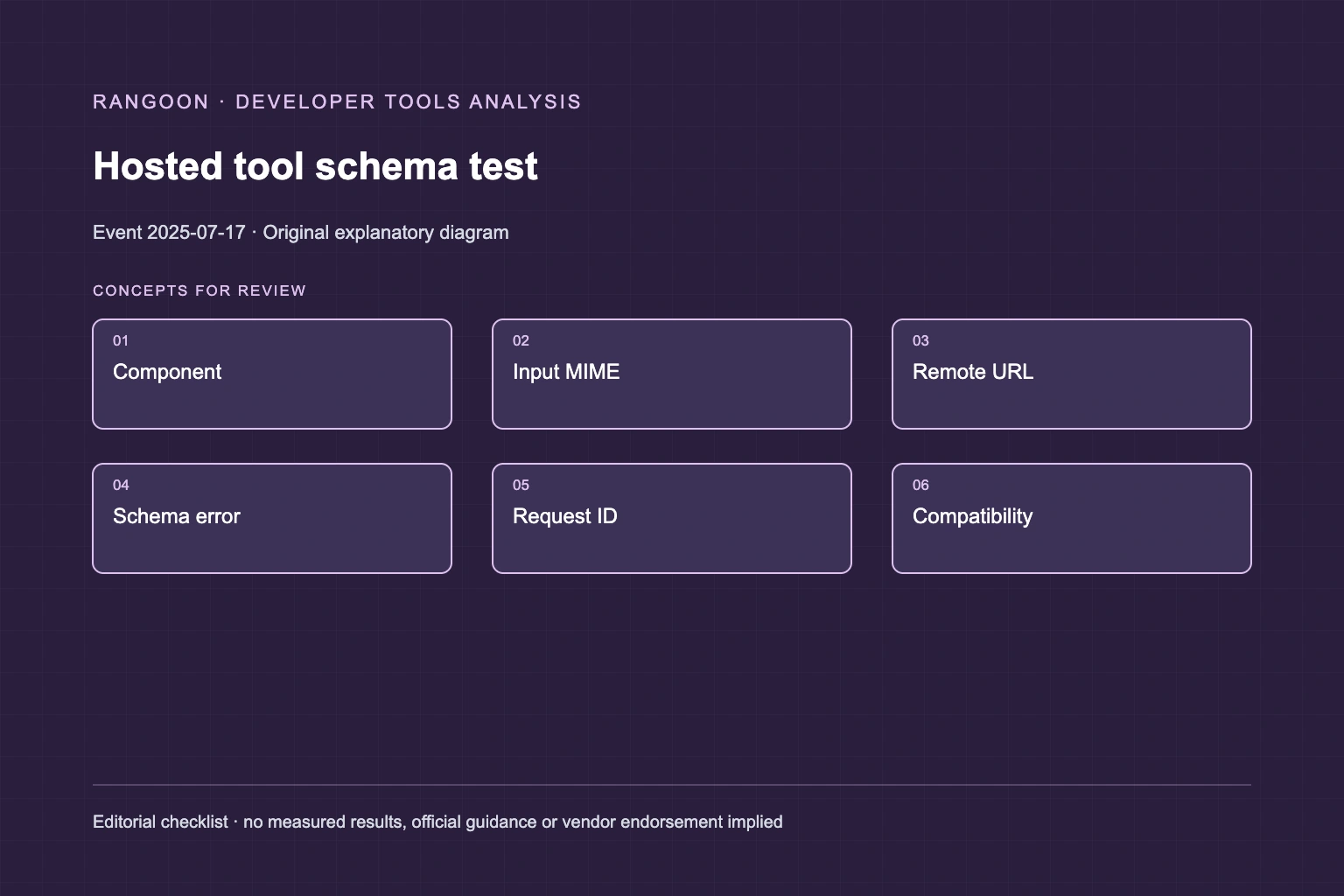
A browser user can recover from an unclear form, while an agent may interpret a loosely typed response as authoritative input for another action. Define a machine-readable schema, validation errors, size limits and explicit file-transfer path before treating a hosted application as a tool. When a remote server needs a public URL for a file, record who creates it, how long it remains available and whether it contains sensitive content.
Test remote tool behavior with malformed and sensitive fixtures[source 1][source 2]
Exercise absent files, inaccessible URLs, oversized inputs, unexpected MIME types and a result that contains model-generated instructions. Verify the calling agent presents a clear failure rather than retrying blindly or treating an error page as data. Pin server versions where possible and retain a request identifier with each use. If a Space owner changes an interface, the caller should fail closed until its schema compatibility test passes again.
Analysis: toolification makes interface discipline visible[source 1][source 2]
Editorial analysis: exposing an application through MCP can reuse useful capability, but it also converts informal UI assumptions into system dependencies. Teams should review hosted tools as they would any API: provenance, schema, availability, data handling and revocation. The protocol can carry a request; it does not decide whether the request should be trusted or acted upon.
The July update targeted Gradio 5.38.0 and named five concrete changes: local file support, real-time progress notifications, one-line OpenAPI-to-MCP conversion, authentication improvements and editable tool descriptions.
Its file-handling discussion explains the distributed constraint: a remote server normally needs an input file reachable by public URL because it runs on another machine. A hosted UI becoming an MCP tool must therefore define what gets uploaded, converted into a URL, retained and returned. Progress notifications also mean a caller needs a protocol for incomplete work, cancellation and final result rather than treating the first response as completion.
Generate a contract test from each exposed component and OpenAPI conversion, then version or reject changes that alter input/output shape. Authentication and tool description are part of the endpoint contract because each changes who can call a capability and how an agent interprets it.
Sources
- Hugging Face: Five Gradio MCP improvements (July 17, 2025)
- Hugging Face: Gradio MCP servers (July 9, 2025)
Continue reading
Related reading
 News analysisHugging Face connected ZeroGPU demos to ahead-of-time compilation3 min read
 News analysisLeRobotDataset v3 changed robot-data scale through chunked episodes and streaming3 min read
 News analysisLeRobot v0.4 joined scalable datasets, plug-ins and simulation without merging their evidence3 min read