

LeRobot v0.4 joined scalable datasets, plug-ins and simulation without merging their evidence
Hugging Face released LeRobot v0.4.0 on October 24, 2025, packaging dataset v3, robot plug-ins, simulation support and selected vision-language-action policies.
Historical reporting: Hugging Face announced LeRobot v0.4.0 on October 24, 2025 and described dataset v3, simulation integrations, a hardware plug-in system and selected third-party vision-language-action policies. The associated public GitHub release is a source-control release record, while the blog explains the vendor’s intended workflow. Neither source establishes performance, availability or compatibility for every robot, policy, operating system or production environment. Policy and benchmark claims remain attributable to their original suppliers and evaluation conditions.
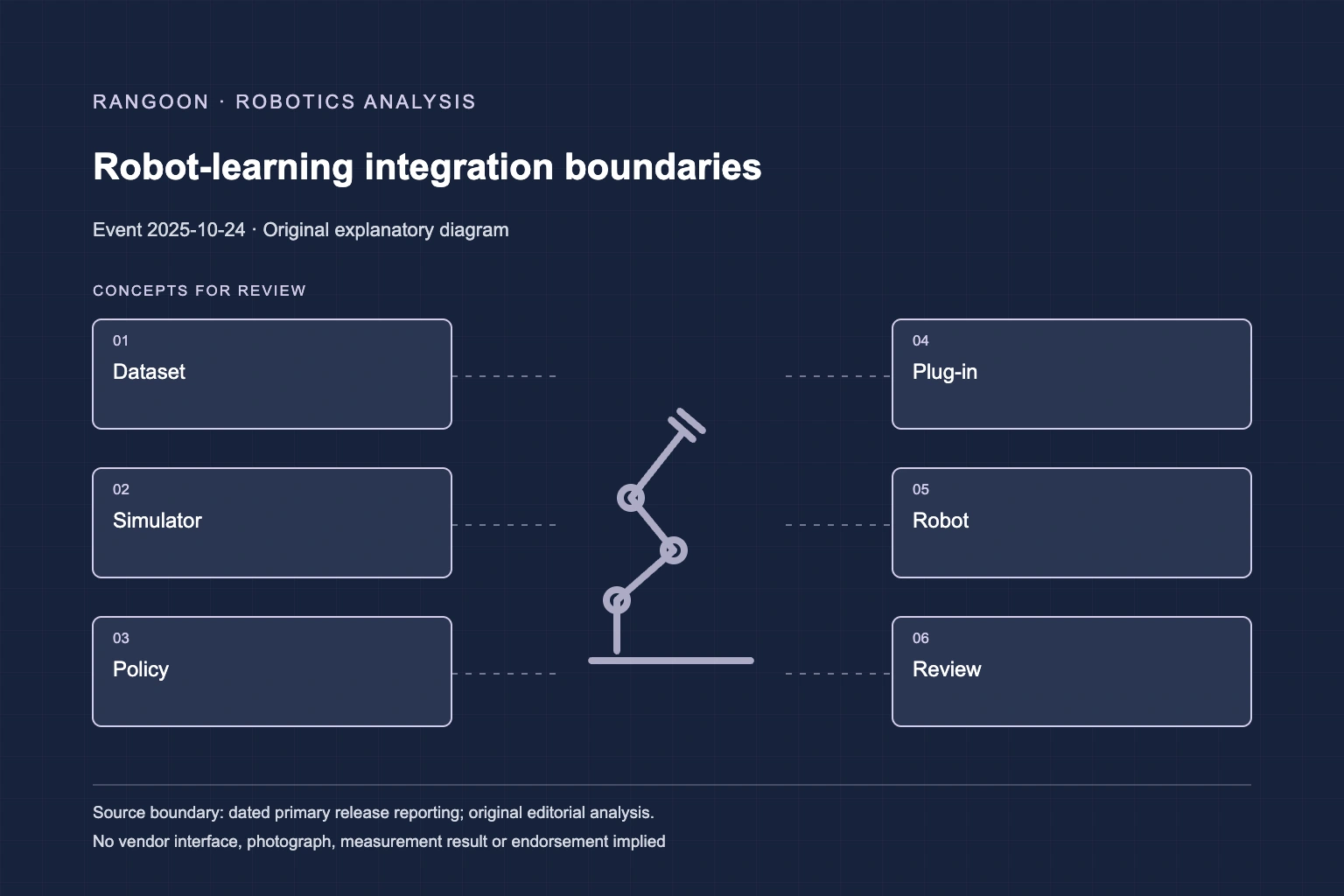
Key takeaways
- LeRobot v0.4 was a framework release that combined separate interfaces for data, simulations, policies and hardware integration.
- A plug-in mechanism reduces repeated integration work only after its versions, device behavior and failure handling are tested in the intended system.
- Bundling model adapters does not make supplier benchmark results interchangeable or prove a real-world robot task.
The October release was a toolkit expansion rather than a single new robotics model[source 1][source 2]
On October 24, 2025, Hugging Face announced LeRobot v0.4.0. The release combined several layers that are often discussed together but fail differently: LeRobotDataset v3 for records, LIBERO and Meta-World simulation support, policy integrations and a plug-in mechanism for hardware. This packaging is useful because it offers a common project surface across parts of a robot-learning workflow. It does not mean those layers have become one evidence source. A data format answers storage and retrieval questions; a simulator answers only the questions represented by its environment; a policy adapter exposes a model interface; and a hardware plug-in still needs to account for actual devices, timing and safety constraints.
Hardware plug-ins made integration declarations more explicit[source 1]
Hugging Face described a plug-in system intended to make hardware integration easier and identified examples including Reachy 2 and phone support. A plug-in boundary can help a framework keep device-specific setup out of a central code path, while making versions and supported features inspectable. It cannot certify a robot, establish that a command is safe for every actuator or replace a deployment team’s calibration and emergency controls. Hardware is not only an API: it includes sensing, mechanics, current limits, latency, operator procedures and the surrounding workspace. The release can support reporting that LeRobot exposed an extension mechanism; it cannot support a broader claim that attached hardware behaves predictably in a new task.
Simulation entries and policy integrations preserved separate evaluation boundaries[source 1]
The announcement linked the release to LIBERO and Meta-World environments and to integrations for policies including π0.5 and GR00T N1.5. These are useful components for experimentation because they let a practitioner select an environment and connect a compatible policy through the framework. They do not make a synthetic score a direct measure of performance on a physical robot. Simulation behavior depends on assets, dynamics, observations, success definitions and randomization; policy outcomes depend on model weights, inputs and task adaptation. Nor does inclusion in LeRobot validate a supplier’s stated model results. A careful read keeps the evidence partitioned: the framework announced integration paths, while model and benchmark claims retain their own methods and provenance.
Open source distribution made version capture more valuable, not optional[source 1][source 2]
The public release record gives operators a concrete version boundary for a project that otherwise changes quickly. That matters when a training or evaluation result needs to be reproduced: record the framework version, policy revision, dataset revision, simulation version, hardware plug-ins and configuration alongside the output. Open source permits inspection and modification, but it does not guarantee that two installations share the same dependencies or behavior. The October event is best understood as a broader operating surface for robot-learning experiments. It was not a declaration that any connected robot had completed a production-readiness review, nor a promise that an installation would remain compatible as upstream policy and simulator projects evolved.
Sources
- Hugging Face: LeRobot v0.4.0: Supercharging OSS Robot Learning (October 24, 2025)
- GitHub: huggingface/lerobot release v0.4.0 (October 24, 2025)
Continue reading
Related reading
 News analysisLeRobotDataset v3 changed robot-data scale through chunked episodes and streaming3 min read
 News analysisHugging Face and Pollen introduced Reachy Mini as an open desktop robot with an SDK and simulation path3 min read
 News analysisSmolVLA put a 450M action policy and community robot data into an open package3 min read